




Amend UUCA, or face uncertain future
A student's group today urged the government to amend the University and University Colleges (UUCA) Act as soon as possible or risk facing an uncertain future.
A student's group today urged the government to amend the University and University Colleges (UUCA) Act as soon as possible or risk facing an uncertain future.
In a statement today, National Union of Malaysian Islamic Students or PKPIM said the time has come for the Act to be reviewed and re-evaluated.
It's secretary-general Mohd Hilmi Ramli said although the Act was formulated to prevent undergraduates from falling into the trappings of many ills, it has however given rise to many unhealthy phenomenons.
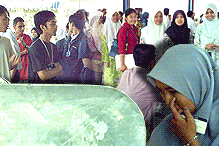 Among them, he said students have become 'individualistic and materialistic'.
"They feel that universities are just places to obtain a degree and subsequently get a good job. In the end, they become numb to the issues affecting society at large.
"They are shadowed by laws that curtail their courage to be outspoken and critical," he added.
According to Himli, students are only focused on campus activities which are sometimes recreational and hedonistic in nature.
"Only a handful are interested in intellectual activities that sharpen the mind," he said.
Undergraduates lose interest in wanting to know or analyse current issues that take place outside of their universities, he added.
Najib commended
On the same note, PKPIM also commended Deputy Prime Minister Najib Abdul Razak for saying that the Act will not be repealed but be amended in stages.
Hilmi said the deputy premier's remark reflected his openness towards the views expressed by students.
Last week, two student groups submitted separate memorandums to Prime Minister Abdullah Ahmad Badawi and Najib with one calling for the Act to be repealed while the other wanting it to be preserved.
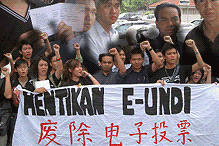 The political culture in public universities here is centred around what are commonly termed as the 'pro-establishment' and 'anti-establishment' groups.
The 'pro-establishment' faction for the first time took control of all 17 public universities in last September's campus elections marred by allegations of irregularities and boycotts.
Some of the students involved in the boycott were later hauled up by their respective university authorities to face disciplinary action.


Are you sure you want to delete this comment?
This action cannot be undone.