




Campus polls: A tame affair but irregularities abound
Polling day for campus elections this year turned out to be a problem-ridden one though it was mostly a tame affair due to boycotts launched by 'anti-establishment' student camps at five major universities.
Polling day for campus elections this year turned out to be a problem-ridden one though it was mostly a tame affair due to boycotts launched by 'anti-establishment' student camps at five major universities.
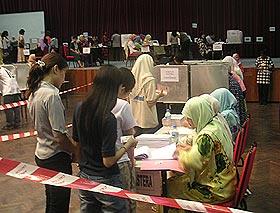 While no balloting was carried out in a number of varsities due to the boycotts, complaints abound in campuses where polling was held.
Intimidation of candidates, circulation of poison-pen letters and a 'preferred candidates' list by the universities authorities were among some of the irregularities discovered by malaysiakini during a visit to Universiti Malaya (UM) and Universiti Putra Malaysia (UPM) today.
 At UPM, police were called to the campus at Serdang last night after final-year student Lua Khang Wei, 23, complained he had been physically detained by a group of about 30 university officials and students from the university's 'pro-establishment' students camp who were seen to be backed by campus authorities.
Lua was believed to have been handing out leaflets calling on students to spurn today's vote.
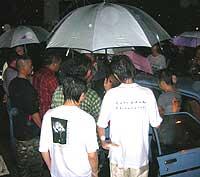 According to a copy of the police report lodged by Lua at the Serdang police station, the group suddenly stopped his car and prevented him from leaving a residential college. Lua is a former student representative aligned to the 'anti-establishment' camp.
His report also stated that the group threatened him and uttered vulgar words besides confiscating his personal belongings. He also claimed the group surrounded his car and disallowed him from entering it even though it was raining.
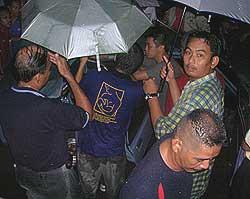 The stand-off which lasted for about an hour ended after police intervened at about 10pm. The group of 'pro-establishment' students also lodged a counter police report to the Serdang police station.
Over the past few years, the government and campus authorities have overtly backed a pro-establishment student faction to stamp out anti-government forces in campuses nationwide.
The pro-government forces, with the help from the authorities, have progressively knocked out anti-establishment students from the students representative councils, including varsities where anti-government forces were once dominant.
With the boycott, almost all the universities have now fallen under the control of pro-government students.
Electronic voting system
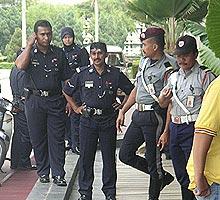 Today, UPM officials were abusive towards journalists who gathered at the campus to cover the handing over of a memorandum by about 30 'anti-establishment' students to UPM vice-chancellor Prof Mohd Zohadie Bardaie to protest against the implementation of the electronic voting system, which they claimed could be easily manipulated by the authorities.
Several officials rudely warned journalists repeatedly to leave even though the journalists had followed the instructions of UPM deputy vice-chancellor (student affairs) Assoc Prof Dr Azali Mohamad, who was present at the scene, by obtaining an entry permit which is usually not required.
After negotiations later, a public relations officer from the university intervened and apologised to the journalists for the officials' behaviour. Azali, though, refused to speak to reporters.
The students were unsuccessful in submitting their memorandum to the vice-chancellor as the latter was not in the office despite students having confirmed an appointment earlier. Other university officials also refused to received the memorandum.
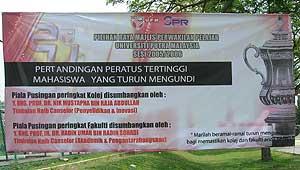 To counter the boycotts by the 'anti-establishment' student group, UPM organised a competition at its residential colleges and faculties level for students to win a 'Highest Voters' Turnout' trophy (
photo
).
To counter the boycotts by the 'anti-establishment' student group, UPM organised a competition at its residential colleges and faculties level for students to win a 'Highest Voters' Turnout' trophy (
photo
).
At UPM, voting is compulsory for all students and those do not vote are required to submit an explanation letter.
There are 48 seats in UPM's student representatives' council. The 'pro-establishment' camp had won 32 seats uncontested when nominations closed last Monday. The remaining 16 seats are contested only among 23 'pro-establishment' candidates following the boycott by the 'anti-establishment' camp.
'Phantom voters' concern
At UM, malaysiakini spotted university officials at the polling centres recording the serial numbers of balloting paper as students cast their vote. The practice was widely criticised as students feared their votes would be traced, especially if they did not vote for the 'pro-establishment' candidates.
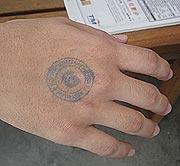 While voting is not compulsory at UM, notices, however, were displayed at the residential colleges stating that the colleges' gates would be closed and that students who did not vote would not be allowed to leave their colleges. Students who has cast their vote had their palms stamped as a record.
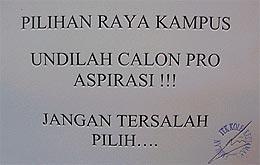
Fliers, approved by UM authorities and which called upon students to vote for the 'pro-establishment' students were seen on campus. Anti-establishment students claimed that their fliers were however not approved by the authorities. Students were also given a 'menu' which had a list of the university-backed candidates.
 Tight security was evident at all UM's residential colleges. However, student sources said university officials were allowed into the colleges last night and allegedly went from room-to-room telling students to vote for the 'pro-establishment' candidates.
 UM deputy vice-chancellor (student affairs) Prof Dr Mohd Razali Agus (
photo
), when met at the campus, denied that there were any electoral irregularities and said that he did not interfere in the campus polls or take any sides.
UM deputy vice-chancellor (student affairs) Prof Dr Mohd Razali Agus (
photo
), when met at the campus, denied that there were any electoral irregularities and said that he did not interfere in the campus polls or take any sides.
"There is no issue, when I look at it (the elections), they are just normal things ... (the disgruntled students) are just typical young people. No disciplinary action has been taken against anyone, they are just baseless allegations.
"UM is an established university, we have 100-year-old history. We implemented these election rules years ago even before the Suhakam (Human Rights Commission) was formed," Razali said.
He argued that the recording of serial numbers was to prevent 'phantom voters' while making it compulsory for students in residential colleges to vote - even though this was not stipulated in the election rules - and to increase the voter turnout.
On the case of a student who claimed he was assaulted by a university official, Razali said he had formed an investigation committee.
A total of 41 seats are open for contest at UM with the 'pro-establishment' camp winning 12 seats uncontested after nomination day on Monday. Poll results are expected to be announced at 11pm.
Low voter turnout
Meanwhile, at Universiti Islam Antarabangsa Malaysia (UIA), the campus elections was a non-even t as opposed to previous years. The campus is a traditional bastion for the 'anti-establishment' camp but their boycott this year paved way for the 'pro-establishment' faction to take over.
There are 24 seats up for grabs at UIA. Out of that, 20 were won uncontested on Monday with the remaining four seats to be filled by appointed student representatives later.
At Universiti Kebangsaan Malaysia (UKM), where anti-establishment students had decided not join the boycott, balloting was reported to be smooth apart from the expected low voter turnout, according to student sources.
There is an interesting twist in the battle for control of UKM's 33 seats as the pro-establishment students are split into two factions, making it a three-corner fight.
Meanwhile, Deputy Higher Education Minister Fu Ah Kiow when contacted said he has not received any report over the campus elections and he was in the dark over allegations made by the 'anti-establishment' students.


Report this comment
Are you sure you want to delete this comment?
This action cannot be undone.