


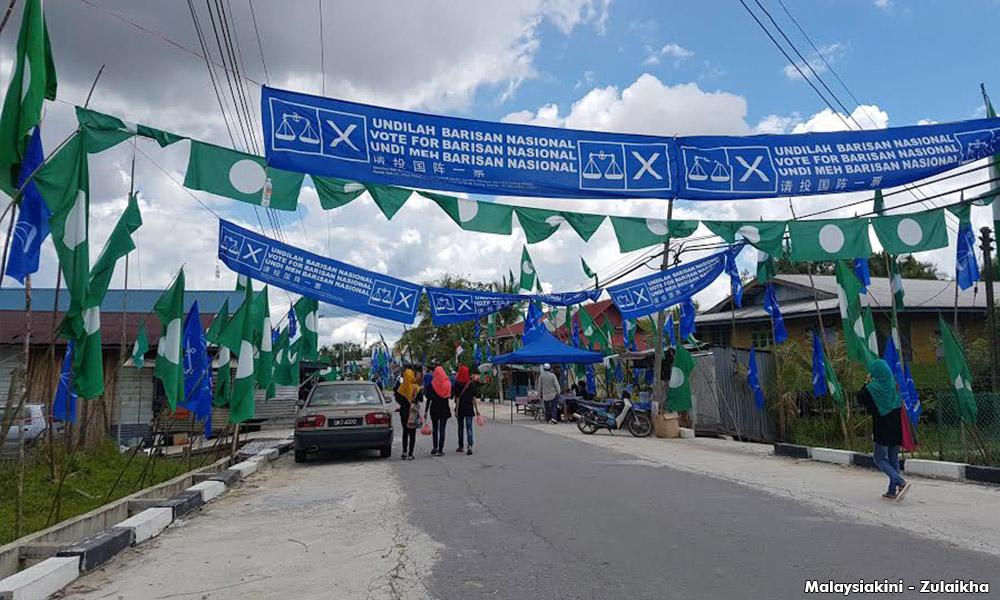

Imagining a ‘BN-PAS coalition’ during GE14
The 14th general election saw PAS field a total of 158 candidates for Parliament and 390 candidates for various legislative assemblies, the largest-ever contingent from a single party.
Despite PAS' low win rate, its large pool of candidates – which included a handful from Parti Ikatan Bangsa Malaysia (Ikatan) and the Pan Malaysia Islamic Front (Berjasa) – captured a 16.7 percent vote share.
Former premier Najib Abdul Razak, who led BN to its worst defeat ever, had recently claimed that PAS' ambitious election efforts were part of his "strategy" to split the opposition vote...
The 14th general election saw PAS field a total of 158 candidates for Parliament and 390 candidates for various legislative assemblies, the largest-ever contingent from a single party.
Despite PAS' low win rate, its large pool of candidates – which included a handful from Parti Ikatan Bangsa Malaysia (Ikatan) and the Pan Malaysia Islamic Front (Berjasa) – captured a 16.7 percent vote share.
Former premier Najib Abdul Razak, who led BN to its worst defeat ever, had recently claimed that PAS' ambitious election efforts were part of his "strategy" to split the opposition vote.
There were hundreds of multi-cornered contests during the last general election, unlike in 2008 and 2013, which saw mostly straight fights.
The gambit obviously did not pay off for BN, which was demolished in the more populous west coast of Peninsular Malaysia. The coalition only won in Perlis, Pahang and Sarawak.
PAS went on to set a new record for its candidates losing their deposits – one in three for federal seats, and one in four in the states – but won handsomely in Kelantan and managed to wrest Terengganu.

Since the last general election, BN and PAS have avoided clashing with each other in by-elections. This strategy paid off during the Cameron Highlands by-election, with voting data clearly showing that PAS’ support was transferable to BN.
This raises an important question: if the votes received by BN and PAS were combined during the last general election, what would be the outcome of GE14?
'Bossku' wouldn't have surfaced
A simple method of measuring this would be to assume that like in the Cameron Highlands polls, all voters who opted for PAS in GE14 would choose BN.
This method is, of course, not scientific, but serves to illustrate the efficacy of a 'BN-PAS coalition'.
Based on Malaysiakini’s review of the results, a 'BN-PAS coalition' would have won 127 parliamentary seats.
This is an increase of 30 seats from what the two parties actually won, and would leave Pakatan Harapan and ally Parti Warisan Sabah with just 92.

Of the 30 seats that the hypothetical 'BN-PAS coalition' could have won, 14 are currently held by PKR, seven each by Amanah and Bersatu, followed by two held by DAP.
For instance, Bersatu deputy president and Kedah menteri besar Mukhriz Mahathir won the Jerlun parliamentary seat with just 42 percent of votes, while his opponents from BN and PAS both secured about 29 percent.
Moreover, six cabinet ministers and nine deputy ministers would have lost the election. They are as follows:
Cabinet ministers
- Rural & Regional Development Minister - Rina Harun
- Health Minister - Dzulkefly Ahmad
- Foreign Affairs Minister - Saifuddin Abdullah
- Domestic Trade and Consumer Affairs Minister - Saifuddin Nasution
- Water, Land and Natural Resources Minister - Xavier Jayakumar
- Minister in the Prime Minister's Department (Religious Affairs) - Mujahid Yusof Rawa
Deputy ministers
- Deputy Finance Minister - Amiruddin Hamzah
- Deputy Communication and Multimedia Minister - Eddin Syazlee
- Deputy Human Resources Minister - Mahfuz Omar
- Deputy Federal Territories Minister- Shahruddin Md Salleh
- Deputy Works Minister - Mohd Annuar Mohd Tahir
- Deputy Entrepreneur Development Minister - Hatta Ramli
- Deputy Water, Land and Natural Resources Minister - Tengku Zulpuri Shah Raja Puji
- Deputy Minister in the Prime Minister's Department (Religious Affairs) - Fuziah Salleh
- Deputy Minister in the Prime Minister's Department (National Unity and Social Well-Being) - Md Farid Md Rafik
Ironically, two key critics of PAS from MCA – Liow Tiong Lai and Chew Mei Fun – would have survived the last general election had there been the hypothetical 'BN-PAS coalition' at the time.
Fewer Harapan state gov'ts
The last general election saw Harapan gaining control of Negeri Sembilan, Johor and Malacca, while retaining Penang and Selangor.
There was no clear winner in Kedah, Perak and Sabah. Eventually, a series of political manoeuvrings saw Harapan governments being formed in Kedah and Perak, while a Warisan government was formed in Sabah.
Against a hypothetical 'BN-PAS coalition', however, Harapan would not have been able to form governments in Kedah, Perak and Malacca.
In Kedah, Harapan won 18 out of 36 seats in the legislative assembly, leading to a hung assembly. Against the hypothetical 'BN-PAS coalition', Harapan would have won only seven.
The resulting scenario would have been even more startling in Perak, where Harapan won 29 out of 50 seats. A 'BN-PAS coalition' would have won 40, giving them a two-thirds hold of the legislative assembly.
In the case of Kelantan and Terengganu, this hypothetical scenario would see zero state-level opposition lawmakers.

Winning formula?
If everyone who voted for PAS in GE14 had opted for BN instead, the results of GE14 would have been drastically different, and Najib would still be in power today.
It must be stressed that this assumption is overly simplified, and does not account for the multitude of variables in any given election.
Meaningful cooperation between BN and PAS only manifested during the Cameron Highlands by-election, when both parties campaigned together for two weeks.
Eventually, BN won with a vote share of 54.73 percent – nearly the same as the 55.23 percent secured by BN and PAS collectively during GE14.
If this trend were to continue for the several other by-elections expected this year, BN and PAS may very well have found a winning formula.


Pakatan learnt that Malaysia was almost a failed state when they took over and yet it went on to abolish GST instantly as its first post GE14 action without back up plan in place first for revenue to pay for the hefty debt incurred by previous regime. Realising the huge hole to fill up, they have no choice but to find way to raise revenue and force to deploy the same old regime tax tactic with different names attached but less efficient then GST, it came back to haunt them now as the wound gets worse and thr bleeding continues. Old wine in a new bottle , everyone complaining. Pakatan answer is to keep complaining it was old gov problem but......
Report this comment
Are you sure you want to delete this comment?
This action cannot be undone.