



Expert hits dummy with Fire Dept van, finds similar imprint on Adib
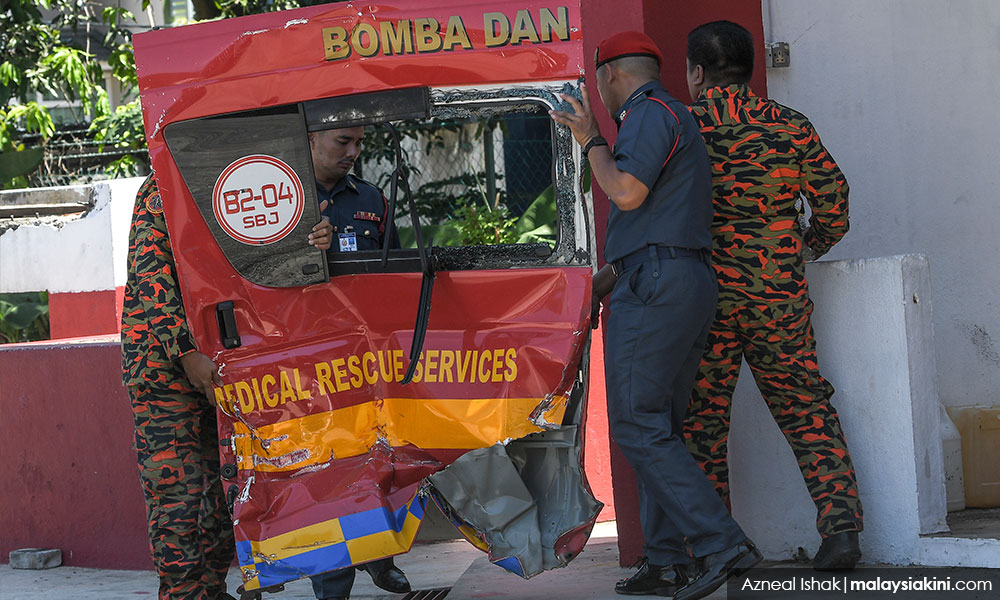
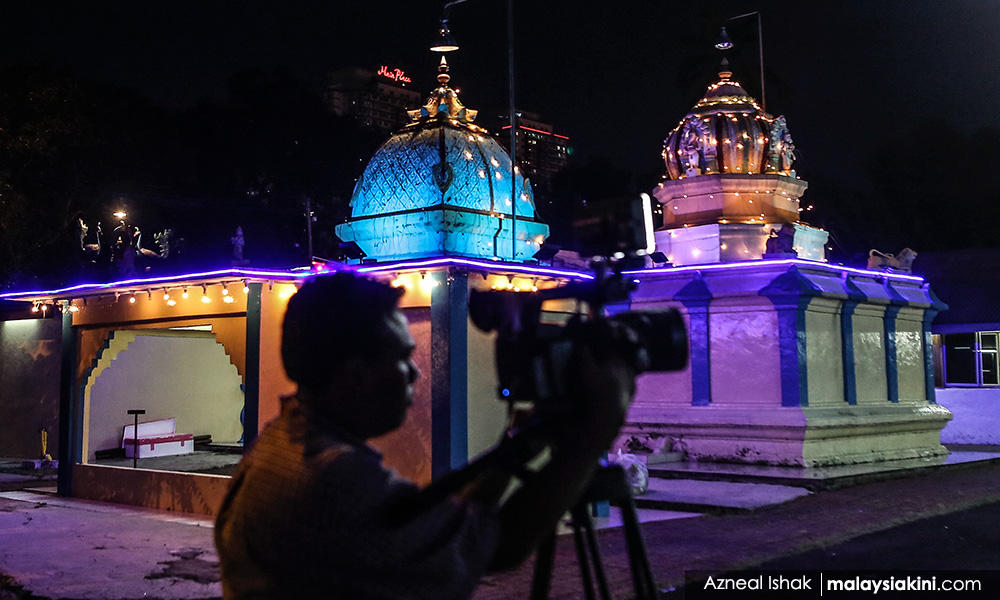
INQUEST | The injuries on Muhammad Adib Mohd Kassim's right chest could not have been caused by the firefighter falling onto a road kerb during the Seafield temple riots last November, the Coroner's Court in Shah Alam heard today.
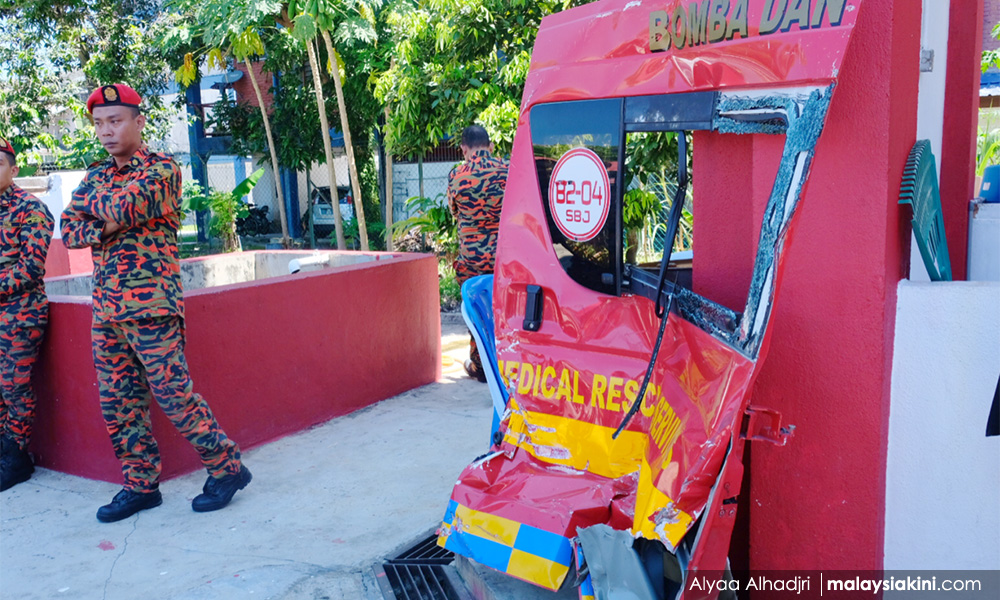
Dr Shahrom Abd Wahid, a retired forensic pathologist, said that the pattern of injury matched the door of the Emergency Medical Response Service (EMRS) van that Adib was in...
INQUEST | The injuries on Muhammad Adib Mohd Kassim's right chest could not have been caused by the firefighter falling onto a kerb during the Seafield temple riots last November, the Coroner's Court in Shah Alam heard today.
Dr Shahrom Abd Wahid, a retired forensic pathologist, said that the pattern of injury matched the door of the Emergency Medical Response Service (EMRS) van that Adib was in.
Testifying before coroner Rofiah Mohamad the inquest to determine the cause of Adib's death, Shahrom pointed out that he discovered this through an experiment involving a rubber mannequin being pressed between the EMRS van's door and its frame.
The former head of Universiti Kebangsaan Malaysia's Forensics Department described his experiment under examination from inquest coordinating officer Hamdan Hamzah.
Shahrom: I wanted to test (the theory that Adib was injured when falling to the kerb). So, I took a photo of the victim's injuries, and tried to match those with photos of the kerb.
In my opinion, it did not match Adib's injuries at all.
Based on this, I started looking for other objects that could have hit the victim's body and cause this kind of imprint.
I initially based my opinion from the police's photograph (reconstruction of the incident). But I wanted to see for myself so I went there (to the site of the incident).
I put a (length) scale (on the kerb) based on the reconstruction photograph, and made comparison. Based on police's reconstruction of the event, I found that the kerb was not a match.
Even when I went there and took a photograph (of the injury), still nothing matched. There was no match (with the injury pattern at all).
I even examined a stretch of the road kerb, but there was no part that was protruding (menonjol) that could cause the abrasion wound (luka sagat) on the victim's chest.
Next, I used a rubberised mannequin (to do the experiment). We had a firefighter holding the mannequin (in between EMRS door) and had the door pushed hard.
We could not kick the door, as it could injure the firefighter (who was holding the mannequin). So we pushed the door as hard as we could.
And it created this pattern [shows a photograph of an orange mannequin].
This pattern was more of a match. It was not 100 percent. If we were to get the perfect match, we would have to kick it as hard as we could, and at the same time pull it quickly.
Hamdan: What do these photographs of this dummy show?
Shahrom: This is an orange dummy. We painted black paint to the edge of EMRS door, then we swung the door towards the dummy, where at the same time we pulled the dummy out (of the van).
Rofiah: So the dummy was put on the (front passenger) seat?
Shahrom: The dummy was put in between the door and its frame, then we hit the dummy with the door, at the same time as it was being pulled out.
So this resulted in such a pattern, which we then matched to the injury on the victim's right chest.
In my opinion, this pattern was more reproduceable. If we look at it, the pattern is more similar (to the injury), although it is not perfect.
It looks like the force from the EMRS door could cause this kind of injury to the chest.
Hamdan: So the black paint is the part where the door hit the dummy?
Shahrom: (Yes) it is the part that hit the dummy.
Shahrom's (below) testimony today was a continuation of his theory that Adib sustained injuries to his ribs and lung due to being pinned between the EMRS van door and its frame.
The pathologist had suggested that Adib was pulled out of the van by an attacker, at the same time as the van door was kicked by one or two others.
His opinion, however, stood in contrast to that of two other forensics experts from Kuala Lumpur Hospital, Dr Mohd Shah Mahmood and Dr Ahmad Hafizam Hasmi.
Shah, who heads the HKL Forensics Department, and Ahmad Hafizam, a forensic medicine specialist, had testified that Adib’s injuries do not support the allegation that he was pulled out of the EMRS van on the night of the riots.
The two experts, who participated in Adib's postmortem, said the nature and pattern of his rib fractures and external injuries support the notion that he was standing outside the EMRS van when hit by the vehicle’s front right passenger door as it reversed, to avoid an angry mob at the scene.
Earlier today, Shahrom told off the HKL Forensics Department for its recording of Adib's injuries.
He said HKL should have included a colour scale when taking photographs of the victim's bruises during the postmortem.
The pathologist was asked to assess a triangle-shaped bruise on Adib's right arm, based on a photograph from the postmortem.
Hamdan: You said that the victim's injuries were caused by the (Emergency Medical Rescue Services van) door hitting the upper front side of his body, and that the imprint mark was produced when the body was hit by the door frame.
If you look at the bruise, can you tell us the colour of the bruise?
Shahrom: In this matter, I would like to see the original postmortem photograph.
[Shahrom then examines a photograph tendered as evidence in the inquest.]
Shahrom: This original photograph should have a colour scale, (because) I want to know the RGB reference. The colour scale, red, green, and blue.
Only when we look at the reference, can we comment on the colour (of the bruise).
If we refer to page 16 (another photograph), the colour of the victim's arm is more yellowish compared to this postmortem photo, which is brownish.
So, I want to comment... I apologise for making this comment. The practice of (HKL) forensic pathologists in taking photographs that involve colours (of injuries), there must be a colour scale as well, not only a length scale.
Thus, on this basis, I do not want to comment (on the colour of the victim's bruise), because it can be black, blue, brown or anything, because there is no reference.
When we want to photograph (bruises), we have to include a colour scale. So when we refer to the RGB (scale) side by side, we can tell the real colour (of the bruise).
The inquest continues into its 29th day on Friday.


Are you sure you want to delete this comment?
This action cannot be undone.