




Report card on status of Malaysian women
Come May 24, the government's report card on the status of women will face strict scrutiny for the first time since Malaysia ratified the Committee on the Elimination of Discrimination against Women (CEDAW) Convention in 1995.
Come May 24, the government's report card on the status of women will face strict scrutiny for the first time since Malaysia ratified the Committee on the Elimination of Discrimination against Women (CEDAW) Convention in 1995.
A delegation from the Women, Family and Community Development Ministry will face questions from a CEDAW panel of 23 independent experts in New York tasked with gauging how much of the obligations under the convention the government has met so far.
Malaysia will be presenting the initial and second periodic reports as it has yet to submit any report as required following ratification.
 The review panel will then counterbalance the signatory government's report with the respective NGO feedback obtained earlier before making the necessary recommendations.
The 35th CEDAW session will run from May 15 to June 2. The convention, a human rights treaty for women and an international law that promotes gender equality, has been ratified by 182 countries.
On May 22, six women's rights activists representing 30 Malaysian non-governmental organisation (NGO) will use the allotted eight-minute slot to highlight the gaps in the government's findings.
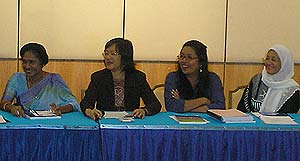
Dr Hamidah Karim (National Council of Women's Organisations), Meera Samanther, Ivy Josiah and Vizla Kumaresan (all with Women's Aid Organisation), Zaitun Kasim (Sisters In Islam) and Zarizana Abdul Aziz (Women's Centre for Change, Penang) will be flying off to the Big Apple next week.
NGO critique
In releasing Malaysia's first NGO Shadow Report in Petaling Jaya yesterday as a critique of the government's report, SIS programme manager Zaitun said the oral presentation will cover four critical areas.
"We had to distill the (160-odd page) report down to eight minutes covering four main areas out of the 20 critical issues which we have summarised into several parts.
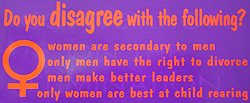
"The critical areas are participation in policy formulation and decision-making, the impact of narrowly-interpreted codified Islamic laws, gender sensitisation and women with increased vulnerability and risks such as stateless women and sexual minority groups."
 She said the government will have to substantiate the actions taken or a lack of it before the CEDAW panel.
"The NCWO will be handing the shadow report to the ministry before the New York meet. The next session is in four years' time."
The turnout of less than 50, however, was poor given the significance and potential impact of the shadow report on the progress of women's issues in Malaysia. There was also a brief question-and-answer session.
Women's Development Collective executive director Maria Chin Abdullah, who chaired the briefing, said the shadow report also offers additional information of women in the country.
"The project initiated by the NCWO in 2003 has seen women's groups, academics and individuals contribute important information and analyses on the status of women here," she said, adding that the shadow report was submitted to CEDAW early this year.
In addition, she said, the Joint Action Group of Gender Equality's list of critical issues submitted to CEDAW had helped formulate questions for the government on the need for a concrete plan of action and time lines for law and policy reform.
Critical issues
Josiah, who is the WAO executive director, said the report is to emphasise the prevalence and magnitude of the critical issues that Malaysian women face and of which the government has downplayed or failed to highlight.
"Our report is to provide the necessary checks and balances, to add pressure on governments to improve on existing mechanisms and as a tool for advocacy."
 After receiving the government's report in May 2004, she said the NGOs kicked off the feedback process in August followed by more research the following year before publishing the shadow report this year.
Asked about the trip, she said the estimated cost for each person is around RM10,000.
"We had to approach a lot of parties and managed to obtain funding from the British Human Rights Fund and the International Women's Rights Action Watch, Asia Pacific.
"Some of us are also using our own money to make this trip possible."
On the importance of CEDAW to Malaysian women, NCWO health commission chairperson Hamidah said there were still some reservations the government has retained.
"There is also the optional protocol which involves communications procedures and inquiry mechanism.
"By ratifying the convention, the government has shown commitment and taken many steps but all is still not well," she noted.
"The existing mechanisms are ineffective, for example, there is no gender sensitisation among politicians as we have seen from the numerous media reports."
Following New York, the group will organise a conference to publicise the concluding remarks or recommendations made by the CEDAW panel for the government to adopt and implement.
In her welcoming address, NCWO vice-president Ramani Gurusamy thanked all those involved in preparing the shadow report with WAO president Meera later introducing the NGO team of six.
Today's briefing session was funded by the Friedrich Ebert Foundation.


Are you sure you want to delete this comment?
This action cannot be undone.