




Mahathir vents frustration on DVD
exclusive A two-hour DVD depicting former Umno strongman Dr Mahathir Mohamad flaying the current crop of leaders for "lacking courage" is currently making its rounds as the party celebrates its 60th anniversary today.
exclusive A two-hour DVD depicting former Umno strongman Dr Mahathir Mohamad flaying the current crop of leaders for "lacking courage" is currently making its rounds as the party celebrates its 60th anniversary today.
"If you want things to be right, you have to take the risk. But what I see now is a desire to avoid risks at all cost even if the country goes to the dogs," said Mahathir, who had spearheaded the ruling party for more than one-third of its history.
The 82-year-old former premier said members were afraid of putting their heads on the chopping block and thus opted for silence when things went wrong.
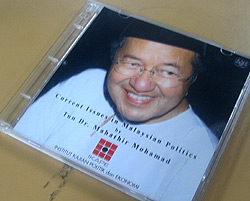 The former premier made the scathing remarks at a talk with 100 Malay professionals, a recording of which is now made available on DVD by think-tank Institute of Economic and Political Studies (Ikape).
During the close-door session, Mahathir also spoke, among others, about the disputed bridge to Singapore, Proton and how the 'days are over' for his estranged former deputy, Anwar Ibrahim.
The invitation-only talk - titled 'Current Issues in Malaysian Politics' - was organised last December by Ikape, headed by former New Straits Times editor-in-chief Abdullah Ahmad.
The DVD, which comes in two discs, kicks off with an hour-long speech by Mahathir, followed by a fiery question-and-answer session.
Malaysiakini has obtained a copy of the DVD and reproduced below the Q&A session:
Question: I am in Umno, but whenever I try to contribute, people label you based on which team - Team A or Team B - that you are in. They are not looking at you as a person but which team you are with.
Mahathir: I've tried to avoid the AP (Approved Permit) issue, but I think I need to use it as an illustration. I knew something was going wrong, and nobody was willing to say anything. Everybody was silent and willing to allow something that was wrong to go on and on. So I had to come out with a public statement despite my resolution not to comment about the government.
This is a kind of abuse of power and doing something that is against national interest. I cannot accept that a minister should give to somebody he or she knows so much wealth, and I'm learning a little bit more everyday, for example, I knew that DRB Hicom (in order) to get APs to import cars, they have to pay more than RM300 million to two people up front. That is wrong.
If DRB Hicom is not a bumiputera company and therefore, is not entitled to APs then it should not get an AP at all. But to say that it is not bumiputera but it is alright for DRB Hicom to get the AP if it goes through these very important people - they have to pay money up front. That, to me, is wrong. I wouldn't say it is corruption or whatever, because that is very difficult.
What disappoints me is that in Umno itself, there is no willingness to criticise something that is obviously wrong. And if I may say so, because this is the leader of the Wanita (Rafidah Aziz who was also the minister in charge of APs), (the) Wanita (wing) has got no opinion whatsoever, never said one word against the boss.
I think, during my time, people criticised me. Umno people criticised me, they even stood against me, tried to bring me down, but nowadays, when you see something obviously wrong, and you refuse to stick your neck out to be chopped, I think you have ceased to become a real political force. So you have to take risks.
I have taken risks before. I am not putting myself in a basket and carrying myself up, it's a bit difficult to do that. But, as you know, at the time when everybody refused to say anything against the (first prime minister) Tunku (Abdul Rahman), I stuck my neck out and I was chopped. I was thrown out of Umno and if not for (the second prime minister) Tun (Abdul) Razak allowing me to rejoin Umno, I wouldn't have become prime minister.
Of course, lots of people condemned, but people see that it is something right to criticise when a leader goes wrong and Tunku Abdul Rahman was definitely doing something wrong, (by) not giving the Malays the right opportunities so I had to come up and take the risk.
So if you want things to be right, you have to take the risk. But what I see now is a desire to avoid risks at all cost even if the country goes to the dogs, that's alright as long as I'm safe. That's something that I regret. I thought that some people would support me when I talked about the AP issue. There are lots of issues I can talk about but I'm not going to talk about them. Just to take this one issue, the AP issue, where there is blatant abuse of authority, of power, and yet, I get no support at all from my own party, I'm still a member of Umno.
If they supported me, they never studied the problem. They were talking about sentiments rather than facts, but the facts are the problem and I spent a lot of time explaining to them what the facts are. Members of parliament came to see me and asked me a lot of questions, I went through every detail and then they went to Parliament, they said nothing, beyond saying that, 'well, we know all the facts now so we don't have to raise this in Parliament,' so they never raised this at all. Why did they come and ask me (then), I don't know. I made up my mind then that I'm not going to waste my time explaining to people who only want to 'improve' their knowledge.
I think, if you like to let the rot rot on, then of course you're going to have something rotten. But if you are prepared to chop off the rotten part, you may save the rest. I've been trained as a doctor, as you know. We have been trained to chop off people's legs if they are gangrenous in order to save the rest of the body. You feel that you should not chop off the gangrenous part because you kasihan lah (pitiful), so in the end, of course, he's going to die of gangrene.
My fear, it doesn't really matter, I'll be on my way very soon, so my fear is that if you're not prepared to take some risks to criticise what is wrong, if you are only keen on saying 'yes' to everything, that the party will rot. That is my fear.
Do you think that we should not use the term New Malay which seems to imply that our values and traditions are incompatible with modernity and progress? What is it that really needs to be changed about the Malays?
Restoration in Japan actually refers to restoring the Emperor. Before that, they had the Shogun, the military general who wielded all the power in Japan. The Tokugawas took over the ruling of Japan and they took the Emperor to the side and gave him no more power, no more role. So during the Meiji Restoration, the Meiji was made the head of state for Japan. Restoration does not mean the restoration of Japanese culture alone although the Japanese did maintain much of their old culture. But when they maintained much of their old culture, it was a strong culture.
What is the culture of the Japanese? They were people who were very, very disciplined. They also have a very strong sense of shame to the point where if you are ashamed, you kill yourself - harakiri . If you fail to carry out an assignment given to you by the Emperor, then the Emperor gives you a knife and you commit suicide in front of him. That is the kind of strong feeling of shame that the Japanese had. When they lost the war, hundreds of them jumped over the cliff to kill themselves because they were ashamed that Japan should lose in the war. So they wanted to restore this strong sense of shame and strong sense of discipline.
That discipline was there during the Tokugawa period. So the restoration is really the restoration of the role of the Emperor as against the role of the Shogun. But culture-wise, they wanted to emulate the West. I must say, at times, they made mistakes. For example, Japan never had colonies, but because the West had colonies, they also wanted to have colonies, and so they colonised Korea, with very disastrous results.
When we want to change the Malays, we look at the history of the Malays. We have values that are not conducive to success. We don't give value to the sense of shame, for example.
Of course, if you take off your clothing, you'll feel malu (shame). When you fail in something, you should feel ashamed. If you study something and you don't succeed, you should feel ashamed. But, some people say, 'I failed the exam, seronok pula (happy too)'. There is no sense of shame. We have to build a sense of shame so that when you have a strong sense of shame, you will strive not to feel a sense of shame and when you undertake to do something, you do it well. If you do business, you must succeed in business. You must do the right things. You mustn't cheat and things like that. We must try get these New Malays to have this sense of shame.
The other thing we try to emphasise is discipline. If you are not disciplined, you are easily carried away by ways that are really not good. Friends say, you take a little bit of marijuana, tak apa. try sikit, you try sikit (It's OK, just try a little), and then you go (and try). Why? There is no discipline. Your parents did not bring you up with this discipline, to deny your natural desires.
That is why the majority of drug addicts in Malaysia are Malays and even the majority of people involved in rapes are Malays. Whereas we are Muslims and all these things are forbidden in Islam. But we have no discipline, so what we want to see in the Malays are a few things that they should cling to and that they should practice: discipline, a sense of shame, a desire to accomplish, a desire to prove that you are not less than anybody else, that you boleh (can) what others boleh .
We encourage people to climb Mount Everest, to sail around the world alone, to swim the English Channel, what do they get? When they do that, they become convinced that they can do things and that require discipline.
We sent Azahar (Mansor - who sailed solo around the world) and Malik (Maidin - who swam across the English Channel) to give talks to young people. The questions they ask are quite interesting. The Chinese and Indians asked how they trained for these feats, the Malays ask, Apa ilmu pakai? (What mystical knowledge was used). So if they know that ilmu , they can sail around the world. It's very simple.
Actually, they had to train. Sharifah (Mazlina Syed Abdul Kadir who mounted a solo expedition to the Antartica) had to train like mad for two years. It's not easy. Shaping the character of a person to face ordeals, that is important. That is the new Malay that we want.
Alright, if you don't want to call it new, you can call it by any name. But the important (thing) is the new character of the new Malay, that he can stand up to anybody and overcome this challenge. He is able to do things that others cannot do and do it better. Of course, it's not always about climbing Mount Everest or walking across Antartica but you must have that character.
That is the new Malay that we want. I'm not talking about forgetting all our culture, but some of our culture we need to forget. You know, easy money.
The sultans might get angry with me, but datang orang putih (when the white men came), janji (promised) we will give you a political pension, you don't have to work. We work. Wah, seronoklah (happy). You see, that's what they did. They gave political pension to all the Malay rulers, and the Malay rulers left the administration to the Europeans, to the British, and as a result, we were colonised. They didn't fight any war against us.
Dapat payung kuning satu (Get a yellow umbrella), satu kereta Rolls Royce (a Rolls Royce car), dapat istana (a palace), dengan pencen (with pension). Apa lagi nak? Tak payah buat kerja (What more is there to ask, no need to do work). That is not the kind of Malays we should have. So, if you don't like to call it Melayu Baru (New Malays), you want to call it any other name, its alright. But please remember, the idea is to change that kind of value system which is not going to help the Malays to succeed.
How do we instill honest values in our children? How do we make our children remember what is right and what is wrong?
I can understand the predicament of the present generation because we have seen Malays who have migrated to the towns. Usually both father and mother are working so that the children have less time with their parents and sometimes we leave it to others to instill good values in our children. That is because many of us are busy, both mother and father would be busy.
Of course, we don't want the ladies to stay at home and be good mothers cooking the food and all that. We need the ladies because the boys are not learning at all in the universities, only 30 percent are boys, 70 percent are girls (in universities). So if you say the girls shouldn't study, we wouldn't have anybody at all because the boys are not studying either. So, we want the women to study, but at the same time, after graduating, after starting their own business, how do they give sufficient attention to their own children?
Apparently, the Chinese children and even the Indian children are able to do this. The parents somehow or other insist, in fact, some Indian parents drive their children mad by insisting that they must excel in this, they must excel in that, that they all must become doctors, but Malay parents, somehow or other, cannot handle this new way of life where they are busy working, doing business, and yet they want children, they have children, but they have no time for their children.
You have to make time for them. You must spend time with the children and not leave it to the ustaz or school teacher to teach good values, good character. I read a reply by one of the students who did extremely well in the recent examination. What he said was 'I'm glad my father did not have Astro'. Now Astro will have 100 channels. Just imagine. What are you going to tell if you have 100 channels of rubbish, of crime, sex, and all that?
Far too often, if they are not out of the house, they are watching TV, they are not studying. In my time, I would like to watch TV, but there was no TV, so I had to study. So I think there must be some control, parental control over the TV. Certain times should be allocated for them to see TV, but not too much, but the rest, they must spend time studying.
I know what I say is not easy to accomplish, but I know that if you want your children to have the right character, the right values, you have to have that character to make them have the right values. And to have that character, you must be willing to be unpleasant to your children and make them study and tell them what is good and what is bad.
Today, I read of a young man who undertakes to kill people, a contract to kill. I think when you see violent movies, when you see death just like that, you really don't think much about killing people. I don't watch TV myself because there are too many things, but when you watch TV, it's all about violence, about sex, and just imagine, a teenager, for example, seeing some pornographic thing on the Internet, he goes wild, he goes mad. He goes out and finds a one-year old and he rapes. It didn't happen before but it happens now.
You look at all these DVDs and the Internet. I thought it was difficult to find it on the Internet, so I tried, and wow, my goodness, even an idiot can get access to all these things. It doesn't affect me at 80 years old... I kept wishing I was a teenager. A teenager, he'll go out and rape the first person he meets. So, these things have got an effect in undermining our character. Parents must make an effort to give quality time to their children and ensure that their children remain relatively free from the influence of violence and sex that comes through the TV and Internet.
How do you evaluate the political stability of the country? How do you see the mindset of the people? Can we fulfill Vision 2020? How do you feel about the Second Bridge issue? What about the invasion of Temasek (Singapore government's investment arm)?
I must admit that if I were to answer this, I would be very biased.
I had thought that one way to achieve Vision 2020 is, of course, to activate the country through investments. Of course, when you invest, when the government invests, it has to use its money. Whether I'm right or I'm wrong, I'm being told now that these investments have resulted in Malaysia having no money. Therefore, everything has to be slowed down. Obviously, if you want to make progress, you have to go faster. If you slow down, you don't make progress. Maybe we will progress and become a developed country by 2020. There is some niggling things in my mind that we may not make it.
I tell foreigners, and you are not foreigners, you are Malaysians so I can be frank with you. Foreigners, every time they ask me 'Are you going to make it?' I say 'Yes, sure. We'll do it' because we have always done what other people say we cannot do.
But if you don't spend money, then the country will not grow. That is something I believe in. Maybe I'm wrong, so maybe we'll meet the target, maybe we'll not. It's not a satisfactory answer. I'm trying to be as diplomatic as possible.
The Second Bridge - as you know, the Second Bridge has been built. That is the Second Crossing, but I think you mean the replacement for the Causeway. Well, because we want Singapore to be happy, we have to wait until they agree. Of course, I feel that we need not wait.
Actually, when I became prime minister in 1981, I went to Singapore to make friends with Mr Lee Kuan Yew. I strained very hard. I bent over backwards until it became almost like a bow. But somehow or rather, I could not get Mr Lee to agree on anything but he would like us to give more things to him and as a result, of course, when I stepped down, the problem is still there after 22 years.
I believe that the present government thinks that they should try again to be friendly with Singapore, to play golf - I don't play golf, which is very bad - and to pat each other's back. Unfortunately, after two years, after putting in the piles, this bridge is not going to be built just as yet. At the same, the Customs, Immigration (and Quarantine) Complex will be completed soon, but that will be a white elephant because there is no road leading to this new complex. So the Second Bridge will not be built anytime soon.
If you were to wait for Singapore to agree, they will not agree. I was told by Mr Lee Kuan Yew, we will have to wait until Goh Chok Tong (to step down), because he has this nostalgia about the Causeway. Until he is not around, we cannot build the bridge.
But as you know, Goh Chok Tong stepped down as prime minister but he was elevated to senior minister and, apparently, more senior than the prime minister himself, because on the (bridge) issue, only he is allowed to negotiate and since his nostalgia is still there, we will have to wait until either he steps down as senior minister - which is not likely - or he fades away from this earth, then perhaps we can build the bridge. But since we want to be friendly with Singapore then we should be patient enough to wait for Singapore, to wait for Mr Goh Chok Tong.
I think of Singapore wants to invest in Malaysia, then why not? Foreign Direct Investment, they want to buy up our Proton, for example, which is making losses now. Losing companies usually sell more cheaply, but as you know, we messed up. The Wall Street Journal says that the advisor messed up things. So now, you are seeing the losses. So when they (the companies) are cheap, others would be quite willing to buy. We would be saving ourselves by giving it to them. You see, losing companies you sell, profitable companies you keep for yourself, so we kept Proton for ourselves because at one time it was profitable. Now that it is losing, it should be sold and other companies, too, in Malaysia, should also be sold.
We should not distinguish Singaporeans from other foreigners. If that is our policy, then, I think, we should welcome the desire of Singapore to invest in Malaysia.
On nationalisation - I did not believe much in nationalisation because all nationalised companies during my time were losing money, so I privatised. During my time. But now, privatised companies are losing money, so we nationalise again.
Dr M on current issues in Malaysian politics
Tomorrow: Mahathir on going agricultural, the half-bridge and Anwar .


Are you sure you want to delete this comment?
This action cannot be undone.