




Dr M on current issues in Malaysian politics
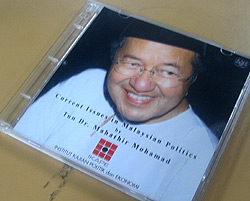
 Former prime minister Dr Mahathir Mohamad held a closed-door-session with a group of Malay professionals last year, where he addressed several interesting issues. This is now available on DVD.
The invitation-only talk - titled 'Current Issues in Malaysian Politics' - was organised by the Institute of Economic and Political Studies (Ikape) headed by former News Straits Times editor-in-chief Abdullah Ahmad.
Malaysiakini has obtained a copy of the DVD and has reproduced excerpts from Mahathir's candid speech.
 Former prime minister Dr Mahathir Mohamad held a closed-door-session with a group of Malay professionals last year, where he addressed several interesting issues. This is now available on DVD.
The invitation-only talk - titled 'Current Issues in Malaysian Politics' - was organised by the Institute of Economic and Political Studies (Ikape) headed by former News Straits Times editor-in-chief Abdullah Ahmad.
Malaysiakini has obtained a copy of the DVD and has reproduced excerpts from Mahathir's candid speech.
BN dominance
I think there are no political issues in Malaysia today. As you can see, I'm struggling to find the issues because things are so good.
 For example, in the Pengkalan Pasir by-election in Kelantan, Barisan Nasional won. Umno won when it was expected to lose. Of course, this recalcitrant Ibrahim Ali came into the picture, but the BN did very well. You know, in the 2004 (general) election, the BN won with such a huge majority that today, practically speaking, there is no opposition.
What is clear is that the people in this country gave the Barisan Nasional and therefore, the government, solid support. And of course, the support is because they (the people) have no issues to grouse about. So, what you see today, is a very stable Malaysia with very few issues and which seems to have the support of most of the people.
Actually, during my time, I was able to maintain two-thirds majority. The present government has attained a four-fifths majority. No, nine-tenths majority, 90 percent and over, support the government. So in such a situation, it is very difficult to find issues to debate and to grouse about.
Race relations
So, how does a person talk about current issues in Malaysian politics when there are no issues? We have to create some issue. For example, race relations in Malaysia is very good. That is not much of an issue. Yes, there are, of course, lunatic fringes which is never ever satisfied with racial issues in Malaysia, race relations in Malaysia. But, by and large, the three major communities in this country seem to be able to live together, work together and play together.
I have been invited to many countries and among the things they are impressed about Malaysia is the ability of this country, a multiracial country, to have a stable and peaceful environment. Most countries with multiracial or multiethnic populations, as you know, will never be stable, they will be fighting each other.
Strong government
There is, of course, the fear that when a party dominates too strongly, political debate becomes impossible, and, if I may say so, one of the things that people might feel today is an inability to debate, to question, because you would be outvoted anyway. And I believe that a country must be governed with strong governance, but not too strong. If the government is too strong, it kills initiative, it kills debate.
 We've seen this in some neighbouring countries where for years now, for decades now, the country has been ruled by just one party. If there happens to be somebody from the opposition winning in an election, it is easy to charge him with corruption and take him to court, declare that he is bankrupt because he cannot pay the fine, and then, of course, you'll be freed from any opposition members altogether. But fortunately in Malaysia, this does not happen. Opposition candidates can win elections, can sit in Parliament, can even govern the states, though they have never been able to challenge at the central level.
So, what we see today is a strong government but maybe a little bit too strong. I've always believed that a two-thirds majority is necessary in order to enable the government to carry out its policies. But a government that has 90 percent of the seats in Parliament may be regarded as a little bit too strong and there will be a lot of psychophants along the elected members and they will not criticise anything. If they criticise, it will be in a very subdued kind of way.
You should be strong, but not too strong. How strong? Well, it's very difficult to say. A two-thirds majority would enable the government to change the constitution if it wants to, but a nine-tenth (majority) would not only be able to change the constitution, but make critical assessment of its policy impossible.
Nationalisation vs privatisation?
I'm told in Malaysia, we believe in nationalisation against privatisation. Privatisation has, of course, failed completely, and therefore, now, companies are now being nationalised, taken back by the government because the private sector has proven themselves incompetent and therefore the government has to come in and buy up the privatised companies. As you know, the privatised companies made a lot of losses and because of that privatisation is not the right way to go now.
Now, we must nationalise and place them under what is now called GLCs - government-linked companies. The government-linked companies will practically own everything. Whether this is good or bad, time will tell, but perhaps that is something that we should think about, should debate. Was privatisation truly a failure? If we look around us, we would see the things that we see today happening without privatisation? That, perhaps, is an issue worthy of debate.
Poor negotiation skills
I want to tell you, we had wanted to buy Russian MiGs (fighter planes). You know Russians, they are very inferior. Somehow or other, it was wangled without my knowledge, that part of the money (only to be used to purchase MiGs was also used) to buy (the American made) F-18 (planes). The very good American aircraft costs twice as much as the MiGs. And then, we acquired eight F-18s and 18 MiGs. MiGs are sold to us without any condition. If we feel like bombing Singapore, for example, the Russians are not going to object. Any Singaporeans here? Or ex-Singaporeans?
But this great aircraft called F-18 which we bought from America, after buying it, after several months, I got to know that these aircraft cannot be used for any attacks against any country even if it is not Singapore, because the Americans sold the aircraft, but the source code is kept by them. So you cannot plan anything, you cannot fly them to carry out any bombing attacks against anybody but you have this wonderful aircraft which you can see at Lima (the Langkawi International Maritime and Aviation Exhibition). So, we spent this huge sum of money and they actually negotiated and agreed to these terms. So that's why I say we are not very good at negotiating.
There's another agreement we entered into which is quite interesting. We decided to buy frigates from the British and the British agreed to deliver the frigates in two years' time. They will take two years to build the frigates. And the agreement says if they exceed this time by six months, they would have to compensate us. But if it is more than six months, they don't have to compensate us. So the British actually delivered the frigates two years behind time, so nothing to pay because they said they will only pay for the first six months. The first six months, they pay something, but the rest, they don't have to pay anything. So, it shows how smart we are in negotiating terms like these.
If you are doing business and you agree to that kind of agreement, I think you will be very soon declared a bankrupt.
Stimulating the economy
I had this crazy idea that, if you spend money, the government spends money, it stimulates the economy. That was my belief. Businesses when they spend money, when they invest capital, they expect some returns on their investment, but the returns may not be there. They may not get any returns because the business might be a failure and they might lose all their money. But government is different. When government spends money, even if it is not profitable, somebody - because the government is not profitable - somebody has made some profit from the government and the government can tax the person who makes the profit, so the money comes back.
So when the government spends money, usually it generates a lot of economic activity, and people make money, and of course they have to pay taxes, so the government gets back its money. Just imagine if you don't spend money since 1981 (when Mahathir became prime minister), I don't know if we would have developed the way we have developed, but as I said, the test of the pie is in the eating, but you cannot reverse the process. We would have to wait another 20 years to see whether spending money is good or not spending money is good.
I have always advised people, if you keep money under your pillow, it will actually shrink, it will lose its value, its purchasing power, simply because of the inflation, but if you spend the money, you get the full value of the money at any given time, so saving money is good. A lot of people tell us you should save money, but I think if you save money, save it by investing in something. Then you have some return, some fixed deposit, at least you get something in return, which will balance the inflation. But if you put money under your pillow, you are going to have less and less over time, so actually, the money is shrinking in value.
I'm not so sure now. I used to be very certain about myself, now I'm a little bit uncertain about myself.
Opposition dying
In Kelantan, we are winning. Next election, I will warn PAS, (menteri besar of the PAS-controlled state) Nik Abdul Aziz, that unless he joins the Barisan Nasional, he may have no more place. I think we are doing very well at the moment. I don't think we should grouse and dig up for issues. We are doing fine, the whole world tells us we are doing fine. America, Australia tell us we are doing fine. We must be doing fine because they tell us we are doing fine.
So, we should not be grousing, we should not be looking for political issues. Instead, we should try and ensure that the country remains stable, politically there are no problems, and we can then continue to prosper and to grow. I think I have exhausted my treasury of issues.
Religion
I think this country has got very little religious problems, really. If you follow Islam properly, and Islam advocates that people should be free to practice their religion. To you, your religion, to me my religion, quoting from the Quran. I read the Quran in English and in Malay. I can't read it in Arabic. I can read it in Arabic but I wouldn't understand. That's what Islam says, so we are very tolerant. We celebrate Deeparaya and many other things together. Do you see these things anywhere else in the world? Nowhere.
Even Catholics and Protestants do not celebrate with each other. But here we have Hindus, Muslims and Buddhists and Christians celebrating together. Maybe that is on the surface, maybe underneath, things are boiling, but they haven't boiled up and they haven't exploded. So, I think even with religion Malaysia is doing well.
Language
As to language, there is no real protest against the use of Malay as the official language. Of course, recently, we decided to teach science and mathematics in English, and there have been some protests from the Malays and the Chinese, but the government has remained very firm, and I think that is the right thing to do.
So, on the question of language, there may be the usual protests from the Malays, from the Chinese. But by and large, Malaysia has not had too much problem with language and it has not had too much problem with religion, either.
Mahathir vents frustration on DVD
Mahathir vents frustration on DVD, Pt 2


Report this comment
Are you sure you want to delete this comment?
This action cannot be undone.