




Hindus want freedom of worship protected
Given the increasing angst among Hindu Malaysians over the demolition of temples, the government must make the relevant allocation for space in existing and future development projects.
Given the increasing angst among Hindu Malaysians over the demolition of temples, the government must make the relevant allocation for space in existing and future development projects.
Hindu Rights Action Force (Hindraf) chairperson P Waytha Moorthy said every new development should allocate land for places of worship for the various faiths in the country.
"Currently there are no legal provisions for this to be done in new townships and increased urbanisation is seeing more Malaysian Hindus slowly moving or being relocated," he said when contacted.
He claimed the government had never fully-funded or initiated the construction of any Buddhist, Hindu and Sikh temples or Christian churches since Merdeka.
"Since 1957, there has not been a single place of worship of any of the non-Muslim faiths that was built with full government funding.
 "It is the duty of the government to provide for the establishment and maintenance of places of worship of the other faiths."
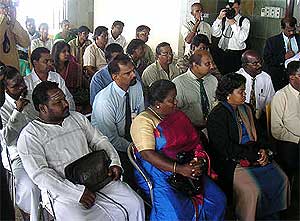
Last Sunday, more than 160 temple caretakers and Malaysian Hindu community leaders adopted 11 resolutions including the prime minister as the minister for non-Muslim affairs and a new freedom to worship law.
Several caretakers of mostly century-old temples in Perak, Selangor and Negeri Sembilan narrated the pre-dawn operations by local authority enforcers who allegedly tore down or torched the structures.
Citing the destruction of places of worship, several people were also disturbed with the government's intrusion into private space and feared the worst in the future.
UN member
Citing the Declaration on the Elimination of All Forms of Intolerance and of Discrimination based on Religion or Belief 1981, he said the government had an obligation to serve the spiritual needs of non-Muslims.
Waytha Moorthy added that the declaration was adopted without a vote by the UN General Assembly on Nov 25, 1981.
"To me, this is stronger than if a unanimous vote had been recorded because it is such a basic right."
Articles 6(a) and 7 provide for the right to freedom of thought, conscience, religion or belief including the freedom to worship or assemble in prayer and to establish and maintain places of worship.
 "(Building of)
masjid
(mosques) come under by-laws that are formulated by the respective local councils but the policy is not clearly-defined, which is why we want a national policy.
"(Building of)
masjid
(mosques) come under by-laws that are formulated by the respective local councils but the policy is not clearly-defined, which is why we want a national policy.
"Although our laws are silent on this matter, Malaysia has an international obligation as a member of the United Nations to ensure that such rights are protected."
'Forgot to gazette? '
He also said that ancient temples and places of worship of any faith must be protected as a national heritage the same way historical buildings are preserved.
"When local authorities acquired land from British-owned plantations, they never gazetted any land for the temples.
"The prime minister who chairs the National Physical Planning Council with the power to order for land to be gazetted for temples should do so without delay."
 Lawyer P Uthayakumar echoing his brother Waytha Moorthy's views agreed that it is the state's responsibility to alienate land for places of worship of non-Muslim faiths.
"The excuse often given for demolishing a temple is its illegal status, either the land or for building without approval.
"But the government forgets that temples were built long before local authorities came into existence."
Hindu Malaysians, he said, have long been hoodwinked by politicians and the authorities into thinking that registering with the Registrar of Societies will afford protection from eviction or demolition.
He also saw nothing wrong for Hindu Malaysians to ask for land to build temples when Muslims are automatically assured of a place for prayer at every turn.
"When every building plan must provide for a surau before it is approved, what's wrong in asking for a community temple to serve a particular locale?"
Many temples, he said, were being destroyed to make way for highways, railways and property development projects.
"In some cases, no notices are given prior to demolition and when approached, the wakil rakyats (elected representatives) at Parliament and state legislatures only serve to postpone the inevitable."


