




UNHCR advises Msia to sign refugee convention
Today, June 20, is World Refugee Day. Although the issue is not a new one, Malaysia has again been urged to join 146 other countries to ratify the 1951 Refugee Convention.
Today, June 20, is World Refugee Day. Although the issue is not a new one, Malaysia has again been urged to join 146 other countries to ratify the 1951 Refugee Convention.
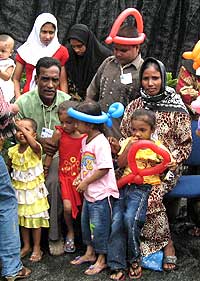
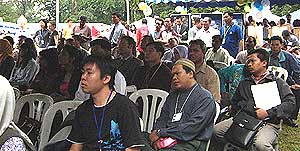
In an effort to show Malaysia the plight of refugees, United Nations High Commissioner for Refugees (UNHCR) organised a carnival at its grounds at Bukit Petaling this morning, bringing together 200 refugee families living in Malaysia.
 This group of people, made up of Acehnese, Myanmarese Chins and Rohingyas, are usually 'invisible' in society because they cannot get formal employment, hence many live and work in the shadows.
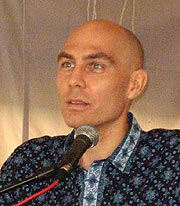
But Malaysians, insisted UNHCR representative Dr Volker Turk (right), have a very strong humanitarian tradition and are 'great' when it comes to dealing with refugees.
"The cooperation with the government is very constructive, we have seen very positive engagement on the part of the government with refugee issues," he said.
Over the past two years, added Turk, there has been a lot of tangible progress in UNHCR's work with the Malaysian government, particularly in Ops Tegas last year when UNHCR set up a hotline for the authorities to verify refugee documentation with them.
Asked about the risk of arrest refugees face in Malaysia, which has not signed the refugee convention, Turk said UNHCR has informal arrangements with law enforcement authorities here to protect refugees.
"There is an understanding that people who are documented by us would not be arrested in connection with immigration proceedings, which is in line with international standards," he said.
 Turk hoped Malaysia could be at the forefront in matters concerning refugee protection, especially in a region where only the Philippines, Cambodia, and Timor-Leste have signed the convention.
On whether Malaysia's reluctance to sign the convention is a major stumbling block against UNHCR's efforts in Malaysia, Turk agreed that it would be better if Malaysia ratified it because the convention provides a framework within which refugee protection can be done.
"It (refugee convention) also talks about responsibilities of refugees, not just their rights and the responsibilities of states," he said.
Turk also acknowledged that the possibility of Malaysia ratifying the convention may take a while as this would require much more discussion between UNHCR and the government.
Living, barely
Currently, refugees holding genuine UNHCR documentation still cannot get employment legally and Turk described this as a major problem refugees face in Malaysia, although there are companies that have enquired UNHCR about recruiting them.
"I think there is, obviously, labour shortage here, especially in areas where refugees are now working informally - construction, plantations, restaurants. These are jobs Malaysians are not keen to take," he said.
Turk added that by allowing refugees to work legally, Malaysia would not only be solving a labour issue but also demonstrate well in humanitarian terms.
 "Of course there is the pull factor argument, would attract more (illegal immigrants)? But I think that concern, which is a legitimate concern, can be addressed, but it needs to be managed very well," he said.
Education is another issue UNHCR hoped to get response from the government as there are three thousand refugee children especially from the Rohingya community who do not have access to formal education.
Turk said for now, some NGOs have provided educational facilities but it could not cover the whole population.
As of January 2006, there are some 45,000 refugees registered with UNHCR in Malaysia.
"UNHCR conducts a very thorough interview, and we have to investigate whether their stories are correct [...] to determine whether someone fulfils the definition of a refugee," he said, adding that refugees should not be confused with economic migrants, because refugees cannot go back to their home country.


Are you sure you want to delete this comment?
This action cannot be undone.