
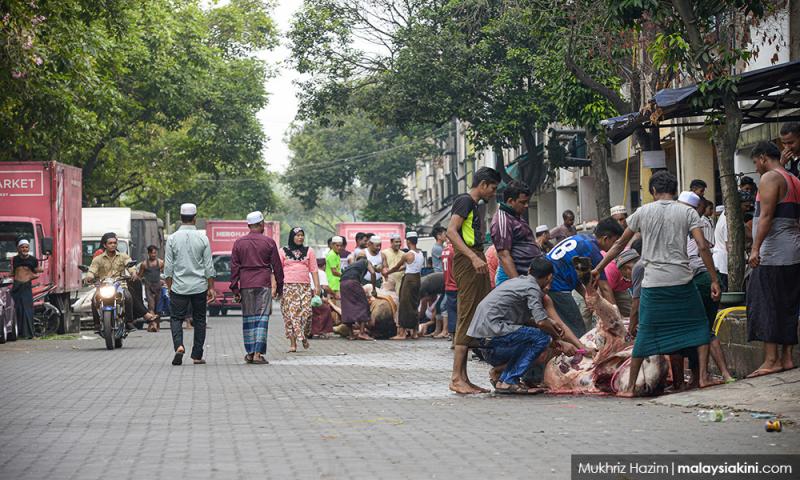
Mosque ban on foreigners raises concern ahead of Hari Raya Haji celebrations
The ongoing ban against foreigners to enter mosques has raised concerns that they would be left out in the distribution of meat from animals sacrificed in conjunction with the upcoming Hari Raya Haji celebrations.
De facto Religious Affairs Minister Zulkifli Mohamad Al-Bakri told Malaysiakini that despite the restrictions, there is still room to find a solution on how the distribution will be carried out.
"Insya-Allah, we will try to...
The ongoing ban against foreigners to enter mosques has raised concerns that they would be left out in the distribution of meat from animals sacrificed in conjunction with the upcoming Hari Raya Haji celebrations.
De facto Religious Affairs Minister Zulkifli Mohamad Al-Bakri told Malaysiakini that despite the restrictions, there is still room to find a solution on how the distribution will be carried out.
"Insya-Allah, we will try to distribute to all, and we have a solution.
"In fact, it's not just them (foreigners). Even for us based on new norms, there will be slight changes in procedure to carry out the animal sacrifice," he said.
"We will announce the solution ahead of the Hari Raya celebration," Zulkifli said when met after attending an appreciation ceremony at Kolej Profesional Baitulmal in Kuala Lumpur.
Quizzed further, the minister said the announcement can be expected in one or two days.
There are concerns that this year, migrants - including refugees - might be left out of the meat distribution process, while in previous years they would flock their local mosques to collect their share of the sacrificed animals.
This concern comes after a restriction against foreigners from entering mosques here, enforced since the beginning of the movement control order (MCO) on March 18.
Aside from private properties, the annual animal sacrifice is also carried out in mosques.

In some areas, recipients will collect their share at a mosque, while certain mosques would take the initiative to distribute the meat from house to house.
In Penang, foreigners are forbidden from participating in the slaughtering of animals or meat processing at their local mosques.
According to Penang mufti Wan Salim Wan Mohd Noor, the decision was made at a recent meeting of the state's mosques and surau development committee.
However, Wan Salim told Malaysiakini that the mosques' management can take their own initiative to distribute the meat to migrants in their various communities.
As for Kelantan mufti Mohamad Shukri Mohamed, he said the issue does not really arise in the state as there is a very small number of migrants there.
He said it is customary for the ritual sacrifice to be performed at home, aside from at local mosques or those carried out by the Kelantan Islamic Council.
For the sacrifices performed at mosques, Mohamad Shukri explained that a coupon system is used for the distribution of meat, and the target recipients, particularly the needy, have been identified.
"So I don't think the issue arises in Kelantan," he told Malaysiakini.
The beginning of MCO saw a ban on all religious activities at all houses of worship, but restrictions have largely been lifted.

Foreigners are however still banned from entering mosques and Zulkifli (photo) had earlier this month hinted that it might take another one or two months before the restriction is lifted.
Based on standard operating procedures set by Jakim, the annual animal sacrifice is allowed to be performed at all mosques and permissible areas in the Federal Territories.
This however comes with restrictions including maximum participation of 250 people, with 30 to be in charge of slaughtering and processing one cow.
Each state, however, has put in place its own procedures. In Melaka, recipients are not allowed to personally collect their share of sacrificed meat, which would instead be distributed to their homes.
Muslims around the world will be celebrating Hari Raya Haji on July 31.


Are you sure you want to delete this comment?
This action cannot be undone.