




IPCMC forum a letdown
The Royal Malaysia Police blew the first chance they had Thursday evening to personally tell their side of the story on the proposed Independent Police Complaints and Misconduct Commission (IPCMC).
The Royal Malaysia Police blew the first chance they had Thursday evening to personally tell their side of the story on the proposed Independent Police Complaints and Misconduct Commission (IPCMC).
Inspector-General of Police (IGP) Mohd Bakri Omar turned down an invitation to speak at a public forum "Independent Police Commission (IPCMC): Yes or No?" organised by the Bar Council in Kuala Lumpur.
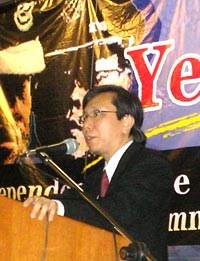 "He also declined to send a representative saying that the matter has been left entirely to the government (to decide)," said council chairperson Yeo Yang Poh in his opening remarks at the Selangor Chinese Assembly Hall.
However, the scheduled appearance of Malaysian Ex-Policemen Association vice-president Abd Malek had raised hopes of a heated debate over the contentious proposal.
But that was also not to be because a few days earlier, he had verbally informed the organiser of his withdrawal.
Another scheduled speaker, Parti Keadilan Rakyat (PKR) Youth chief Mohd Ezam Mohd Noor, was also absent due to a flight delay from Jakarta where he was involved in tsunami aid work.
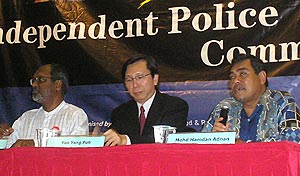
So, the panel that finally took to the stage last night comprised lawyer-politican R Sivarasa and former human rights commissioner Prof Mohd Hamdan Adnan, with Yeo chairing the session.
Sivarasa voiced concerns over which version of the draft IPCMC the government would proceed with.
"It would be interesting to see what form the IPCMC will take when it's finally set up because it remains unclear what the police have agreed to," he said, referring to deputy IGP Musa Hassan's recent statement expressing support.
Political implication
Sivarasa, who is PKR vice-president, felt that the issue was not detached from the prevailing political situation and reminded participants that police reform did not end with the IPCMC.
"The reform should also address the racial imbalance in the composition. The face of the force should reflect the Malaysian reality of a multi-racial society.
Acknowledging the shortcomings in personnel, equipment and infrastructure, he urged the police to "stop being political instruments of the government and go back to being a professional force".
 "There are an estimated 20,000-30,000 Special Branch officers (out of a total 80,000-member force). No wonder snatch thieves are walking around with smiles because SBs are busy attending talks such as this," he said to laughter and applause from the floor.
"Another 4,000-5,000 are FRU (riot police) personnel. But we don't need this many because Malaysia does not have demonstrations every day. There is no effective policing due to all these factors."
Undeniable truth
Earlier, a 15-minute video presentation showed powerful images of police brutality collected over the years during demolition exercises of squatter colonies in Kampung Selayang Bahagia and Taman Aman, and at various other peaceful demonstrations in the city.
It also featured newspaper clippings on fatal police shootings, custodial deaths and ill-treatment of detainees sharply contrasting with TV news footage of the unveiling of the new police motto which included the word 'mesra' (friendly).
The main objection to the IPCMC hinges on the fact that if established as per the recommended draft, it would have a lot of clout and be much more powerful than the police particularly the investigation methods and tools.
Drawing on his three-term experience with the Human Rights Commission of Malaysia (Suhakam), Hamdan stressed on the importance of the IPCMC having "real power".
"Otherwise, it will be another window-dressing Malaysia does not need. The proposal is timely and the public support is crucial in making this a reality."
Of the total complaints to Suhakam, Hamdan, who had headed the complaints and public inquiry working group, said 60 percent were against the police.
During the question-and-answer, several points in the IPCMC draft proposal drew a mixed reaction, particularly the absence or lack of gender sensitivity, provisions to protect migrants workers and whether Rela (People's Volunteer Corps) would come under the watchdog.
People's stories
Comments from the floor were recollection of unsavoury, intimidating and abusive encounters with the police, both verbal and physical.
"Reports are lodged all the time but there is never any follow-through. Complainants are left wondering about the outcome, if there is any," said a participant.
Another recounted with anger his experience of being shouted at and threatened while trying to help a youth being assaulted by police near ex-deputy premier Anwar Ibrahim's house just before he was arrested in 1998.
Yet another candidly described the police as "more like licenced gangsters" and referred to their plight of low income and shortage of resources which resulted in them being far below par compared with their English counterpart earning a respectable salary.
Approached later, Yeo said the council had plans to hold similar public forums in other states as part of an awareness programme and to garner wider mass support.
"We first want to concentrate on getting the organisational and individual support shown through signatures which we hope to submit before Merdeka day on Aug 31."
A total of 10,000 individuals have signed the petition with another 200 organisational endorsement.


