




US FTA: Group is sceptical of success
A Penang-based non-profit organisation is sceptical about Malaysia's ability to thwart advances of the US through 'standard-format' demands in the ongoing Free Trade Agreement (FTA) negotiations.
A Penang-based non-profit organisation is sceptical about Malaysia's ability to thwart advances of the US through 'standard-format' demands in the ongoing Free Trade Agreement (FTA) negotiations.
Although the government has vowed to protect national interests, Third World Network (TWN) legal advisor Lim Li Lin noted the unaltered 'template' of US demands in other countries.
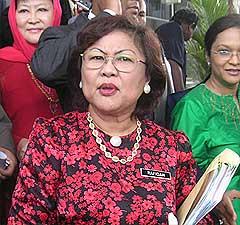 Asked to comment on International Trade and Industry Minister Rafidah Aziz's assurances that Malaysia "will not accept any agreement that does not contain adequate flexibilities and safeguards".
In welcoming the assurances, Lim said in an e-mail reply to malaysiakini that TWN's analysis of all existing US FTAs showed "little deviation from the 'template' of US demands to other countries".
The minister also gave an assurance that the government would include "longer time frames for liberalisation of sensitive products and the services sector".
"These have very far-reaching and wide-ranging consequences, for example, by benefiting multinational drug companies that own patents at the expense of the public's right to affordable medicines."
She said the government also risked direct legal action from US companies if profits are "damaged by a policy which is in the interests of Malaysian citizens".
Under pressure
MITI's statement on the Malaysia-US FTA talks, issued on June 28, continues to raise concerns that the government may buckle under pressure given the US' position as Malaysia's largest trading partner and foreign investor.
It has also been posted on the TWN website .
Rafidah issued the statement following exploratory first-round negotiations in Penang in mid-June covering 18 issues including intellectual property rights, textiles and clothing, e-commerce, telecommunications, legal services and environment.
On market access issues, she said that both sides had explored the possibility of "further increasing trade through elimination of remaining tariffs".
"Malaysia submitted it's request for early duty elimination for textile and garments, rubber and wood, ceramics, electrical and electronics, and agricultural products with current duties ranging between five and 32 percent."
"Adequate safeguard provisions" were also requested, allowing for remedial measures should domestic industries suffer from liberalisation.
Sceptical of success
But Lim was less than convinced with this official assurance.
"We are disappointed that the cost-benefit study the minister talked about has not been made public and open to scrutiny," she said, citing Rafidah's reference to "inputs from the private sector".
"Non-governmental organisations and civil society groups were not invited to provide their inputs, and we wonder if other ministries had any role in this study."
She said the government needs to prioritise citizens' interests in all sectors presently under negotiation.
"Only then can we be assured that trade-offs in some sectors which may be against public interest will not be made.
"These should also be openly communicated to the US, and if the US wants more out of Malaysia than Malaysians are prepared to give, then both sides can choose whether or not to continue negotiations, instead of allowing the pressure of negotiations to determine the outcome," she added.
Citing other US FTA talks, Lim said the country's strong demands over pharmaceuticals in negotiations with South Korea in the last round had led to an "abrupt termination" of talks.
 "(But) from our analysis of all existing US FTAs, the government's expectations of this FTA are overly optimistic," she opined.
"There are many legal limitations to what the US can actually give, and so the playing field is likely to remain uneven for Malaysian companies in the US, even after an FTA."
Rafidah reportedly said that Malaysia will not sign anything with the US "if the conditions are not beneficial or right for the country".
Other deals
Lim, quoting a Bernama report from Washington, said US businesses were reluctant to grant market access to Malaysian rubber- and palm oil-based goods because they felt threatened.
Much of Malaysia's aspirations under the FTA, she said, was possible through other forms of trade cooperation particularly when the FTA appears to greatly favour US investors.
"Malaysia should continue to pursue its own progressive liberalisation agenda at its own pace and in its own way instead of locking it into an FTA with the US that is open to legal challenges."
Discussions on several sectors are in the preliminary stage of ascertaining the scope.
"Malaysia wants information sharing, technical cooperation and training to build capacity in enforcement of international agreements to be the primary objective of any agreement in (environment, competition policy and intellectual property rights)," read Rafidah's statement.
At the Penang round, the Malaysian delegation led by the MITI secretary-general comprised 128 officers from various government agencies, and representatives of industrial bodies and professional services.
The second of five scheduled rounds of Malaysia-US talks began on July 17 in Washington and will conclude tomorrow.
"However, Malaysia will seek whatever time frame that is necessary to negotiate an agreement that would benefit Malaysia," was Rafidah's final assurance.
The subsequent rounds of talks on Sept 17, Oct 30 and Dec 11 are scheduled for completion before the expiry of the US Trade Promotion Authority in June 2007.


