




PM's gag order a 'disappointment'
A local think-tank and an international human rights watchdog today decried Prime Minister Abdullah Ahmad Badawi's gag order Tuesday on public discussions pertaining to religious freedom, and Islam's status in particular.
A local think-tank and an international human rights watchdog today decried Prime Minister Abdullah Ahmad Badawi's gag order Tuesday on public discussions pertaining to religious freedom, and Islam's status in particular.
Centre for Public Policy Studies (CPPS) found the official position taken on open discourses disappointing and hoped that it will be lifted soon.
 "(We hope) the present decision is only a temporary one," said its chairperson Ramon Navaratnam in a statement e-mailed to
malaysiakini
.
"(We hope) the present decision is only a temporary one," said its chairperson Ramon Navaratnam in a statement e-mailed to
malaysiakini
.
"We call on the government to reconsider its decision based on an open, full and fair assessment of what has taken place with regard to the forums conducted by Article 11.
"It is not the Article 11 group that is intentionally stirring up anger and tension but rather the small group of intolerant religious extremists that are bent on silencing them and coercing and intimidating the great majority of right-thinking and fair-minded people with their authoritarian tactics."
He quoted Abdullah's recent statement that Islam Hadhari would "showcase Islam as a tolerant and caring religion".
"Among the guiding principles if Islam Hadhari are to foster a free and liberated people and to ensure the protection of the rights of minority groups."
 Ramon said the overall situation including the roles played by both the proponents and detractors of the public forums should have been analysed prior to issuing the order.
Total intolerance
"We strongly support the government in standing firmly behind the principles of the freedom of speech and assembly as enshrined in the Constitution, to not to give in to intolerant extremist groups, and to protect and not undermine or diminish the right of Article 11 and other similar organizations to exercising their democratic rights and freedoms."
The Article 11 coalition comprises 13 activist groups with a declared mission of upholding constitutional rights of all citizens.
Yesterday, Muslim non-governmental oganisations and PAS lauded the decision as long-overdue while the Article 11 group, which has been on a road show explaining Malaysians' constitutional rights, is seeking a meeting with Abdullah.
Ramon said the order had mistakenly assumed that public discussion of fundamental liberties would result in racial or religious tension.
"We would like to point out that these forums are not related in any way to the proposals to establish an Inter-Faith Commission (IFC)," he said, adding that the Article 11 road show was not about promoting inter-faith dialogue.
Truth is out there
He said the actual substance of the discussion on the constitutional guarantees had been manipulated and distorted by a small group of extremists to imply an attack on the position of Islam in the Federal Constitution.
"Nothing can be further from the truth. The three forums (so far) have sought civil and rational discussion on crucial issues of fundamental liberties and rights."
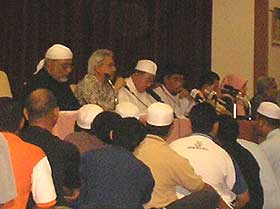
The forums have been held in Kuala Lumpur and Melaka, aborted in Penang after aggressive protests outside the venue and forced to end earlier than scheduled in Johor Baru last Saturday although the proceedings were wrapped up in time and without any incident.
 Banning open dialogue, he said, not only violated constitutional rights on free speech but also directly contradicted with Islam Hadhari principles and values.
He said it was timely and important for Abdullah to lead the Islam Hadhari view of a tolerant, self-confident and progressive religion.
"(It should not be) one that is being hijacked by intolerant religious hardliners determined to impose their narrow and bigoted agenda, insecurities and interests on Muslims and non-Muslims alike.
"We also fear that this regressive move will encourage other minority groups of extreme views to pressure the government to alter policies according to their own interests and bring about a retreat on the upholding of basic liberties."
Ramon also noted with concern the grip extremist groups appear to have on the government.
"That extremist groups can so easily influence the country's key socio-political policies and fundamental liberties will not say much about the government's commitment to equally protecting the rights and freedoms of all groups."
Free speech?
Adding his comments, the centre's public policy studies director Dr Lim Teck Ghee said it was important for all organisations to support free speech.
"It is important for all to stand firmly behind the freedom of speech, assembly and associations as enshrined in the constitution and to call on the government not to give in to the minority voices of repression and authoritarianism which have sought to muzzle Article 11 and that if encouraged by passivity from our public, will seek to further diminish the democratic rights and freedoms of all Malaysians."
 Amnesty International (AI) executive director Josef Roy urged the prime minister to respect freedom of expression and opinion.
"While there has been a lot of public concern on issues pertaining Article 11 and other relevant provisions that deal with rights and freedom, we are disappointed that the PM has resorted to sweep this matter under the carpet.
"His intervention seems to reflect a sliding effect on the development of freedom of expression in this country," he said in a statement.
He said Article 19 of the Universal Declaration of Human Rights provides the "right to hold opinions without interference and to seek receive and impart information and ideas through any media regardless of frontiers".
"This call (order) is seen to further deprive the public the right to receive, understand and form opinions over the position of rights and freedoms guaranteed in the Constitution," he said.
Abdullah, he added, should foster healthy public debate on matters pertaining to human rights and respond to concerns raised by citizens.


