



COMMENT | Comprehensive forest policy needed
COMMENT | This year commemoration of the International Day of Forests has a special significance for Malaysia. The country finally has a national policy in its real sense, albeit geographically.
The Malaysia Forestry Policy approved at the 78th National Land Council meeting in January is the first policy document on forest matters that covers the three regions of the country – Peninsular Malaysia, Sabah and Sarawak.
Prior to this, little known to the public, the nine-page National Forestry Policy 1978 (amended 1992) only relates to the peninsular region.
Another significance of the policy is the reported inclusion of the much-touted 50 percent forest cover pledge made at the Rio Earth Summit in 1992. After nearly 30 years, this moral commitment is finally enshrined in an official policy document.
The good news is that, despite this delay, the country has succeeded in maintaining forest cover over 55.3 percent of its terrestrial landmass.
Thus far, the policy has yet to be made public. Up to yesterday (March 20), the Ministry of Energy and Natural Resources has yet to upload the policy on its website.
Having the target in black and white is only the first step. It remains to be seen if the policy includes any additional operational mechanism...
COMMENT | This year commemoration of the International Day of Forests has a special significance for Malaysia. The country finally has a national policy in its real sense, albeit geographically.
The Malaysia Forestry Policy approved at the 78th National Land Council meeting in January is the first policy document on forest matters that covers the three regions of the country – Peninsular Malaysia, Sabah and Sarawak.
Prior to this, little known to the public, the nine-page National Forestry Policy 1978 (amended 1992) only relates to the peninsular region.
Another significance of the policy is the reported inclusion of the much-touted 50 percent forest cover pledge made at the Rio Earth Summit in 1992. After nearly 30 years, this moral commitment is finally enshrined in an official policy document.
The good news is that, despite this delay, the country has succeeded in maintaining forest cover over 55.3 percent of its terrestrial landmass.
Thus far, the policy has yet to be made public. Up to yesterday (March 20), the Ministry of Energy and Natural Resources has yet to upload the policy on its website.
Having the target in black and white is only the first step. It remains to be seen if the policy includes any additional operational mechanism. As understood, forests and the land where they are located comes under the respective states’ jurisdiction.
As it stands, the distribution of forests varies among states. In terms of geographical regions, the forest coverage percentages are 43.6 for Peninsular Malaysia, 64.5 for Sabah and 62.3 for Sarawak. Given the economic development and population concentration, it is unsurprising that Peninsular Malaysia has lost more than half of its forests.
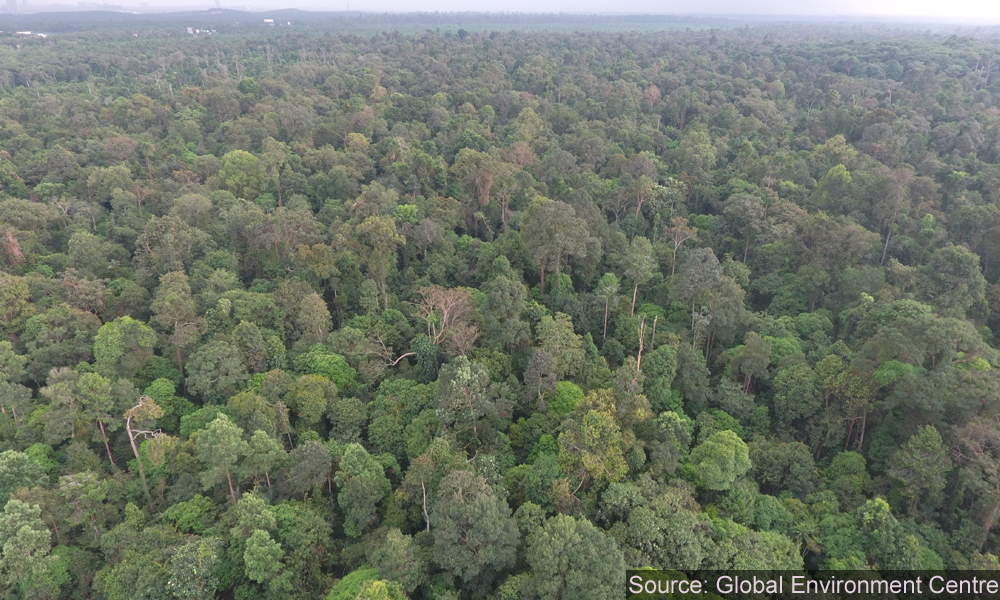
Over the past few years, some states had indirectly declared their contribution to the national pledge. For example, as the most industrialised state, Selangor set a target of at least 30 percent. Sabah has declared at least 50 percent in its latest policy launched in 2018.
In the long-run, the challenges of maintaining the pledge will only increase. The demand for land for infrastructure development is expected to increase in Sabah and Sarawak as well as states on the east coast of the peninsular. Plans to exploit minerals such as rare earth deposited in the forest reserves is undoubted pressure on the quest to maintain a high forest cover.
Therefore, it is high time that policy-makers develop a far-sighted, comprehensive plan which could include a burden-sharing mechanism among the states or regions.
Already, we are witnessing conflicts with states having more forested land demanding compensation for the ecosystem services such as surface water supplies from rivers that flow across states’ boundaries.
Another inevitable consideration, perhaps, would be a relook at the target. This would be tricky and contentious as Malaysia has been struggling to handle the long-standing disinformation campaign on deforestation accusations which adversely affect its commodity industries.
Managing the forest well is not merely about the forest cover in what the authorities defined as forests. Degradation of forests, such as converting natural forests into monoculture plantations, will affect the carbon stocks and count towards the country’s emission level.
As precious carbon sinks, the forestry sector is an important component of Malaysia's climate actions for decades to come. Hence, getting the policy right on forests cannot be emphasised further and should be accorded the needed urgency.
HILARY CHIEW is a freelance environmental consultant with special interests in forests and climate change.
The views expressed here are those of the author/contributor and do not necessarily represent the views of Malaysiakini.



Are you sure you want to delete this comment?
This action cannot be undone.