




Azmin's 'casual attitude' to FDI exodus highlights govt disconnect, says Anwar
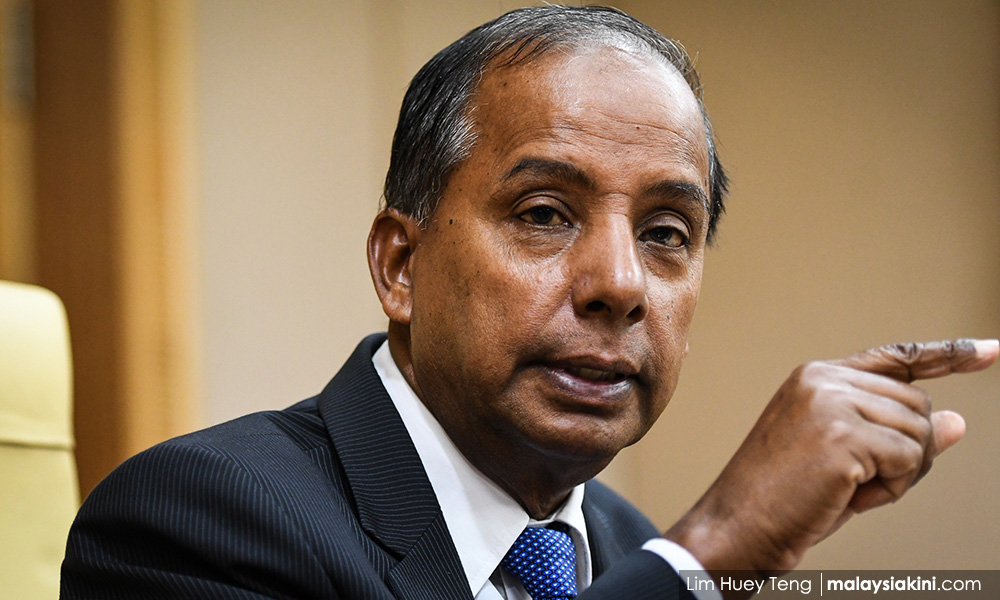
PKR president Anwar Ibrahim has raised concern about International Trade and Industry Minister Azmin Ali’s "casual attitude" over foreign companies shutting operations in Malaysia.
This came after IBM announced that it will close its Cyberjaya Global Delivery Center on May 31, as well as similar announcements from companies moving out of the country such as Hyundai and Panasonic...
PKR president Anwar Ibrahim has raised concern about International Trade and Industry Minister Azmin Ali’s "casual attitude" over foreign companies shutting operations in Malaysia.
This came after IBM announced that it will close its Cyberjaya Global Delivery Center on May 31, as well as similar announcements from companies moving out of the country such as Hyundai and Panasonic.
"The PN government's response to this trend seems to be that it doesn't matter.
"The senior minister overseeing foreign investment said that Malaysia has the luxury of being selective and is seeking high-value investors while turning away the low-value ones," Anwar said in a statement.
Due to the closing of foreign companies' operations, Anwar questioned if the PN government has the ability to address the resulting issue of layoffs which affected the livelihoods of the families involved.
Anwar highlighted the reality which the country is facing from several international reports.
"The United Nations Conference on Trade and Development (Unctad) report in January 2021 stated that FDI into Malaysia plunged by more than two-thirds to just US$2.5 billion (RM10.3 billion) in 2020, making it the worst drop in Southeast Asia.
"The January 2021 comments from the head of the EU-Malaysia Chamber of Commerce and Industry also voiced his members' concerns regarding Malaysia as a viable investment destination."
Anwar also noted the December 2020 downgrade of Malaysia's Long-Term Foreign-Currency Issuer Default Rating to 'BBB+' by Fitch citing "lingering political uncertainty following the change in government last March which weighs on the policy outlook as well as prospects for further improvement in governance standards."
In addition to that, he lambasted the government for its "unorthodox manner" in rolling out the 5G spectrum through a government owned Special Purpose Vehicle.
"Arguably a lynchpin in PN's national digital strategy, the RM15 billion project has been subject to zero scrutiny, zero industry consultation, and represents one of the only countries in the world to adopt such an approach.
"With no clarity offered on the terms of the 5G deal, we wonder how many more investors will be looking elsewhere for safer shores," he said.
Opposition politician Lee Chean Chung has also urged the government to disclose the real reason behind why multinational companies are leaving Malaysia.
Lee was unconvinced by Azmin's stance that Malaysia was simply becoming “more selective” in its investment agenda.
“Why is it (when) Azmin is talking about quality investments being established, quality multinational corporations (MNCs) are leaving?
“It is even more unfortunate that until today, the public has not heard any statement or clarification from the PN government regarding their (MNCs) reasons for leaving and additional remedies to address the issue,” the PKR treasurer-general said in a statement today.

The Edge previously reported that US technology MNC IBM will be shutting down its Global Delivery Centre in Cyberjaya at the end of May, seven years after it opened.
It is estimated more than a thousand jobs would be lost.
Last November, German technology firm T-Systems sold off its Malaysia business to a private investment holding company. This reportedly cost 800 jobs.
The UN Conference on Trade and Development (UNCTAD) previously reported that Malaysia suffered the worst drop in foreign direct investment in Southeast Asia in 2020.
The Semambu assemblyperson compared these developments to neighbouring countries Vietnam, Indonesia, and Singapore, where he observed those nations continuing to receive strong foreign investment.
“Azmin and PN’s state-of-denial does not help the government to acknowledge our inherent structural weaknesses... and to identify new growth opportunities to propel the nation to the next level.
“Sugar-coating statements will not help because investors can simply vote with their feet,” he remarked.
Yesterday, Azmin denied that Malaysia was losing out on foreign investment from MNCs to other Southeast Asian countries.
The minister explained that the government was shifting away from “labour-intensive” industries which relied heavily on foreign workers.
Instead, he said Malaysia wanted to focus on “quality” investments that would benefit Malaysians, sharing that the government was in talks with global technology giants Microsoft, Google, and Amazon to build data centres here.
“We would like to welcome foreign investments that can create value (for) the local players. We do not want any future investments that are tied to labour intensive (industries); that is not our priority now. They can choose other countries,” Azmin was quoted as saying by The Edge.
Last December, international ratings agency Fitch downgraded Malaysia’s long-term foreign-currency issuer default rating from A- to BBB+, citing political uncertainty following the Sheraton Move political coup as one of the factors.
Just yesterday, it again expressed concern that political instability was weighing down the ringgit and revised its 2021 average RM/US dollar exchange rate forecast from RM4.05 to RM4.15.




Report this comment
Are you sure you want to delete this comment?
This action cannot be undone.