



MOH finds 8 more local cases of Covid-19 variant 'of concern'
The Health Ministry has identified eight more local cases of a Covid-19 variant that renders some vaccines less effective, bringing the total to 17 cases so far.
This followed the ministry’s follow-up investigation in Sepang and Kuala Langat, Selangor, after announcing the presence of the B.1.351 variant on April 1.
According to the latest statement, three more cases...
The Health Ministry has identified eight more local cases of a Covid-19 variant that renders some vaccines less effective, bringing the total to 17 cases so far.
This followed the ministry’s follow-up investigation in Sepang and Kuala Langat, Selangor after it announced the presence of the B.1.351 variant on April 1.
According to the latest statement, three more cases have been identified in the Kebun Baru cluster, one in the Teknologi Emas cluster and four through contact tracing.
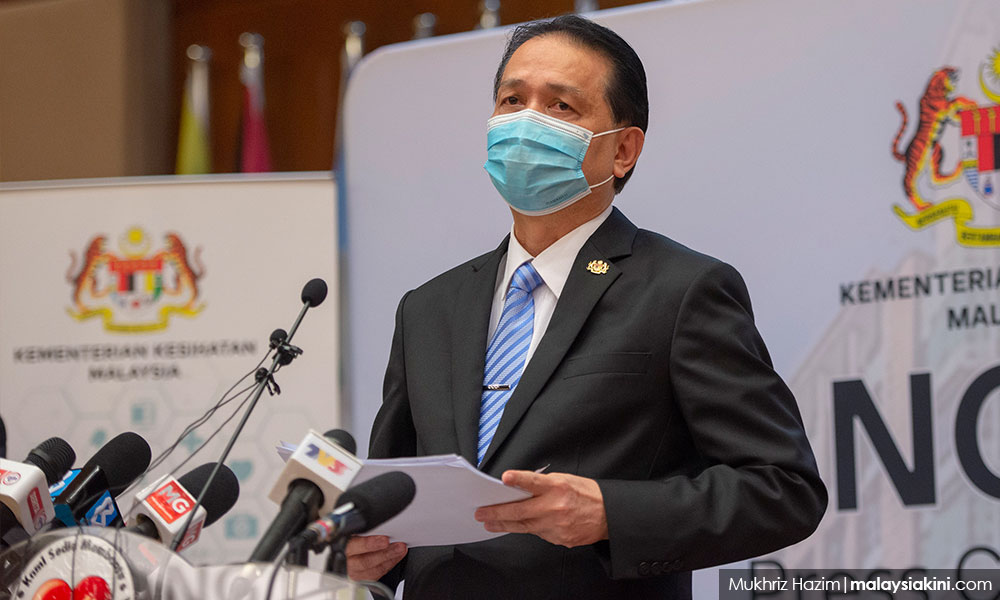
“To date, phylogenetic analysis and geographical links show these cases are likely to have originated from the same source,” said Health Ministry director-general Dr Noor Hisham Abdullah (above) in a statement today.
In his last announcement on the variant two weeks ago, there were three cases in the Jalan Lima cluster and six cases in the Kebun Baru cluster.
The first local case of the B.1.351 variant was identified on March 18, prompting the Health Ministry to intensify genomic surveillance in the surrounding areas after which it uncovered the rest of the aforementioned cases.
For context, the Jalan Lima cluster has 57 confirmed Covid-19 cases to date, while the Kebun Baru cluster has 1,116 and the Teknologi Emas has 251.
Genomic surveillance plays a key part in tracking mutations in the virus that causes Covid-19 especially parts of the virus that may have an impact on the disease’s transmissibility or severity or parts that can affect Covid-19 tests or vaccines.
For the B.1.351 variant, the variant was first detected in South Africa and in the UK and later found in other parts of the world as well.
It is believed to be more transmissible than the original Covid-19 strain that first emerged in Wuhan, China and has a greater propensity to re-infect those with previous Covid-19 infections.
The Covid-19 vaccine developed by AstraZeneca is found to be only 10.4 percent efficacious against the variant. This prompted the South African government to suspend the rollout of the vaccine in February.
Several vaccines are claimed to still protect against the variant, albeit with somewhat diminished efficacy and more testing is still underway. Vaccine makers are investigating ways to deal with emerging Covid-19 variants, such as by offering booster shots or tweaking their vaccine formula.
However, only a small portion of Covid-19 cases around the world are sampled and sequenced for genomic surveillance purposes due to its resource-intensive nature and the need for specialised equipment.

In Malaysia, Noor Hisham said 128 samples were sequenced last year, and another 145 had been sequenced up to April this year for a total of 273 sequences.
For comparison, Malaysia recorded a total of 365,829 confirmed Covid-19 cases as of today.
Imported cases
National Covid-19 Immunisation Programme coordinating minister Khairy Jamaluddin had said Malaysia would ramp up genomic efforts to 3,000 sequences to ensure Covid-19 vaccines deployed in Malaysia would be effective against variants that are prevalent here. He did not provide a timeline for reaching that goal.
Meanwhile, in outlining Malaysia’s Covid-19 genomic surveillance efforts, Noor Hisham said 123 cases (85.8 percent) of the samples that have been sequenced turned out not to be a “variant of concern” (VOC).
He explained that the first wave of Covid-19 infections in the country comprised the Wuhan B ancestral lineage followed by the second wave linked to several clusters, particularly the Sri Petaling cluster.
“Now, with the third wave in Sabah following the Benteng LD cluster, new variants were introduced that carry the D614G and A701V mutations.
“The lineage that is most prevalent during the third wave is the B.1.524 variant that makes up most of the full genome sequences so far,” he said, adding that B.1.524 is not classified as a VOC.
The first two VOC cases in Malaysia were detected on Feb 3, 2021, when the B.1.1.7 variant prevalent in the UK was detected. This was followed by two cases of the B.1.525 variant prevalent in Nigeria, which was detected here on March 5.
However, these cases are imported cases that underwent quarantine upon arrival in Malaysia.
The detection of the B.1.351 variant, as announced today and April 1, was the first time a VOC was found circulating locally in the country.
Noor Hisham again reassured that the Health Ministry would take the necessary action to prevent new Covid-19 variants from spilling over to Malaysia.




Are you sure you want to delete this comment?
This action cannot be undone.