



Group proposes points system to develop G1 bumi contractors
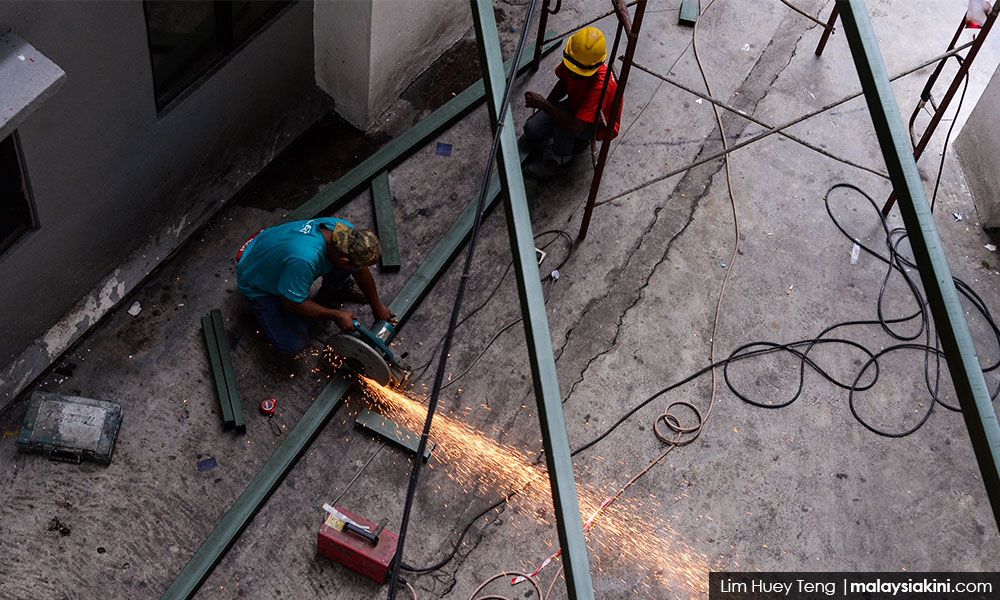
The Institute for Democracy and Economic Affairs (Ideas) has proposed that the government adopt a points system in public procurement to help G1 grade bumiputera contractors to move up to a higher level.
This came after the policy research organisation found that G1 tier contractors account for 63.3 percent out of 66,906 bumiputera contractors, as compare with only 34.5 percent out of 60,482 non-bumiputera contractors.
G1, or formerly known as F-class...
The Institute for Democracy and Economic Affairs (Ideas) has proposed that the government adopt a points system in public procurement to help G1 grade bumiputera contractors to move up to a higher level.
This came after the policy research organisation found that G1 tier contractors account for 63.3 percent out of 66,906 bumiputera contractors, as compare with only 34.5 percent out of 60,482 non-bumiputera contractors.
G1, or formerly known as F-class, refers to contractors who are qualified to apply for construction contracts that are worth below RM200,000.
“The distribution across other tiers is uneven; bumiputera contractors are particularly under-represented at G3 (5.6 percent of total) and G5 (1.9 percent), more so than at the highest grade of G7 (4.3 percent),” read the report dubbed 'Public Procurement and Bumiputera Company Development in the Construction Industry: Reviewing Policies, Exploring Possibilities'.
“We also observe a disproportionately greater presence of G1 contractors in lower-income states, and in rural or mixed rural/urban districts,” said the report.
This is despite Malaysia’s efforts to develop Bumiputera companies through public procurement policy to hold out potentialities and pitfalls, according to the report.
“G1 persists as a comfort zone, even while some do develop capabilities or even graduate upwards to G2 or beyond.”
Guaranteed income
The report stated that these contractors stayed at G1 tier as the works are simpler while the process of securing the contracts are easier. As such, their source of income are guaranteed.
“Moving up in scale corresponds with broadening of technical capacities; within G1, those with a wider set of competencies tend to win contracts more regularly. Specialisation offers another mode of engagement, albeit with a lesser frequency of contracts.
“We propose a points system to be reinforced for the development of bumiputera companies. The highest points can be awarded to new entrants followed by a sliding scale based on time or number of contracts.
“Points can also be awarded for entry into specific grades or specialisations, or adoption of technology, and based on group disadvantage beyond bumiputera status. Generalist and specialist pathways warrant consideration, with appropriate adjustment of terms and rewards, to increase the range of options for contractors to grow their companies,” according to the report.
The report also cited the points system adopted in South Africa, which is implemented in public procurement, licensing, public-private partnerships and sale of state assets.
Ideas also recommended that the government decrease the points scored by the contractors if they stay too long at the lowest tiers.
Currently, the policy limits newly registered G1 licences to a maximum duration of 12 years. For pre-existing G1 companies, those that are 20 years or older in 2019 may renew their licence for up to six years, while those 20 years or younger in 2019 may remain at G1 for a maximum total of 26 years since the initial registration date.






Report this comment
Are you sure you want to delete this comment?
This action cannot be undone.