



Aussie authorities review search data following new MH370 lead
Australian authorities are reviewing data from its underwater search for the missing Malaysian Airlines flight MH370, after new leads emerged on its whereabouts.
However, the Australian Transport Safety Bureau (ATSB) said it is not recommending a new search for the aircraft at this time. Any decision on whether further searches would be conducted rests with the Malaysian government.
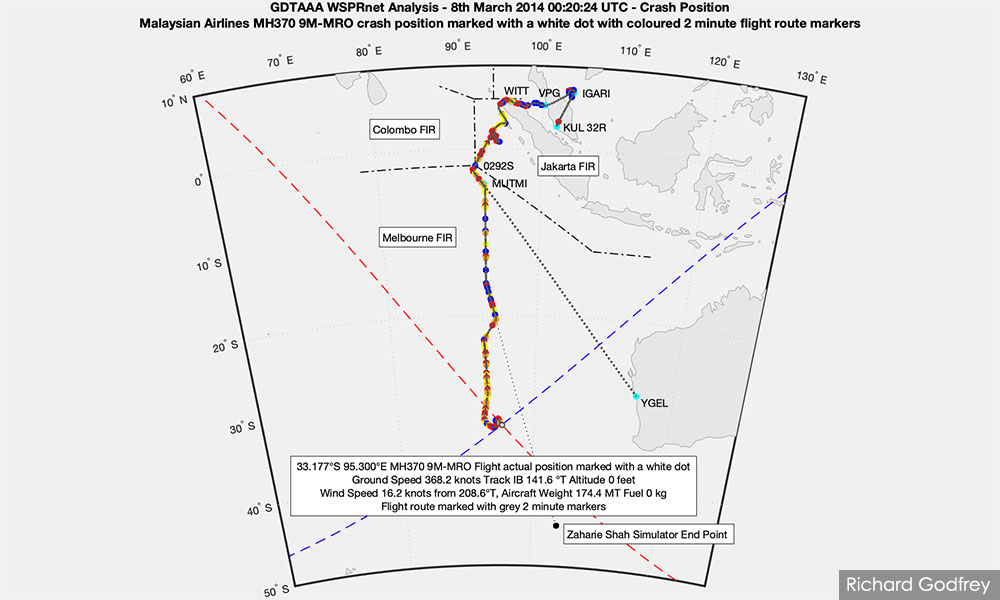
The ATSB statement came following a series of papers last year by the aerospace engineer Richard Godfrey, who claims to have deduced the aircraft’s flight path leading to a location in the Indian Ocean.
The latest paper dated Dec 31, 2021, places the aircraft's location in the northern part of earlier underwater search efforts. It was deduced by analysing anomalies in the WSPRnet amateur radio network, determining which ones may have been caused by interference from MH370, and corroborating it with other data.
In the ATSB statement today, the bureau’s chief commissioner Angus Mitchell said the ATSB had already searched a “significant portion” of the search zone that Godfrey recommended.
“When the ATSB was made aware that Godfrey’s zone incorporates an area of ocean surveyed during the ATSB-led search, out of due diligence the ATSB requested Geoscience Australia review the data it held from the search to re-validate that no items of interest were detected in that area,” he said.
The review is expected to be finalised in the coming weeks and the findings will be made publicly available.
Mitchell added that while Godfrey is a credible expert on MH370, the ATSB lacks the technical expertise to assess his papers and workings on MH370’s likely flight path.
“As such, the ATSB cannot offer an assessment of the validity of Godfrey’s work using WSPR data,” he said.
Nearly 8 years missing
MH370 took off with 239 people on board from Kuala Lumpur International Airport to Beijing on March 8, 2014, but mysteriously turned towards the Indian Ocean instead after its equipment for facilitating tracking via civilian radar was disabled.
It is presumed to have crashed somewhere thousands of kilometres west of Perth, along a wide swath that became known as the “Seventh Arc” based on satellite metadata.
Fragments of the aircraft have washed ashore in various places, but three years of underwater search efforts for the main wreckage came back empty-handed. It was reported that the search had cost around A$200 million (RM680 million) that was mostly borne by the Malaysian government.
An investigation determined that the aircraft controls were likely deliberately manipulated, but no firm conclusion can be reached unless the wreckage is found.






Are you sure you want to delete this comment?
This action cannot be undone.