


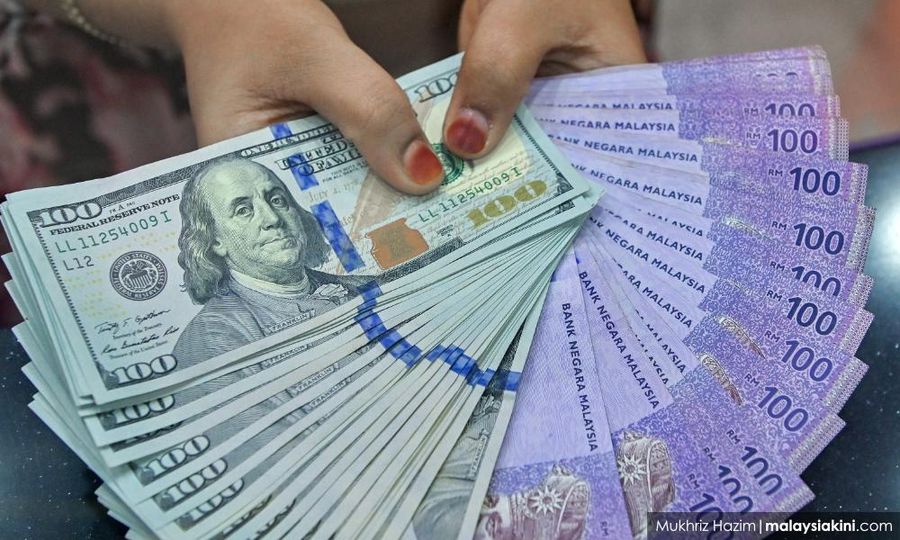

Ringgit slumps as most other Asian currencies also fall
This comes as most Asian currencies weakened today, with the Indonesian rupiah hit by recession concerns.
The ringgit dropped as much as 0.5 percent to trade at RM4.670 to the dollar, its lowest since...
The ringgit slumped to a new 24-year low after the Parliament was dissolved for snap elections.
This comes as most Asian currencies weakened today, with the Indonesian rupiah hit by recession concerns.
The ringgit dropped as much as 0.5 percent to trade at RM4.670 to the dollar, its lowest since January 1998. Stocks also dropped as much as 1.6 percent to their weakest since May 2020.
Prime Minister Ismail Sabri Yaakob announced yesterday the dissolution of Parliament, paving the way for an early election to be held, aiming to win a stronger public mandate.
“A strong mandate would be helpful, but the ringgit will ultimately depend on the priorities of the new government,” said Wei-Liang Chang, an FX and credit strategist at DBS.
“Markets will want to see increased fiscal consolidation, more pro-growth policies, on top of a greater openness to trade and investment.”
The election is to be held within 60 days of the dissolution of Parliament. Analysts at Maybank said this period will likely see the currency remaining under pressure, not helped in the least by buoyant US Treasury yields and the global growth slowdown.
Investors fear that the ongoing monetary tightening cycle in the United States and other major economies, the fastest pace of tightening in several decades, may end up tipping the global economy into a recession.
Bond yields rose for the fourth straight session in Indonesia, with yields last seen at 7.296 percent. The rupiah lost 0.3 percent.
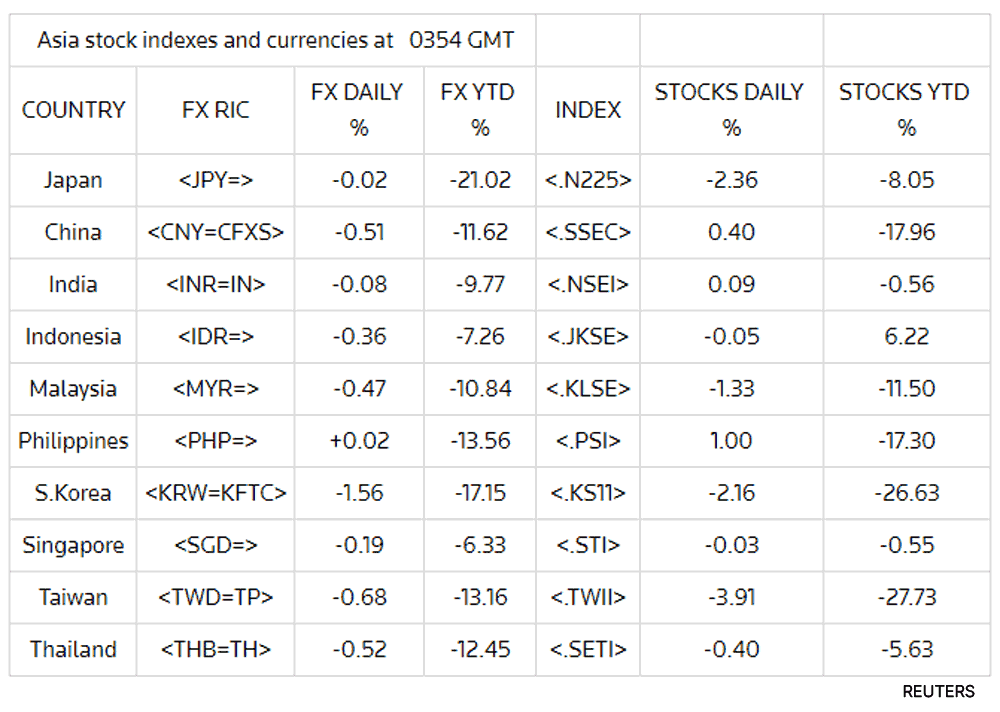
The South Korean won traded about 1.8 percent lower at ₩1,437.3 to the dollar, while the country's main stock index trended 2.2 percent lower. Korean markets returned from a holiday yesterday and were catching up on the day's sell-off.
Baht, SGD weaken
Broader sentiment across the region was also negative, with the Thai baht and Singapore dollar weakening 0.5 percent and 0.2 percent, respectively, bogged down by persistent concerns over global growth and fears of a recession.
The Philippines' trade deficit for August came in at a record $6 billion, with imports rising 26 percent, compared with an ING estimate of 22 percent. The peso, however, was broadly unchanged.
Markets also await US inflation data due late on today. Analysts expect headline inflation to have pulled back slightly in September.
China's yuan fell 0.5 percent against the dollar amid US restrictions aimed at stifling China's semiconductor industry and repeated Covid-19 restrictions clouding the outlook for its economic growth.
US stocks fell yesterday, with the negative sentiment broadly tied to chipmaker stocks and global growth worries.
“Smaller falls in the US equity market yesterday suggest the selling momentum may be running out of steam again,” analysts at ING said.
Stock markets in Asia were mixed, with major stock indices in the Philippines and China rising 1 percent and 0.4 percent, respectively, while those in Taiwan and Thailand fell 3.9 percent and 0.4 percent, respectively.
- Reuters





Report this comment
Are you sure you want to delete this comment?
This action cannot be undone.