


/file/publisher-c1a3f893382d2b2f8a9aa22a654d9c97/2022/09/1f139e2baf4bb3afe71eae747afd3a33.jpg)

Chief justice: We did our duty, up to Najib to go to UN
Chief Justice Tengku Maimun Tuan Mat said the judiciary has discharged its duty in dismissing Najib Abdul Razak’s appeal, so it is up to the former prime minister if he wants to air his grievances to the United Nations.
She said the judiciary is not affected by Najib’s petition to the UN Human Rights Council Working Group on Arbitrary Detention (UNWGAD) over his alleged “arbitrary detention”.
“He can do what he wishes...
Chief Justice Tengku Maimun Tuan Mat said the judiciary has discharged its duty in dismissing Najib Abdul Razak’s appeal, so it is up to the former prime minister if he wants to air his grievances to the United Nations.
She said the judiciary is not affected by Najib’s petition to the UN Human Rights Council Working Group on Arbitrary Detention (UNWGAD) over his alleged “arbitrary detention”.
“He can do what he wishes as we had discharged our duty and responsibility.
“Whatever avenue he wishes to explore, that is beyond us. It is up to him what he wishes to do,” Tengku Maimun told a press conference on the sidelines of the Opening of Legal Year 2023 at Putrajaya International Convention Centre (PICC).
Tengku Maimun was part of the five-person Federal Court bench that dismissed Najib’s appeal to quash his guilty verdict as well as a 12-year jail term and RM210 million fine in the RM42 million SRC International corruption case in August last year.
She was responding to a media query over Najib filing the petition on Jan 5.
Najib’s application to review the judicial verdict is set to come up for hearing before a new quorum of the Federal Court in Putrajaya on Jan 19, as well as a pending petition for a royal pardon.
During the press conference on Jan 5, Najib’s lead defence counsel Muhammad Shafee Abdullah said they filed the petition to get UNWGAD to ask Malaysia for a release or retrial of Najib in the SRC case.
The lawyer said Najib is seeking the UN body’s panel of five experts on international justice to rule that the Malaysian apex court’s dismissal of his appeal was “unjust, flawed, and violated his basic human rights and the Federal Constitution”.
Shafee claimed that the Federal Court did not give Najib’s lawyers sufficient time to prepare for the appeal by allowing an adjournment of the appeal hearing.
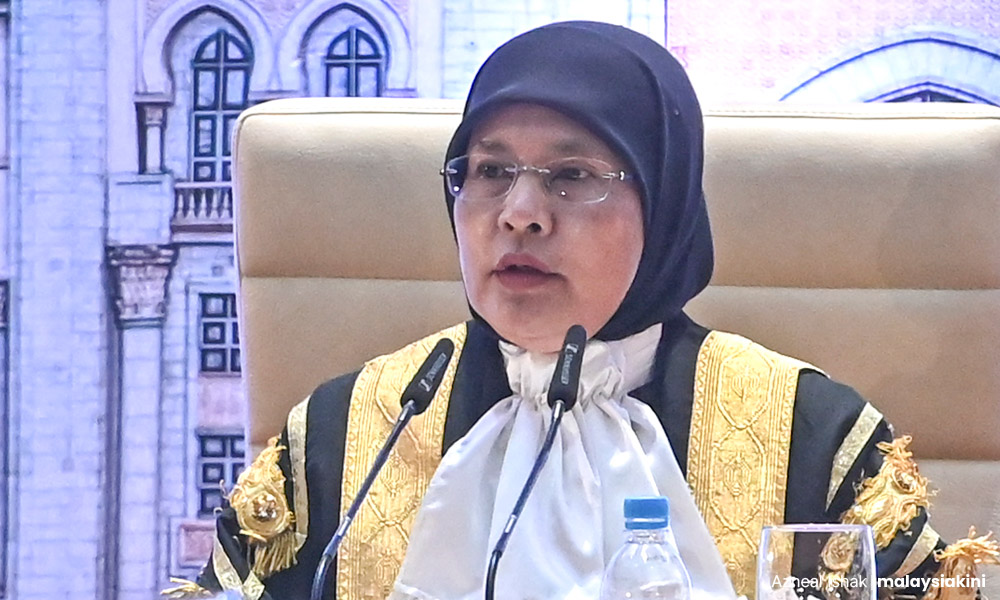
During the media briefing this afternoon, Tengku Maimun said Najib’s SRC review hearing on Jan 19 will proceed as planned despite several vacancies in top judicial posts.
This is because the apex court quorum to hear the review is not affected by the vacancies, she added.
She confirmed that candidate names have been sent to the prime minister as well as the Conference of Rulers for their green light.
She added that the Judicial Appointment Commission (JAC) has sent names to the Prime Minister’s Department since the time of then premier Ismail Sabri Yaakob and right up to current Prime Minister Anwar Ibrahim.
Last year, Rohana Yusuf and Azahar Mohamed retired as Court of Appeal president and chief judge of Malaya respectively. There were also vacancies for two Federal Court judges and nine Court of Appeal judges.
At present, Chief Judge of Sabah and Sarawak Abang Iskandar Abang Hashim and Federal Court judge Mohamad Zabidin Mohd Diah are acting Court of Appeal president and chief judge of Malaya respectively.
Judicial appointments
Meanwhile, in response to the Conference of Rulers decree on Nov 30 last year that JAC should be free from the influence of the prime minister, Tengku Maimun said the judiciary welcomes any suggestion for improvement.
“We feel that if the JAC Act (is) to be amended or improved further, the provision (regarding) the appointment of judges as enshrined in the Federal Constitution needs to be scrutinised so that the appointment of the judges proposed by JAC and the Federal Constitution is done in tandem.
“In other words, we would not achieve the objective of having the appointment of the judiciary independent from the executive if the existing provision which requires the process of consultation with the prime minister remains,” she said, adding that this can help the possible perception of the public who may desire non-participation of the executive in the matter.
Under the present system, the prime minister can propose five names to be appointed to JAC which oversees the appointment of superior court judge positions in the High Court, the Court of Appeal, and the Federal Court.
Per Article 122B of the Federal Constitution, the appointment of the chief justice, the Court of Appeal president, the chief judge of Malaya and the chief judge of Sabah and Sarawak, as well as the judges of the Federal Court, Court of Appeal and High Court, is done by the Yang di-Pertuan Agong on the advice of the sitting premier.
/file/publisher-c1a3f893382d2b2f8a9aa22a654d9c97/2022/08/d28f1d59f749bf9471a4b91d937938a5.jpg)
/file/publisher-c1a3f893382d2b2f8a9aa22a654d9c97/2022/09/1f139e2baf4bb3afe71eae747afd3a33.jpg)
/file/publisher-c1a3f893382d2b2f8a9aa22a654d9c97/2020/01/34e0fc83e068b40714a7c005e311d3c3.jpg)
/file/publisher-c1a3f893382d2b2f8a9aa22a654d9c97/2022/08/a1b63c9c9bc269fd7f5e8cc4a25d7d3e.jpg)
/file/publisher-c1a3f893382d2b2f8a9aa22a654d9c97/2022/08/c5ddbe51afa5e182f9dcf770e6f3688f.jpg)


Report this comment
Are you sure you want to delete this comment?
This action cannot be undone.