


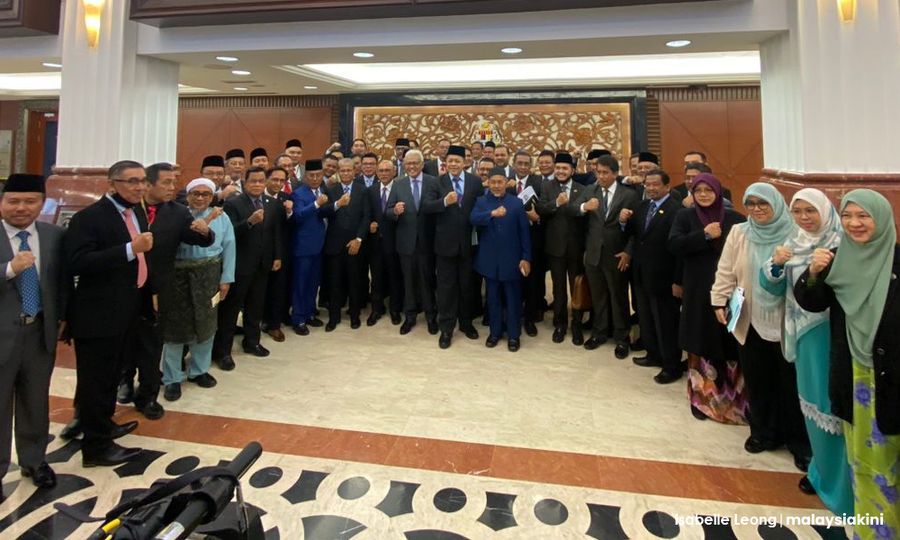

PN MPs stage walkout over EPF withdrawal debate rejection
As the Dewan Rakyat started this morning, Wan Ahmad Fayhsal Wan Ahmad Kamal (PN-Machang) stood up to request a debate on allowing another round of withdrawal despite his motion being rejected by speaker Johari Abdul in writing...
PARLIAMENT | Perikatan Nasional (PN) MPs walked out of the Dewan Rakyat after their proposal to debate the Employees Provident Fund (EPF) withdrawal was rejected.
As the Dewan Rakyat started this morning, Wan Ahmad Fayhsal Wan Ahmad Kamal (PN-Machang) stood up to request a debate on allowing another round of withdrawal despite his motion being rejected by speaker Johari Abdul in writing.

Deputy Dewan Rakyat speaker Alice Lau said the Standing Orders stated that the speaker’s decision is final and she cannot overrule it.
She suggested that Wan Ahmad Fayhsal submit another motion to the speaker or meet with Johari himself later.
This prompted a wave of protests from PN lawmakers, who said the matter of EPF withdrawals is of urgent public interest.
However, Lau did not budge and repeated that she cannot overrule the speaker’s decision.
She then advised the opposition MPs to file an appeal to Johari if they are unhappy with the decision.
Shahidan Kassim (PN-Arau), who submitted a similar motion to the speaker, said he has yet to receive a reply.
He pointed out that there are only two more days left in the current Parliament session and as such, the matter of EPF withdrawals should be debated today.
Following this, PN lawmakers left the Dewan Rakyat en masse.

At a press conference at the Parliament lobby later, Takiyuddin Hassan (PN-Kota Baru) explained that Wan Ahmad Fayhsal’s motion was to refer Prime Minister Anwar Ibrahim to the Parliamentary Rights and Privileges Committee for allegedly misleading the august house by announcing that EPF members can use their savings as collateral for bank loans.
He questioned the speaker’s decision to reject the motion as it fulfilled all three criteria under Standing Order 18(1) - the matter raised is definite, of public importance and urgent.
“Section 51 of the EPF Act is clear - it does not allow this (EPF-backed loans).
“Even legal experts have said that if the prime minister wants to implement this, the act must be amended first,” the PAS secretary-general told reporters.
Section 51 of the act prevents the savings of any EPF member from being assigned, attached, transferred, sequestered, levied upon, for, or in respect of, any debt or claim whatsoever.

On March 21, Anwar, who is also the finance minister, said that the proposal to allow EPF members to use their savings as collateral for bank loans does not breach Section 51 of the EPF Act.
He explained that the government had checked with the EPF and the attorney-general for legal advice on this matter.
Meanwhile, on PN’s next course of action, Takiyuddin said the opposition will inform the public of the government’s policy that is against the law.
“We may conduct a nationwide roadshow to tell the whole country on the policies that the Madani government has.
“We want an explanation from the prime minister. Who was the one who advised him, or was he not advised, or was he wrongly advised? Was it the law minister (Azalina Othman Said) or who?
“This is not something that can be trifled with,” he added.
Among opposition lawmakers who were present at the press conference were opposition leader Hamzah Zainuddin (PN-Larut), Tuan Ibrahim Tuan Man (PN-Kubang Kerian), Mas Ermieyati Samsudin (PN-Masjid Tanah), Saifuddin Abdullah (PN-Indera Mahkota), Nik Muhammad Zawawi Salleh (PN-Pasir Puteh) and Ahmad Fadhli Shaari (PN-Pasir Mas).
However, PAS president Abdul Hadi Awang, who is also Marang MP, was absent.
The lawmakers made their way back to the Dewan Rakyat after the conclusion of the press conference.
No clear policies
Meanwhile, Liew Chin Tong (Harapan-Iskandar Puteri) berated PN for its staged walkout, saying it’s merely an attempt to rile up the people’s emotions.
“PN does not have clear policies. Using the EPF withdrawals as its only economic agenda in Parliament when Malaysia is on the road to economic recovery is a sign of total lack of serious ideas to transform the economy for the majority of Malaysians.
“PN should assist the people by helping the government to face the fundamental challenge of a vicious cycle of low wage, low productivity, low skill and low value-added activities,” the deputy international trade and industry minister said in a statement today.


Report this comment
Are you sure you want to delete this comment?
This action cannot be undone.