
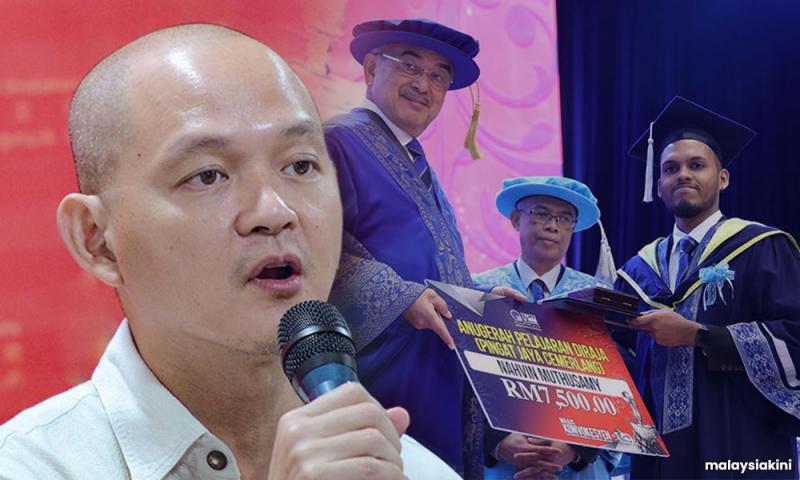
Former MP Ong Kian Ming lauded student Nahvin Muthusamy for highlighting the meritocracy issue at a student award ceremony, saying that he was brave to use the platform to address such topics.

Ong, who is now the Philosophy Politics and Economics programme director at Taylor's University, said Nahvin must have known about the sensitive nature of what he brought up when talking about “unfair” quota systems “and yet he still went on to say what he said”.

“The memory of his friend must still resonate strongly with him and these are personal stories which can motivate people like Nahvin to continue highlighting the injustices faced by minority communities in Malaysia.

“Nahvin must be a well-respected student leader at Universiti Teknikal Malaysia Melaka (UTeM) to be given this award and opportunity to speak.

“One can see that Nahvin is someone who is not afraid of speaking up but in a constructive, calm and deliberative manner,” said Ong, a former two-term MP who served as deputy minister of international trade and industry from 2018 to 2020.

“He can go far as a leader in whichever field he chooses,” Ong added.

He said it was important to note that Nahvin was channelling a feeling that many in the Indian community are facing in Malaysia where they feel that they are being “bullied” but very few people are speaking up on their behalf.

“The field of education is particularly sensitive for the Indian community because this is one of the few avenues by which the community can uplift themselves (through their children's academic achievements).

“This is a good reminder for those in power to go down to the ground to understand the pain points felt by the Indians in many fields - including in education, and importantly, try to find short and long-term solutions to these problems.

“It would not be responsible to just do press conferences to get publicity in the short term but not propose any substantive policies to overcome these gaps,” Ong pointed out.

More solutions needed

Ong then called for intervention in areas of high unemployment rates among Indian youths, suggesting that the government partner with local industries to offer education scholarships.

The scholarships could be targeted to unfortunate Indian youths who have above-average academic performance (for diplomas or technical/vocational programmes) and the government could even introduce initiatives to offer paid internship work to these youths during their semester breaks.

Ong also urged for more innovative solutions to existing problems such as crowdfunding to build better sports facilities in Indian primary schools and renting out these facilities so that income can be generated for the school.

According to Ong, these solutions can be proposed by entrepreneurs, people in government, and corporate figures but the government needs to have flexible structures to roll out the solutions in different contexts (including schools) in order to create better outcomes.

Royal Education Award winner Nahvin told Malaysiakini that he used the opportunity of the award ceremony to draw attention to the lack of meritocracy in the education system, particularly honouring a deceased friend.

Nahvin with his family members

“Addressing the issue of unfairness in education has been a topic close to my heart, especially witnessing friends who, despite possessing outstanding qualifications, face challenges in securing placements,” said Nahvin, who recently graduated from UTeM with a bachelor’s in computer science (artificial intelligence).

The Royal Education Awards are handed out annually to two students in each of the 20 public universities. The award itself is based on race - one award for a bumiputera student and another for a non-bumiputera.

National Council of Professors chairperson Shamsul Amri Baharuddin also lauded Nahvin for speaking up, saying the issues in question have developed gradually and generally since the New Economic Policy (NEP) was introduced in the 1970s.

“We must engage to make sure there is proper change, not just something that is forgotten by next week.

"While there is a correlation between poverty eradication and education, this guy would not be happy about affirmative action and the way it has manifested. There are many issues to be discussed,” said Shamsul.

Independent scholar Sharifah Munirah Alatas also said that she backed Nahvin's sentiments and pointed out that she was opposed in principle to the awards being based on race in the first place.

Minority situations apply to many

Ong mentioned that Malaysians must be cognizant that the “minority experiences” felt by Nahvin are also felt by other minority communities in different forms.

He cited the example of Orang Asli children or natives in Sabah and Sarawak who are moved from their villages and kampungs to study in larger towns with secondary schools and better facilities but get bullied in the hostels by “urban” kids who are in more privileged positions.

“(This includes) those Chinese uncles or aunties who go to a government department but have trouble being served because they don’t know how to speak proper Malay and are not very well educated.

"(Or) the Malay employees who are working in a Chinese-majority company and who feel excluded whenever their colleagues start to speak in an unfamiliar language,” Ong said.

He said that what is needed is for the common people to see past the ethnic/religious barriers to understand and campaign for the rights of other marginalised communities.

“Malays can campaign for the injustice faced by the Indians, the Chinese can fight for a better education environment for Orang Asli students, and Peninsula Malaysians can advocate for East Malaysians to be treated as equals in the country.

“We need more people like Nahvin who are passionate about making a difference but are willing to work within the system (to a certain degree) to bring about positive changes by working with other like-minded people.

“Not all of these people need to join politics to make a change but if they feel called to, they should explore politics as one of many options.

“And political parties need to have flexible structures to give young people like Nahvin a chance to serve the community, for example, by being an assistant to an elected representative, or by being a local councillor, to name a few,” said Ong.