


/file/publisher-c1a3f893382d2b2f8a9aa22a654d9c97/2021/06/0561e3aec111ed0fb52b9b15d76f74d4.jpg)

Plantation players key in preventing human-elephant conflict: Expert
Earlier this month, four elephants were discovered dead in Kahang Timur, Johor. A state executive councillor and environmental group suspected it was due to poisoning.
Management and Ecology of Malaysian Elephants - an elephant-centric research group based at the University of Nottingham Malaysia - said the case shows how plantation owners are critical in efforts to mitigate human-elephant conflicts.
In a public event earlier this month, Meme’s principal investigator Wong Ee Phin explained that...
Earlier this month, four elephants were discovered dead in Kahang Timur, Johor. A state executive councillor and environmental group suspected it was due to poisoning.
Management and Ecology of Malaysian Elephants - an elephant-centric research group based at the University of Nottingham Malaysia - said the case shows how plantation owners are critical in efforts to mitigate human-elephant conflicts.
In a public event earlier this month, the group’s principal investigator Wong Ee Phin explained that with shrinking forests and wildlife habitats becoming fragmented, environmentalists must collaborate with plantation stakeholders to promote human-wildlife coexistence.
“We realised that our forests are shrinking. So, besides the forest, where else can the wildlife go?
“They are not going to the urban area, so they usually venture into agricultural landscapes and cause conflicts with the plantation (owners).”
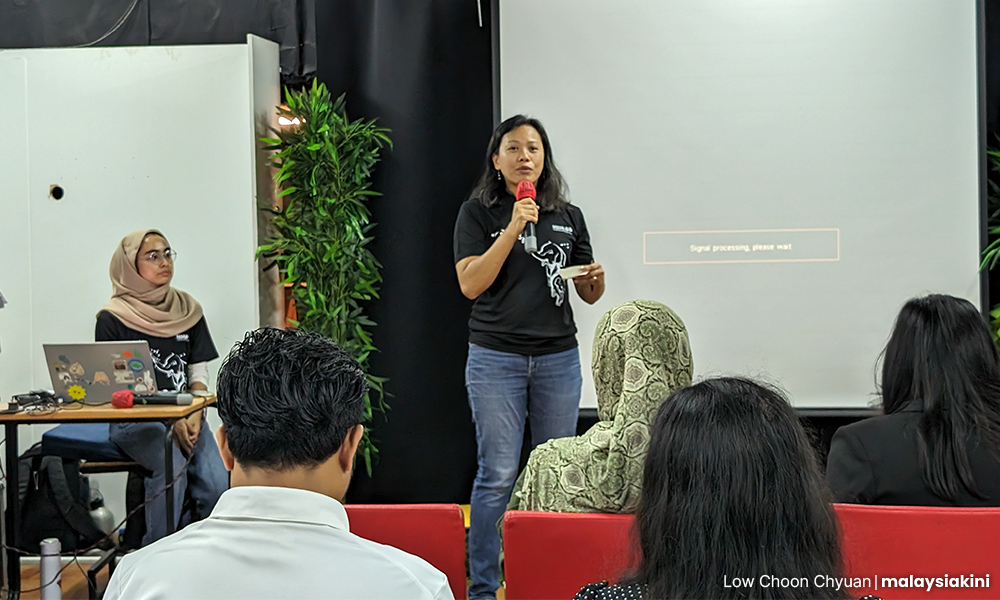
The associate professor at the University of Nottingham Malaysia pointed out that human-elephant conflicts are the top concern in states with elephants, as there are also cases of human deaths and injuries.
According to the National Elephant Conservation Action Plan (Necap 2.0), there were seven human deaths and three injuries from 2015 to 2021. There was also an estimated RM6.6 million in losses in Johor during that period.
Elephants will pass by plantations
Wong said some plantation owners think that “wildlife is not supposed to be in the plantations”, but research found that wildlife, including elephants, tend to move between forest patches for food.
“We find that the wildlife needs to move (around), because one of their food patch areas is here, another area is there.
“So, there will be a certain pathway which goes through the agricultural landscape,” she added.
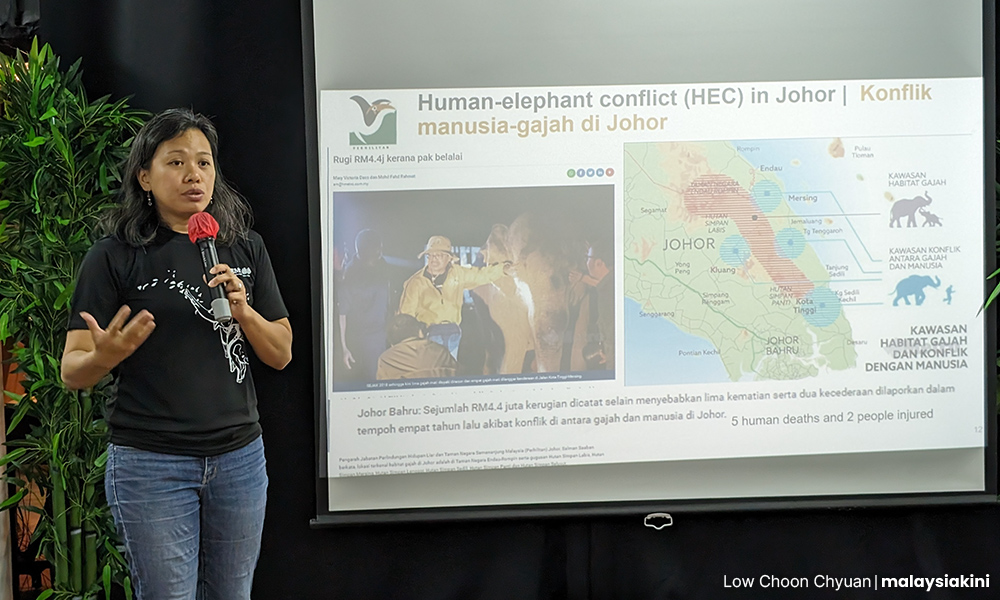
Wong said elephants and humans competing for the same space made “the situation on the ground very challenging”.
The group’s focus is on the coexistence between humans and elephants, not solely on elephant conservation or human interests.
To mitigate conflicts, it monitors elephants’ movements with GPS collars and designs safe passages for the elephants to move between grazing areas.
Elephants love plantation ‘buffets’
Although the public perception is that elephants stay inside forests, Wong said research found that wild elephants in the forest need a larger area to roam, while elephants living in agricultural areas tend to have smaller home ranges.
“Because mature forests have very little undergrowth, there is less food for the elephants and thus they need to roam a larger area.
“When the elephants venture outside of the forest, this is where they can find most vegetation to feed on.
“Elephants will see the plantations and (think) wow, there is a ‘buffet’ there,” she added.
Raising awareness through fun
The group’s plan for human-elephant coexistence is to secure safe passages for the elephants to move and attract the elephants towards grazing grounds located at a distance away from human settlements and near forested areas.
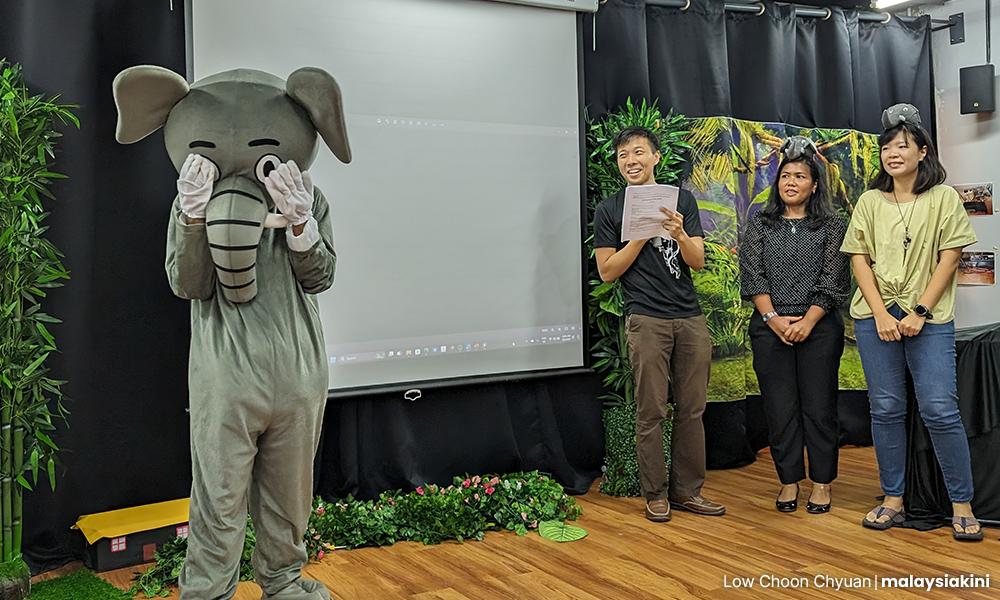
During the event held at Publika Shopping Gallery on June 8 in conjunction with World Environment Day, the group’s co-investigator Cedric Tan hosted an interactive theatre illustrating why elephants go into plantations.
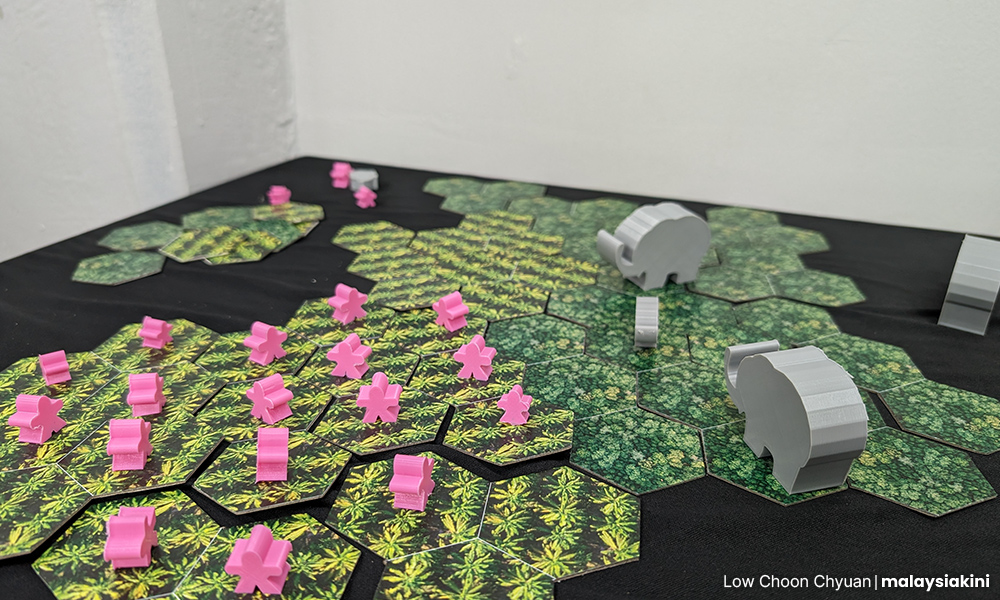
The group also launched its proprietary board game “Trunk Tales”, an educational role-playing game to showcase the complexities of multi-stakeholder management of human-elephant conflicts to achieve coexistence.
The research group was founded in 2011 as a collaboration project between the University of Nottingham Malaysia and the Department of Wildlife and National Parks of Peninsular Malaysia (Perhilitan).
Since the group was founded, Yayasan Sime Darby became its main sponsor, supporting its researchers and providing funding.
It is also involved in forming Project Ace (Achieving Coexistence with Elephants), a coalition involving stakeholders such as palm oil plantation owners, Perhilitan, Forestry Department, and NGOs such as Earthworm Foundation.
Although Project Ace involved big players in the oil palm industry, Wong hoped that more stakeholders on the ground will join the efforts.
In a statement published earlier this month, she said: “Some large plantations have the capacity and capability to turn conflict into coexistence but the agriculture communities at large still need support.
“Having a coalition allows synergy of effort on the ground and sharing of ideas.
“But we are talking about work covering large areas in the districts of Kluang, Segamat, Kota Tinggi, and Mersing, and we need many more stakeholders on the ground to support or join the effort,” she added.
/file/publisher-c1a3f893382d2b2f8a9aa22a654d9c97/2023/10/93c23ae233b93033f7827c6c16379f39.jpg)
/file/publisher-c1a3f893382d2b2f8a9aa22a654d9c97/2023/07/449bc7056db9bbfb7c7f4876104395af.jpg)
/file/publisher-c1a3f893382d2b2f8a9aa22a654d9c97/2022/08/726978f09fc1203513207f9ccb62297b.jpg)
/file/publisher-c1a3f893382d2b2f8a9aa22a654d9c97/2023/11/02dd2ecb10da7de4b638616638581743.jpg)
/file/publisher-c1a3f893382d2b2f8a9aa22a654d9c97/2024/06/71bd4ab47fd21f584d70b3e10a9d6e61.jpg)
/file/publisher-c1a3f893382d2b2f8a9aa22a654d9c97/2019/07/0779561338010245859374d505a067e6.jpg)


Are you sure you want to delete this comment?
This action cannot be undone.