


/file/publisher-c1a3f893382d2b2f8a9aa22a654d9c97/2024/11/139c81ddb5a22747488816bbda87337c.jpg)

M'sia ready to align policies, match new demands, industries: PM
Malaysia stands ready to align its policies to match new demands and ever-evolving industries in a multi-pronged approach to attract high-value investments.
For instance, the country is now talking about assessing the entire policy on water conservation, Prime Minister Anwar Ibrahim said, citing the high demand for water by data centres.
“We have never encountered such a high demand for water except now by these data centres. I don’t know what they do with it, but they have been asking for more water, more energy...
Malaysia stands ready to align its policies to match new demands and ever-evolving industries in a multi-pronged approach to attract high-value investments.
For instance, the country is now talking about assessing the entire policy on water conservation, Prime Minister Anwar Ibrahim said, citing the high demand for water by data centres.
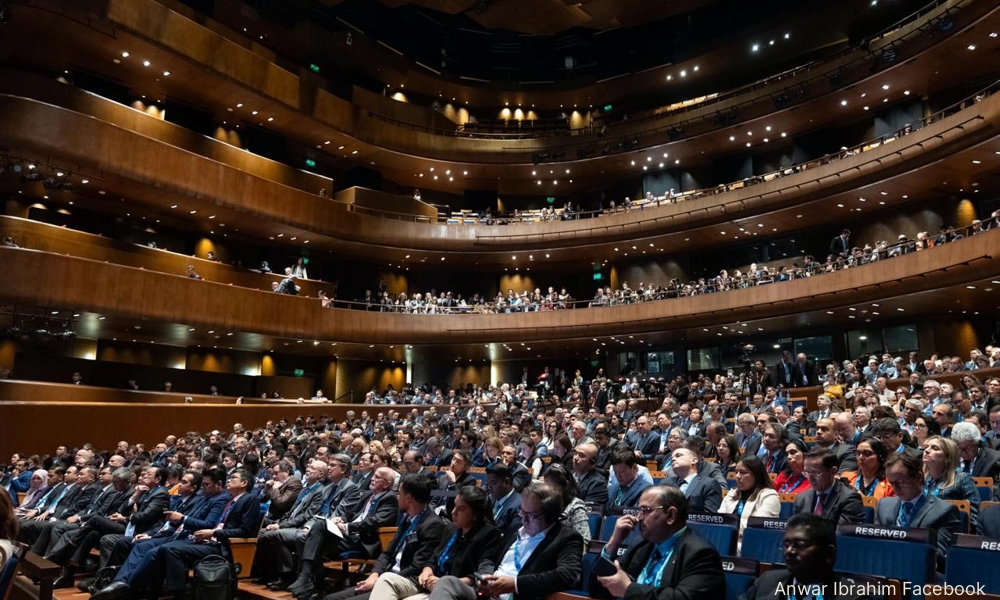
“We have never encountered such a high demand for water except now by these data centres. I don’t know what they do with it, but they have been asking for more water, more energy,” he quipped at the session titled “Opportunities and Challenges in the AI Revolution”, during the Apec CEO Summit in Peru yesterday.
Other panellists in the session were Microsoft vice-president of data and AI Zia Mansoor; Vobile chief executive officer Yangbin Wang; and Google vice-president, government affairs and public policy Karan Bhatia.
Also present at the session were Foreign Minister Mohamad Hasan and International Trade and Industry Minister Tengku Zafrul Abdul Aziz.
The event took place at the Grand National Theatre of Peru and was moderated by Apec Business Council Canada member, Jan De Silva.
There is also a need for skilling, upskilling, training and exposure, changing the curriculum in universities, colleges, and schools. To this end, Malaysia is successful because the government listens, Anwar said.
“When our friends from Microsoft, Google, and Huawei come to us, we tell them to give us some time, let us listen to the requirements they have,” he said.
Hence, public policy and governments cannot assume that they can go on inviting and attracting this sort of investment without being prepared to undertake major initiatives that would allow these agencies of investment to come in, the premier added.
Anwar, who is also finance minister acknowledged that the progress the country has made in attracting investments was not without its challenges and bottlenecks.
“We were also stuck with some bureaucratic rules and we have to be able to coordinate or bypass this. And then the system is not only the state governments, we have municipalities. So, how do you cut across all this?
“But, if we could do it with one particular major investor. Then, it would just spread out,” he explained in the 45-minute session.
Effective Asean cooperation
On a question about how this could be done in the context of Asean, Anwar said it requires effective coordination.
“We have a bigger framework, somewhat similar incentives, and we complement each other because other countries have the expertise, but no water, and some have energy. So, we are keen to have this sort of collaboration more effectively.
“I am proud to say that within Asean, we are already talking about an Asean grid, that will help, for example, create or provide more energy,” he said.
Malaysia will be the Asean chair in 2025.
- Bernama
/file/publisher-c1a3f893382d2b2f8a9aa22a654d9c97/2024/11/2cc174332046f5ffaa5109a9fccb245d.jpg)
/file/publisher-c1a3f893382d2b2f8a9aa22a654d9c97/2024/11/a83bba349e8bb06d3139c64005d35920.jpg)
/file/publisher-c1a3f893382d2b2f8a9aa22a654d9c97/2024/11/3b8fdcfa05959013ca96f5d3186f19f9.jpg)
/file/publisher-c1a3f893382d2b2f8a9aa22a654d9c97/2023/04/99d87f98277113cec33b8a9b3ec77433.png)


Are you sure you want to delete this comment?
This action cannot be undone.