


/file/publisher-c1a3f893382d2b2f8a9aa22a654d9c97/2023/02/5b1ff2178907154309e9bd4db90decdf.jpg)

Sabah scandal: C4 explodes, renews call for political financing reform
Center to Combat Corruption & Cronyism (C4 Center) has urged the government to introduce a Political Financing Act to ensure greater transparency and accountability.
This was after the whistleblower, who implicated Sabah assemblypersons in the alleged scandal, claimed that...
Summary
Center to Combat Corruption & Cronyism (C4 Center) responds to the latest allegation concerning a “settlement offer” received by the whistleblower in the alleged Sabah corruption scandal.
The corruption watchdog argues that it exemplifies how political donations have been weaponised to disguise corruption.
C4 Center also excoriates the government for not doing enough to tackle corruption.
The alleged corruption scandal in Sabah has reignited demands for political financing reform in Malaysia.
Center to Combat Corruption & Cronyism (C4 Center) has urged the government to introduce a Political Financing Act to ensure greater transparency and accountability.
This was after the whistleblower, who implicated Sabah assemblypersons in the alleged scandal, claimed that one of the lawmakers, Mohd Arifin Mohd Arif, allegedly attempted to silence him with a settlement offer.
According to the whistleblower, the offer by Arifin, who is also the son-in-law of Sabah Governor Musa Aman, included the reinstatement of mineral exploration licences in exchange for issuing a pre-written statement declaring that the funds involved were political donations.
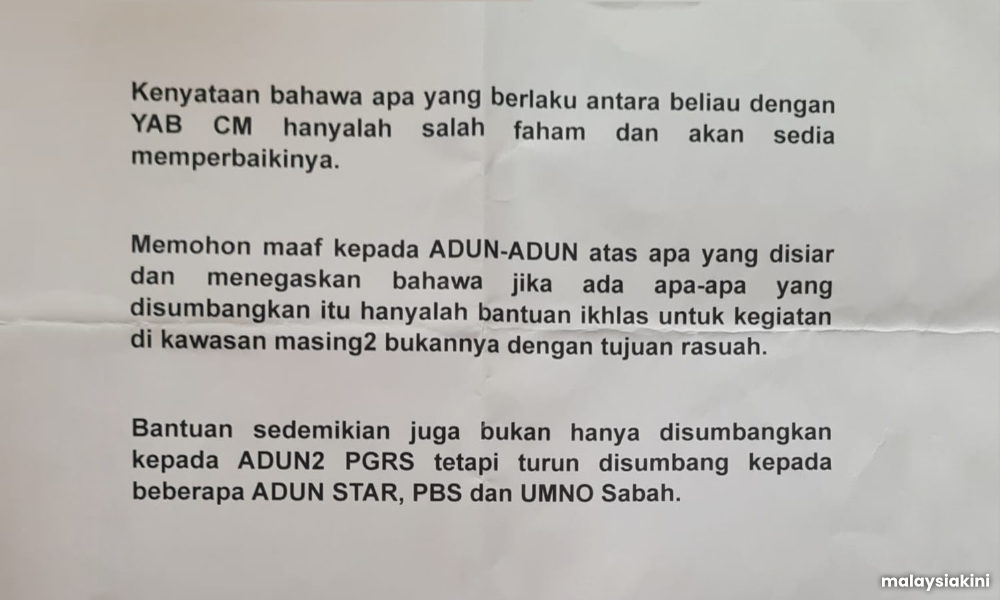
C4 Center demanded that the Madani government take the allegations seriously, expand investigations into the matter, and treat corruption as a matter of significant public interest.
The watchdog argued that it exemplifies how political donations have been weaponised to disguise corruption.
“These allegations reveal the degree to which corruption risks have deeply rooted themselves in Malaysia’s political system. Firstly, the pre-written statement demonstrated that political donations have become so normalised, accepted, and unregulated within the system that politicians are under the impression that it can easily be used to dispel allegations of corruption against them.
“There is no consideration made to whether or not these ‘donations’ would need to be justified or corroborated with documentation further down the line.
“In doing so, these allegations illustrate what anti-corruption advocates and civil society organisations have long claimed - that political donations are a smokescreen to obscure money politics and the formation of crony networks and favours,” it said in a statement.
C4 Center said the allegations also demonstrate the amount of power chief ministers have over the disbursement of state government contracts and permits to private entities, so much so that a promise to reinstate the permits to the whistleblower’s company can be done simply, ostensibly on the unilateral discretion of the minister.
‘Govt discourages protest against corruption’
In the wake of these allegations, C4 Center said the Madani government has done little about political financing reform, despite the clear need for such regulations.
“The government has, however, been vocal in discouraging public protest against corruption,” it added.
Referencing the two rallies organised by the Sekretariat Rakyat Benci Rasuah, C4 Center scorched the government and authorities for summoning student protesters for questioning.
“It is shameful that the government, the police force, and university administrators have issued statements and threats against a grassroots anti-corruption movement demanding a cleaner Malaysia - even more so when these same parties apparently have little to say about the corruption scandal unfolding in Sabah, which ignited the movement in the first place,” it added.
C4 Center said it has “repeatedly interrogated the Madani government’s self-proclaimed commitment” to anti-corruption, and these events have cast doubt on that commitment even further.
“Investigations and enforcement by MACC are not a permanent solution to resolve the systemic rot in our institutions - the Madani government must revive the political financing agenda and table the relevant Act in Parliament,” it added.
The organisation made three demands:
The government introduces a Political Financing Act alongside other regulations that ensure political financing is transparent and accountable;
Separate the offices of the attorney-general and public prosecutor so that high-profile prosecutions are free from perceptions of political interference;
Halt the intimidation of student anti-corruption protesters and other members of the Sekretariat Rakyat Benci Rasuah and ensure that future rallies and demonstrations are protected under the right to freedom of expression and association.
/file/publisher-c1a3f893382d2b2f8a9aa22a654d9c97/2023/02/c7ef714de194bcf444a8e6cdfe9dd2ce.jpg)
/file/publisher-c1a3f893382d2b2f8a9aa22a654d9c97/2019/03/8de5a31ebb4da45eb2722e8d62bc0602.jpg)
/file/publisher-c1a3f893382d2b2f8a9aa22a654d9c97/2023/08/b29e6eedc54736414e0a52aaac189985.jpg)
/file/publisher-c1a3f893382d2b2f8a9aa22a654d9c97/2025/02/00b1980ad3bfd3834ba93cefd2b0b7bd.jpg)


Are you sure you want to delete this comment?
This action cannot be undone.