


/file/1214/0bf383954dafb7c17e3338903e7f3d8f.jpeg)

US stocks close with largest losses since 2020 as tariffs rattle investors
A minimum baseline tariff of 10 percent will be imposed on all countries except Canada and Mexico, with higher penalties charged on nations Trump deemed to be the "worst" trade offenders.
The president said his new economic effort seeks to...
US stocks ended Thursday with a sharp decline in the biggest one-day loss since 2020 after President Donald Trump announced his long-awaited reciprocal tariffs Wednesday after markets closed, Anadolu Ajansi (AA) reported.
A minimum baseline tariff of 10 percent will be imposed on all countries except Canada and Mexico, with higher penalties charged on nations Trump deemed to be the "worst" trade offenders.
The president said his new economic effort seeks to "help build our economy" by spurring domestic manufacturing, raising government revenue and thwarting "cheating" on trade.
Reciprocal tariffs ranging from 10 percent to 50 percent were imposed on products the US imports from many of its trading partners.
The European Union was slapped with 20 percent, China 34 percent, Vietnam 46 percent, Taiwan (32 percent), Japan (24 percent), India (26 percent), South Korea (25 percent), Thailand (36 percent), Switzerland (31 percent), Indonesia (32 percent ), Malaysia (24 percent), Cambodia (49 percent), South Africa (30 percent ), Bangladesh (30 percent), and Israel (17 percent) in reciprocal tariffs.
Some countries, such as Turkiye, the UK, Brazil, Australia, the United Arab Emirates, New Zealand, Egypt and Saudi Arabia were subjected to 10 percent baseline tariffs each.

Tech companies' stock prices fell sharply, with Apple's shares down more than nine percent due to supply chain disruption worries. More US tariffs were imposed on China, the country that supplies essential iPhone components, increasing the overall rate to 54 percent.
‘Patients getting operated’
Similar worries caused chip stocks to also plummet, with Nvidia down more than seven percent. The market capitalisation of the so-called "Magnificent Seven" stocks dropped more than US$900 billion (RM3.9 trillion), according to Anadolu.
The market sell-off was acknowledged by Trump, who compared the imposition of tariffs to “when a patient gets operated on."
"The markets are going to boom. The stock is going to boom. The country is going to boom. And the rest of the world wants to see - is there any way they can make a deal," he said on Thursday.
On the macroeconomic data side, the US foreign trade deficit declined 6.1 per cent in February month-on-month to US$122.7 billion (RM543 billion).
Initial jobless claims in the country fell 6,000 to 219,000 last week, lower than the expected figure of 225,000.
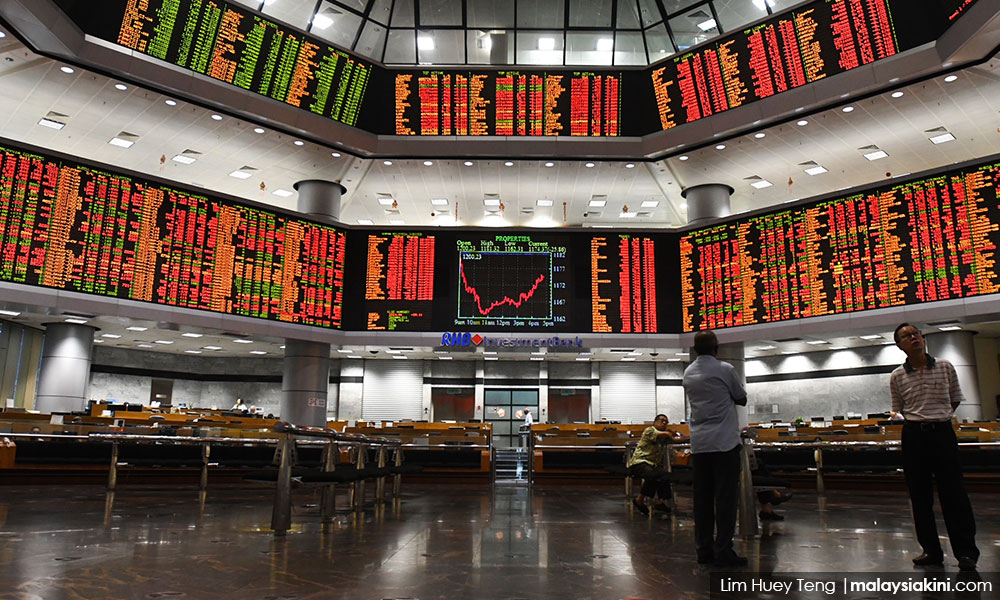
The Dow Jones industrial average dove 3.98 percent, or 1,679.39 points, to end the day at 40,545.93, posting its worst day since June 2020.
The S&P 500 declined 4.84 percent, or 274.45 points, to 5,396.52, also its worst session since June 2020.
The Nasdaq Composite plummeted 5.97 percent, or 1,050.44 points, to 16,550.60, registering its biggest decline since March 2020.
The VIX Index, also known as the “fear index,” soared 39.56 percent to 30.02.
- Bernama-Anadolu
/file/publisher-c1a3f893382d2b2f8a9aa22a654d9c97/2024/10/b0604e71c2c76e58ffea999662584609.jpg)
/file/publisher-c1a3f893382d2b2f8a9aa22a654d9c97/2025/04/cd07f3a02d1bacb46c9dc8585ea64fc8.jpg)
/file/publisher-c1a3f893382d2b2f8a9aa22a654d9c97/2025/02/a9c0856153e4adf4af5c9b44cd23b9fa.jpg)
/file/publisher-c1a3f893382d2b2f8a9aa22a654d9c97/2019/02/cc1edacda79349f502eb94fb7068f62d.jpg)


The idiot has spoken
Are you sure you want to delete this comment?
This action cannot be undone.