


/file/publisher-c1a3f893382d2b2f8a9aa22a654d9c97/2025/05/a58a5221d6c61bc3946cced00d78418d.jpg)

Doctors rich? Almost 30pct in B40 group, says MMA rep
Approximately 30 percent of doctors in Malaysia fall within the B40 category, presenting a stark contrast to the common perception that doctors are wealthy, said the Malaysian Medical Association (MMA).
Its president-elect Dr Thirunavukarasu Rajoo said the reality is that a majority of medical practitioners are low-income earners, based on a 2018 study involving 1,800 doctors.
"We found that the truly successful ones, economically, are...
Summary
Contrary to popular belief, the majority of doctors are not rich, as only 10pct are, according to MMA president-elect Dr Thirunavukarasu Rajoo.
He reveals that a 2018 study found 30pct of doctors are B40, while another 30pct are alarmingly ‘below water’.
Approximately 30 percent of doctors in Malaysia fall within the B40 category, presenting a stark contrast to the common perception that doctors are wealthy, said the Malaysian Medical Association (MMA).
Its president-elect Dr Thirunavukarasu Rajoo said the reality is that a majority of medical practitioners are low-income earners, based on a 2018 study involving 1,800 doctors.
"We found that the truly successful ones, economically, are 10 percent. The B40 among doctors, meanwhile, were almost 30 percent.
“The other 30 percent just cukup makan (just get by)... We have the data," Thirunavukarasu said in his speech at a doctors’ protest in Putrajaya today.
He alarmingly described the remaining 30 percent of doctors as "below the water".
Thirunavukarasu was leading the protest against the government's enforcement of the Price Control and Anti-Profiteering (Price Marking for Drugs) Order 2025, which came into effect on May 1.
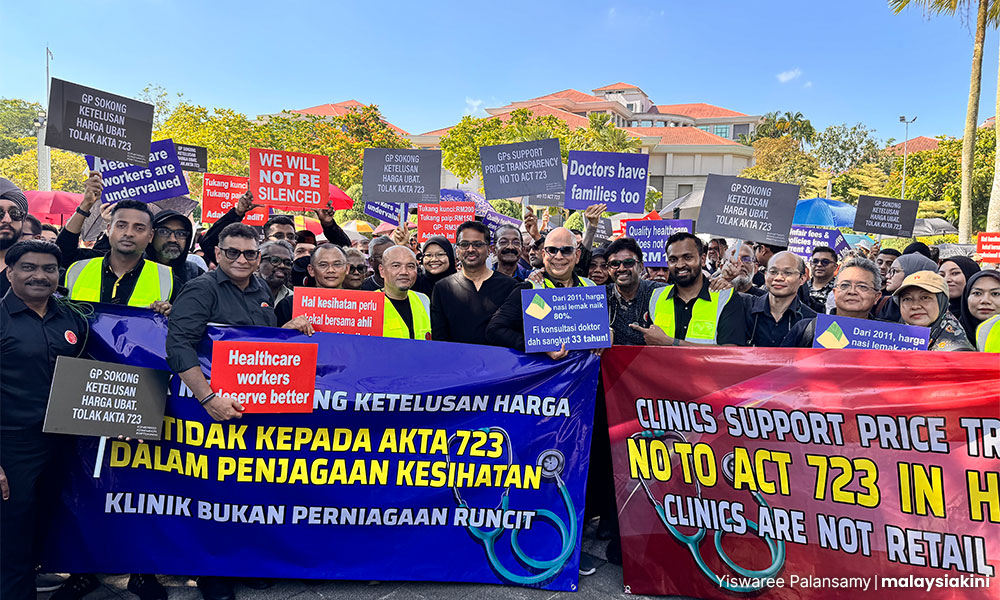
After speaking to the media, he along with a few other medical association representatives, entered the Prime Minister's Office to hand over a memorandum highlighting the group's grievances.
‘Stop punitive inspections’
Private general practitioners last week accused authorities of "betrayal" following reports that enforcement of the Price Control and Anti-Profiteering (Price Marking for Drug) Order 2025 had begun, despite promises of a grace period.
The Federation of Private Medical Practitioners' Associations of Malaysia (FPMPAM) reported that Domestic Trade and Cost of Living Ministry enforcement officers were already inspecting clinics, issuing three-day ultimatums to display medicine prices or face legal action.
This contradicted public assurances from Health Minister Dzulkefly Ahmad and Domestic Trade and Cost of Living Minister Armizan Ali, that the first three months would serve as a grace period focused on advocacy rather than punitive measures.

FPMPAM president Dr Shanmuganathan TV Ganeson last week demanded an immediate cessation of "punitive inspections" until clear guidelines are established and a legally enforceable directive confirming the grace period is issued.
Enforcement authority
Legal experts quoted by health news portal CodeBlue yesterday, noted that the Health Ministry lacks the proper authority to enforce the medicine price display order, which falls exclusively under Armizan's jurisdiction.
They argued that Armizan, who gazetted the order, cannot transfer enforcement powers granted under Section 3 of the Price Control and Anti-Profiteering Act 2011 (Act 723) to Dzulkefly.
Section 3 of Act 723 specifically empowers the minister to appoint price controllers and other enforcement officers from amongst public servants.

Lawyer Manmohan S Dhillon told CodeBlue that the Health Ministry, however, can provide "technical assistance" to Domestic Trade and Cost of Living officers enforcing the requirement for private healthcare facilities and community pharmacies to display drug prices.
He also explained that a drug price display mandate cannot be issued under the Private Healthcare Facilities and Services Act 1998 (Act 586), which falls under the Health Ministry's purview.
"That legislation (Act 586) provides for a fee schedule, but it does not provide for the display of drug prices," Manmohan said in addressing calls from doctors' associations to regulate the medical profession through Act 586 rather than Act 723.
/file/publisher-c1a3f893382d2b2f8a9aa22a654d9c97/2025/05/fed3354ff0125566ab6f86b3f3d31ac8.jpg)
/file/publisher-c1a3f893382d2b2f8a9aa22a654d9c97/2023/03/aa415cd3d85da4ff815418a11c71c010.jpg)
/file/publisher-c1a3f893382d2b2f8a9aa22a654d9c97/2022/05/d349ab64c0e9cf54499463104010e0ac.jpg)
/file/publisher-c1a3f893382d2b2f8a9aa22a654d9c97/2023/03/ab459fc5537a19d8d042d51ecf7f0caa.jpg)


Are you sure you want to delete this comment?
This action cannot be undone.