


/file/publisher-c1a3f893382d2b2f8a9aa22a654d9c97/2025/05/8f46c60a2a149a54a7abf163efdab717.jpg)

Memo to PM: Doctors protest regulatory overreach, fee freeze
The groups say that while they fully support transparency in medicine pricing, they strongly object to the use of the Price Control and Anti-Profiteering (Price Marking for Drugs) Order 2025, under the Price Control and Anti-Profiteering Act 2011 (Act 723).
“Many queries were raised as to...
Summary
Doctors say they fully support transparency in medicine pricing, but regulation must be under the Healthcare Facilities and Services Act 1998.
They oppose the use of the Price Control and Anti-Profiteering (Price Marking for Drugs) Order 2025, under the Price Control and Anti-Profiteering Act 2011.
There are also rising concerns over third-party administrators who outsource medicine prescriptions to third-party pharmacies via e-prescriptions, bypassing attending doctors.
In a memorandum to the prime minister today, 11 medical associations protested against the use of commercial regulations on medical practices.
The groups say that while they fully support transparency in medicine pricing, they strongly object to the use of the Price Control and Anti-Profiteering (Price Marking for Drugs) Order 2025, under the Price Control and Anti-Profiteering Act 2011 (Act 723).
“Many queries were raised as to why Act 723 is being used and on its implementation and enforcement. However, this promise has not been honoured, and all the queries raised remain unanswered.
“The policy was implemented on May 1, with a gazette announcement only one day earlier on April 30.
“There was no dialogue, despite repeated requests for stakeholder engagement,” they said, adding that a separate request by the Malaysian Medical Association (MMA) to meet the Domestic Trade and Cost of Living Ministry remains unanswered.
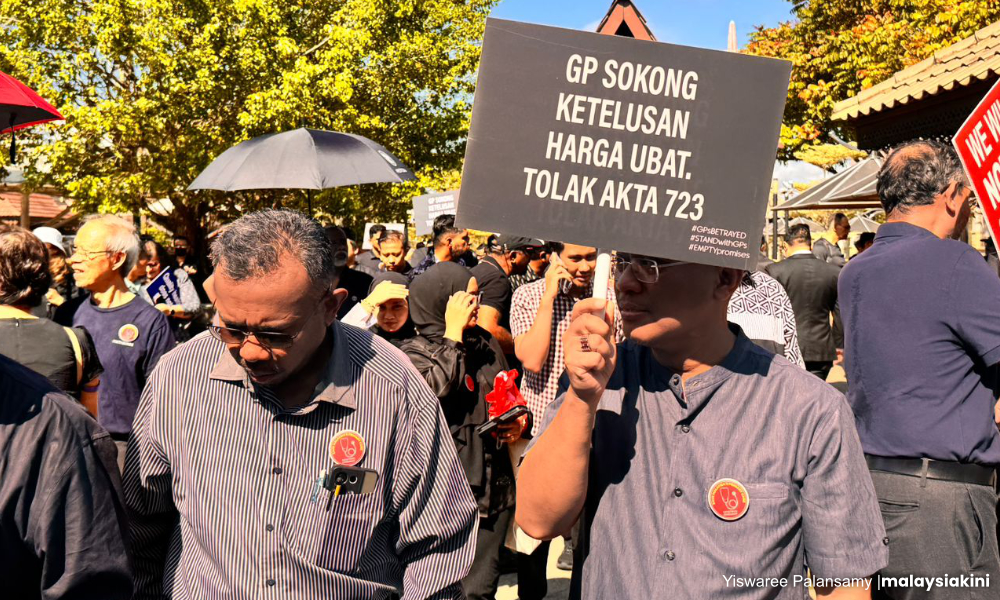
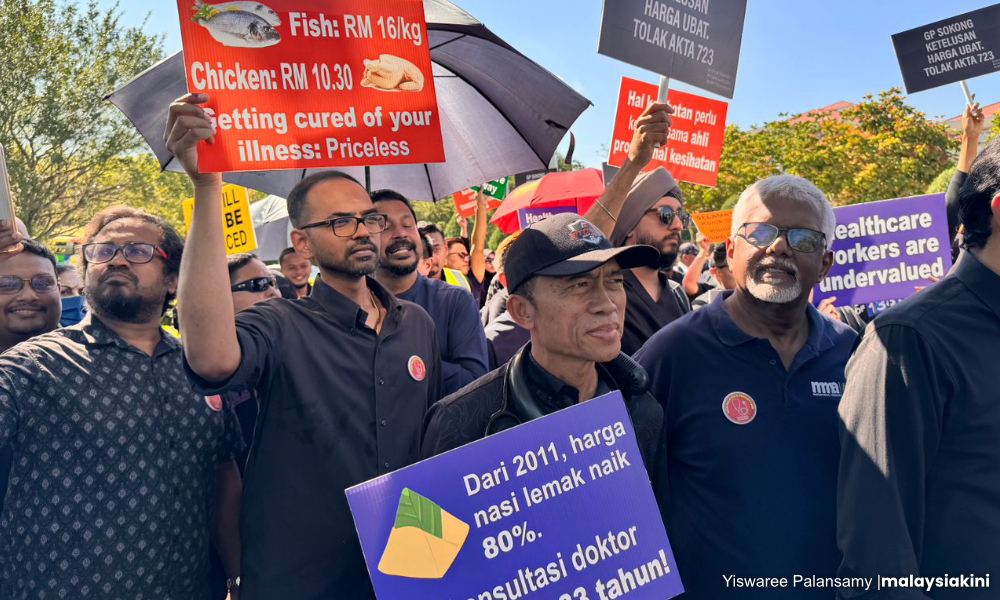
The doctors, who protested outside the Prime Minister’s Office (PMO) in Putrajaya earlier today, said they support transparency in medicine pricing, but regulation must be under the Healthcare Facilities and Services Act 1998 (Act 586).
They later entered the PMO to hand the memorandum to a representative of the prime minister.
The groups also denounced the over-three-decade freeze on consultation fees for general practitioners (GPs).
The memorandum stated how private GP fees have been static since 1992, fixed between RM10 and RM35 despite soaring operational costs, inflation, and increasing regulatory requirements.
“Despite years of appeals by the medical associations, there has been no implementation of a revised fee schedule.
“This is unjust and places an unfair burden on private practitioners who continue to serve the rakyat diligently,” the memorandum read.
Third-party administrators
The associations also raised concerns over the unregulated operations of third-party administrators (TPAs).
They said these administrators, who act as intermediaries between GPs and a patient’s employer or insurer, impose high administrative fees on clinics and cause delays in payment of claims.
This affects the cash flow of clinics and harms operational sustainability, the doctors said.
“And now, more alarmingly, they have begun outsourcing long-term medication prescriptions to third-party pharmacies via e-prescriptions, bypassing the attending doctors.
“This last practice is especially troubling. It is not aligned with evidence-based clinical management and threatens patient safety by removing continuity and exposing patients to increased rates of complications of non-communicable diseases,” they added.
They lamented that while medical associations have been repeatedly raising the issue with the Health Ministry since 2015, and with other agencies, enforcement remains woefully inadequate.
“The continued inaction has emboldened TPAs, resulting in the ongoing commercialisation of healthcare, which compromises ethical practice and threatens patient-centred care,” the associations said.
Foreign investment risks
They also expressed concern over increasing foreign equity ownership in Malaysia’s healthcare sector.
The doctors said that while foreign investment brings capital, technology, and expertise, it also poses risks to national health sovereignty, affordability, and equitable access.
Earlier, over 700 doctors protested outside the PMO, arguing that being under the dual regulations of Act 723 and Act 586 creates an enforcement overlap that may cause confusion and disrupt healthcare.
The MMA also said that about 30 percent of doctors in Malaysia fall within the B40 category.
In his speech at the gathering earlier, MMA president-elect Dr Thirunavukarasu Rajoo said that although people perceive medical practitioners to be rich, the reality is that a large number of them are low-income earners, based on a 2018 study involving 1,800 doctors.
/file/publisher-c1a3f893382d2b2f8a9aa22a654d9c97/2025/05/fed3354ff0125566ab6f86b3f3d31ac8.jpg)
/file/publisher-c1a3f893382d2b2f8a9aa22a654d9c97/2023/03/ab459fc5537a19d8d042d51ecf7f0caa.jpg)
/file/publisher-c1a3f893382d2b2f8a9aa22a654d9c97/2025/05/a58a5221d6c61bc3946cced00d78418d.jpg)
/file/publisher-c1a3f893382d2b2f8a9aa22a654d9c97/2023/03/aa415cd3d85da4ff815418a11c71c010.jpg)


Are you sure you want to delete this comment?
This action cannot be undone.