


/file/publisher-c1a3f893382d2b2f8a9aa22a654d9c97/2025/06/62f000150c36207bd0c4771c90921616.jpg)

Unconditional dialogue key to peace, justice: Timor Leste president
Timor-Leste President Jose Ramos-Horta has emphasised the need for dialogue without preconditions as a crucial step towards achieving global peace and justice.
Delivering a keynote address in Kuala Lumpur, Ramos-Horta drew on Timor-Leste’s decades-long struggle for independence, beginning with the country’s 1975 liberation from Portuguese colonial rule and subsequent occupation by Indonesia.
Summary
Timor-Leste President Jose Ramos-Horta advocates for dialogue without preconditions to achieve global peace and justice, citing his country’s reconciliation after independence.
Ramos-Horta recalls Timor-Leste’s journey, emphasising the decision to move forward after years of conflict and human rights violations.
During the event, a book about Anwar Ibrahim’s perspectives on global justice and peace was launched, with Ramos-Horta sharing anecdotes about their friendship.
Timor-Leste President Jose Ramos-Horta has emphasised the need for dialogue without preconditions as a crucial step towards achieving global peace and justice.
Delivering a keynote address in Kuala Lumpur, Ramos-Horta drew on Timor-Leste’s decades-long struggle for independence, beginning with the country’s 1975 liberation from Portuguese colonial rule and subsequent occupation by Indonesia.
He recounted the difficult road to independence, which included a UN-sponsored referendum in 1999 where an overwhelming majority of East Timorese voted to break away from Indonesian rule, despite facing grave human rights violations and the loss of thousands of lives during the ensuing crisis.
Yet, he said the country chose reconciliation over retribution.
“Xanana (Gusmao), with all his charisma, declared that there will be no revenge, no looking back after 24 years of conflict.
“Xanana said, we honour the dead, we take care of the survivors, but we must move on as a nation,” said Ramos-Horta, referring to Timor-Leste’s founding president and current prime minister.
Same principles can be applied elsewhere
He was speaking at the Rights Foundation’s Global Leadership & Dialogue Initiative.
Ramos-Horta added that the same principle - dialogue without preconditions - could be adopted by leaders of countries embroiled in conflict, including those involved in the Russia-Ukraine war and disputes across the Middle East.
“Our dialogue had continued as Indonesia maintained its claims (to East Timor) while we upheld our rights to self-determination, as decided by the UN,” he said, referring to a prior United Nations General Assembly resolution in 1982.
Following the 1999 referendum, Indonesia formally withdrew its troops, and Timor-Leste eventually gained full independence on May 20, 2002, after a UN-administered transition period.
During the forum, Ramos-Horta also witnessed the launch of “Anwar Ibrahim: Global Justice and Peace Through Dialogue”, a book written by Rights Foundation chairperson and former PKR senator Yusmadi Yusoff.
In his remarks, Ramos-Horta, a Nobel Peace Prize laureate, recalled his long-standing friendship with Prime Minister Anwar Ibrahim, including lobbying then-premier Abdullah Ahmad Badawi to approve a request for Anwar to receive urgent medical treatment in Germany.
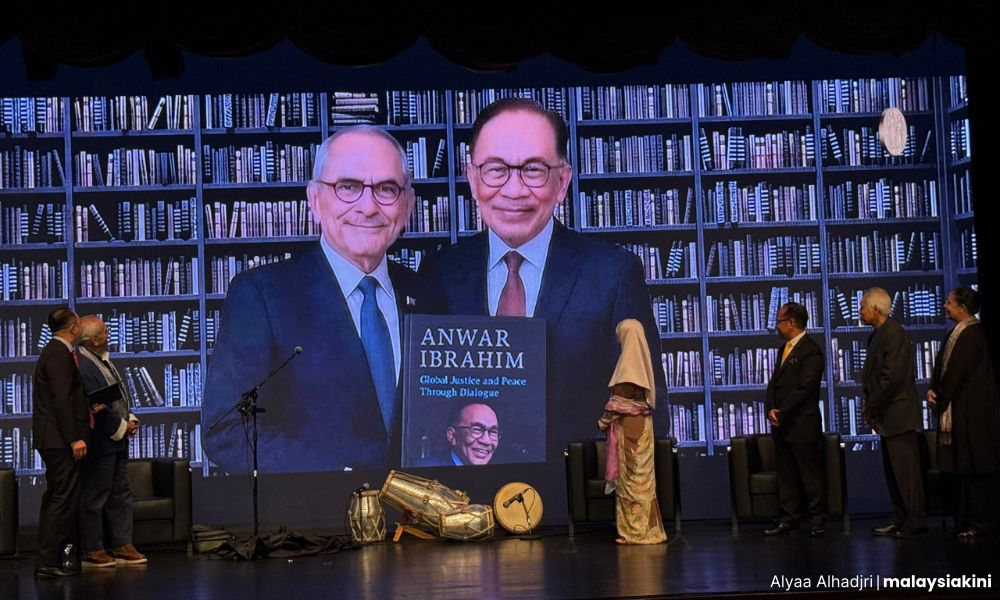
Addressing Anwar’s wife, Dr Wan Azizah Wan Ismail, who was present, Ramos-Horta also remembered meeting their daughter, Nurul Izzah, when she was a teenager advocating at the UN Human Rights Commission for her father’s release.
In his opening speech, Yusmadi said the book drew from his close working relationship with Anwar as a former aide, spanning more than 25 years of personal and political observations.
With a foreword by Institute of Advanced Islamic Studies deputy CEO Prof Osman Bakar, the book also explores Anwar’s positions on geopolitics and his various personal and political challenges.
/file/publisher-c1a3f893382d2b2f8a9aa22a654d9c97/2025/06/2b8a30a471acfcbd146d7365edd0fc09.jpg)
/file/publisher-c1a3f893382d2b2f8a9aa22a654d9c97/2019/09/3b2eb3b32e243cbdaf64442203bc99ab.jpg)
/file/publisher-c1a3f893382d2b2f8a9aa22a654d9c97/2024/09/4dbe74262ef182a0bd1ec35bbf475bb9.jpg)
/file/publisher-c1a3f893382d2b2f8a9aa22a654d9c97/2025/04/dfdd68147179d089593ea48758035cee.jpg)
/file/publisher-c1a3f893382d2b2f8a9aa22a654d9c97/2025/06/9071d01d548f0f761dde452cdde04435.jpg)
/file/1359/cfdaef669b98f470f4760b65a290a761.jpeg)


