


/file/publisher-c1a3f893382d2b2f8a9aa22a654d9c97/2025/08/2ac7c7d4252cc885ce042c2a39d0e576.jpg)

CJ vows to protect independence of judiciary amid Umno past ties concern
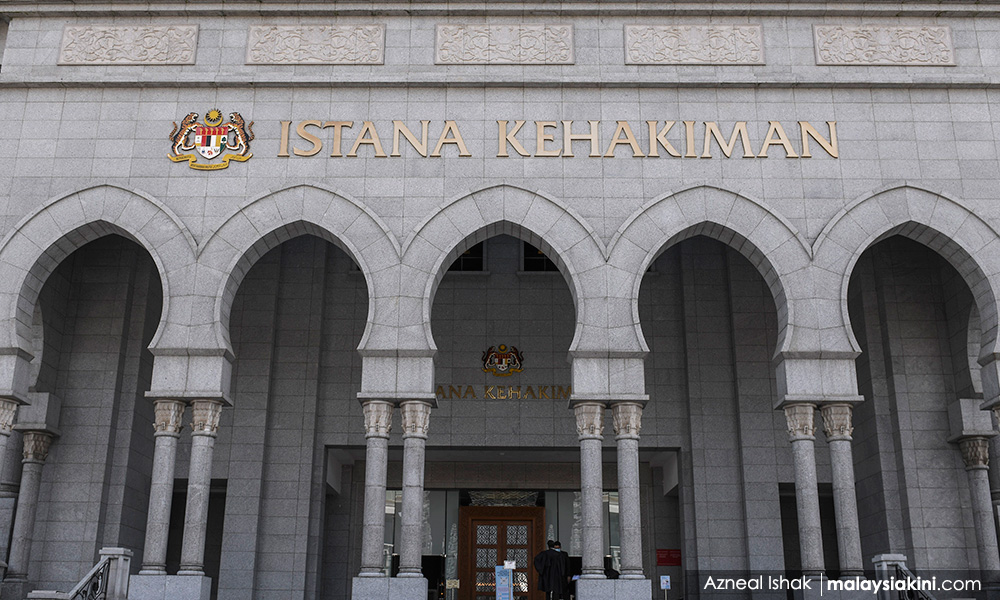
Chief Justice Wan Ahmad Farid Wan Salleh has given his unconditional pledge to safeguard judicial independence, following concerns over his political history.
Wan Ahmad Farid, who faced recent public criticism over his past ties with Umno, acknowledged that his history cannot be erased, nor would he want it to be, as it forms part of who he is.
Summary
Chief Justice Wan Ahmad Farid Wan Salleh addresses concerns over his political history with Umno, vowing to safeguard judicial independence.
He emphasises that judicial independence must be protected at all costs, lest the very fabric of a just society be severely undermined.
Chief Justice Wan Ahmad Farid Wan Salleh has given his unconditional pledge to safeguard judicial independence, following concerns over his political history.
Wan Ahmad Farid, who faced recent public criticism over his past ties with Umno, acknowledged that his history cannot be erased, nor would he want it to be, as it forms part of who he is.
"As I assume this most solemn amanah and for as long as I occupy this chair, I give you my unconditional pledge in the name of my Creator," he said during his speech at a judicial ceremony held today to mark his appointment.
Wan Ahmad Farid noted that the most important player at the forefront of judicial independence is the leadership within the branch itself.
He also paid tribute to past chief justices for their service and leadership, noting that they have collectively made great strides by putting in place institutional and procedural reforms, with continuous emphasis on the need for a transparent and independent judiciary.
"My predecessors have led with utmost integrity, and now the baton has been passed at a most pivotal time, with the country watching closely.
"(Judicial independence) must be protected at all costs, lest the very fabric of a just society be severely undermined.
"When all avenues of recourse are closed, the rakyat and even the government will look to courts for an impartial resolution of their disputes," Wan Ahmad Farid added.
Judicial processes
On efforts to improve judicial processes, he said that the judiciary is also working with the government to increase the number of courtrooms and appoint additional judicial commissioners to tackle the backlog of cases.
Wan Ahmad Farid said that mobile courts were also introduced to bring legal services directly to remote communities, particularly in Sabah and Sarawak, to expand public access to justice.
"These mobile units, equipped as courtrooms, along with a team led by a magistrate, handle matters such as birth registrations, minor offences and legal documentation on the ground," he said.
He added that there is also a need to form more specialised divisions and subdivisions of the High Court, which the judiciary will explore to expose judges to more complex areas of the law and enhance their expertise.
Present at the ceremony were chief judge of Malaya Hasnah Hashim, chief judge of Sabah and Sarawak Azizah Nawawi, former chief justices and fellow judges.
Also attending the ceremony were Attorney-General Dusuki Mokhtar, Sabah state attorney-general Brenndon Keith, Dewan Rakyat speaker Johari Abdul, and Bar Council president Ezri Abdul Wahab.
Notable rulings
On July 18, Wan Ahmad Farid was named as the new chief justice of Malaysia, succeeding Tengku Maimun Tuan Mat, who retired on July 2.
Before his judicial career, Wan Ahmad Farid served as deputy home minister from March 2008 to April 2009 under the administration of former prime minister Abdullah Ahmad Badawi. He was also the Kuala Terengganu Umno chief in 2008.

Wan Ahmad Farid was picked to contest in the Kuala Terengganu by-election in 2009, when Najib Abdul Razak was the prime minister.
Among his notable rulings was recusing himself from hearing an application to allow a Queen’s Counsel (QC) from the UK to represent Najib in the appeal over the RM42 million SRC International corruption case.
Wan Ahmad Farid cited a conflict of interest, noting that a family member was affiliated with Najib’s political party.
On May 11, 2023, he ruled that the children of single mother Loh Siew Hong were lawfully converted to Islam under Perlis state law, citing an affidavit from the state Islamic authorities confirming the children had recited the Kalimah Shahadah (Islamic declaration of faith) in 2020.
In another significant ruling in November 2023, he ordered the police to complete their investigation into Teoh Beng Hock’s 2009 death within six months, deeming the delay in the probe as excessive.
The decision followed his ruling in favour of the Teoh family’s judicial review.
/file/publisher-c1a3f893382d2b2f8a9aa22a654d9c97/2020/10/2bda679309c88e264ef963588bbe46d2.jpg)
/file/publisher-c1a3f893382d2b2f8a9aa22a654d9c97/2025/07/2c90f0ce3a2a01fd053194a63a9c3325.jpg)
/file/publisher-c1a3f893382d2b2f8a9aa22a654d9c97/2025/07/24b2e2d18bc28e014dc147d1a6e70154.jpg)
/file/publisher-c1a3f893382d2b2f8a9aa22a654d9c97/2025/07/17684388b9af871e3a68901acbfb4295.jpg)
/file/publisher-c1a3f893382d2b2f8a9aa22a654d9c97/2025/07/5da5444d752f7f66cb4343092fca8ea1.jpg)
/file/publisher-c1a3f893382d2b2f8a9aa22a654d9c97/2022/06/1cb42b074a931d524a46b4bb2d4864a7.jpg)


Are you sure you want to delete this comment?
This action cannot be undone.