




Ean Yong aspires to inspire youths
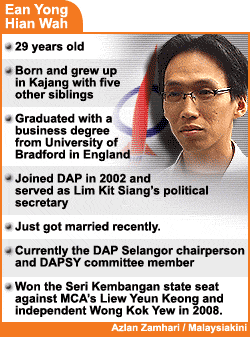
Selangor’s new village development and unlicensed factories settlement state chairperson Ean Yong Hian Wah wants to encourage youths to think about their future.
Selangor’s new village development and unlicensed factories settlement state chairperson Ean Yong Hian Wah wants to encourage youths to think about their future.
 The Seri Kembangan state representative in an exclusive interview with
Malaysiakini
hopes his plans will inspire youths in the new villages to become successful.
Strolling quickly into his office which overlooks the construction on-going near the state building, the DAP Selangor state chairperson apologised for being late.
“I’ve been too busy to even enjoy the view from my office,” he mused.
In a smart black suit and his hair combed back, the chirpy politician talks about his portfolios, the challenges he faces and his response to criticism for being too young to be an executive councillor.
Below are excerpts from the interview:
Can you tell us more about your state exco portfolio?
The name of my portfolio is new village development and unlicensed factories settlement. Previously the new village development portfolio was held by MCA (Tang See Hang). It concerned mostly the Chinese new villages in the state and in Selangor we have 78 new villages, the so-called ‘kampung baru’, ‘kampung bagan’ (fish farm village) and kampung tersusun’ (arranged village).
For unlicensed factories settlement, the states hope to legalise them and help the illegal factories. From there the factories owners can get loans and incentives from the government and we’ll help them to develop more. Right now they are in a situation whereby it is very difficult for them to get loans so their development is restricted.
What are the issues arising under your new village development portfolio?
The new villages are not facing basic infrastructure problems. Most of the problems faced by the people there are social ones. We need to give them more humanity development. I have some projects in the works like setting up mobile libraries which I will try to give them free books. I will also try to invite some experienced new village people so they can give some talks on how to become successful in the society.
What are the social problems arising from the new villages?
Most of the students there drop out of school quite early. Those Chinese students cannot cope with their studies when they reach secondary school so many of them drop out from school and they cannot be hired to work because they are too young. So most of them spend their time in the cyber cafe playing games, so they are wasting their time. So I hope I can encourage them to further their studies and help them rethink about their future because they are young and they can do many things instead of wasting their time.
Who are you liaising with on this issue?
 I’m now discussing this issue with some new village experts. They have a lot of ideas. I will also try to talk to some local associations for example in Serdang. Serdang actually is the biggest new village in the country. So they have a lot of associations and they share their views with me. I will see which views are practical and whether we can implement it in the future because different new villages have different problems. Like in Serdang, it used to have a major shoe industry and in Sungai Buloh, 70 per cent of the furniture in the country comes from there. So different new villages have different characteristics so we need a plan that suits all of them.
What about the land title issue?
In new villages, they already have a leasehold. And we have a special status for these new villages. For example, if you want to extend your leasehold to 60 years, the government gave a really special price which is 50 sen per square feet and then to extend to 99 years, it is priced at RM2.50. It is quite a reasonable and low price. So it shouldn’t be any problem.
Will Selangor adopt the perpetual title for them like how it is being done in Perak?
We will observe the Perak state first and see whether they can implement this successfully. What I understand is that they agree (on this policy) in principle but how they will implement this policy is another matter. I think they need time.
What are the issue arising from your unlicensed factories portfolio?
Let me give you some figures. Under the legalising of factories programme that began in 2006, from the results I can see that it was not that successful. You can see among the 2805 factories, only 26.63 per cent was willing to convert the land from agricultural to industrial. It is not very encouraging. I’m trying to review the policy and give incentive to those who consider converting the land. We are trying to help them. Their major complaint is that the premium is too high. Although there is a 50 per cent discount given by the government last time, they still complain. I’ve already discussed with my department and the land office to perform some analysis and come up with new policies.
How high are these premiums?
They say at the moment the valuation and property services department uses the current industrial land price when calculating the (agricultural) land. The factories are saying it is not reasonable because the land is still agricultural land. Difference areas have different rates.
How many unlicensed factories are there in the state?
Statistics have been done before and they are more focused on the medium to big illegal factories. At the moment there are 2805 factories but we haven’t calculated the small and cottage industries which is easily up to 10,000. It’s huge. If the government succeeds in converting them to licensed factories it would benefit the industry and the government in terms of generating income and revenue.
Do you know how much income has been generated through these factories that is unaccounted for in the state?
I don’t have those figures yet. I only have figures for those accounted for (laughs ). We have gotten around RM2 million from those who converted their licences up til Feb 29, 2008.
What is the enforcement like? Can the state compel them to legalise their licenses?
We try not to use the hard way. We try to encourage them to convert their licenses voluntarily. So I think this is the way to go. Also because there are too many and we can’t close them all at one time. The only thing we can do is give them a compound. The state also gives a special temporary permit where they only need to pay RM1000 per year to get the permit to operate the factory. Not all of them renew it and not all of them apply for the special permit either. We’ll try to reduce the premium instead.
Have you encountered any difficulties so far in dealing with certain people or authorities?
Basically it is the culture of the government office. They need to speed up.
Are most of these unlicensed factories in new villages?
Not necessarily but most of them are. About 90 per cent of them are Chinese.
How did all these unlicensed factories come about?
I think we don’t have enough enforcement in the local authorities. So we’re trying to control them at the moment. There is no registration necessary.
So technically I can set up an unlicensed factory right now?
Yes, actually if you have an agricultural land, the law allows you to set up a house without needing a permit. So maybe they use this as a loophole and build a factory there. If you get the chance, go to Sungai Buloh and see the factories there. It’s amazing. The factories there are too many and they are too big. There are no maintenance on the roads.
There has been criticisms that you are too young to be an exco. What do you have to say about that?
All of us are new in the government, no one has any experience. We are all the same.
Don’t you think your (young) age might affect your performance as a state exco?
Well, when it comes to performing (as a state exco), I might lack the experience in terms of not having a big network compared to my colleagues who are more senior in politics. But in terms of management and ideas, I think we’re almost the same.
Do you think Sungai Pinang state assemblyperson Teng Chang Khim would’ve been more suitable as an exco?
You can analyse from different aspects but we tried to fight for four excos but unfortunately we only got three and one speaker. I think he’ll go fo the speaker. DAP must get the speakership.
What are your comments on criticism that Teng has been sidelined from the party?
It is sad that people have such a perception on this. For me I have no problem cooperating with Teng and we have been coorperating in the past few months when discussing the formation of the new government and issues like that.


Report this comment
Are you sure you want to delete this comment?
This action cannot be undone.