




CAP calls for inquiry into logging, plantations in Sarawak
The Consumer Association of Penang (CAP) today called for a Royal Commission of Inquiry to investigate the massive environmental and social problems caused by the logging and plantation industries in Sarawak.
The Consumer Association of Penang (CAP) today called for a Royal Commission of Inquiry to investigate the massive environmental and social problems caused by the logging and plantation industries in Sarawak.
CAP council member Mohideen Abdul Kader said the commission could also identify and recommend more "rational" and transparent forestry governance and policies to benefit the people rather than "politically well-connected elites".
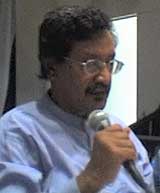 "In light of the many controversies surrounding the forestry industry in Sarawak, we call for a commission of inquiry to be instituted to look into all existing allegations against the logging and plantation industries," he told a press conference in Kuala Lumpur.
He added that the commission could also ascertain why forestry governance in Sarawak remained a closed process, the beneficiaries of such policies and of the industry, as well as its full range of social and environmental impacts.
The set up of such a commission could also start the process of improving the reputations of the federal and Sarawak governments which have been damaged by unfair logging and plantation practices, he added.
"There have been very adverse reports about Malaysia and the way we have been implementing our forestry policies, which have been heavily criticised not only by our NGOs but by international organisations and even other governments.
"This brought our country, our people, the federal government and, of course, the state government into disrepute. Whenever we go to conferences overseas, people are always asking, ‘What's happening to Sarawak?'" he said.
Several Sarawak natives from Bintulu were also present at today's press conference to speak of their suffering, caused by state-sanctioned logging and plantation industries.
Ancestral land seized by companies
 Bagong Swee (
left
) from the village of Sebungan related how his ancestral land had been ‘claimed' by a Kuala Lumpur-based corporation for its 2,000 hectare oil palm plantation.
"It has been years since they came and told us that the land, on which we have lived for generations, was now theirs. Until now, they have refused to compensate us," said Bagong.
Sengok Sabang and his son Malai, from the village of Sungai Binyo in Pandan, Sebauh, related how about a dozen of their storage huts were demolished in March last year by state enforcement personnel at the behest of a corporation intent on planting pulpwood trees.
Geling Enggang, meanwhile, spoke of his fellow villagers' anxiety after being told by another company that their ancestral land was no longer theirs.
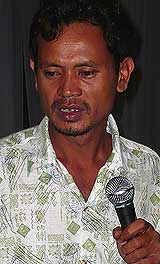 "They told us we are not wanted there. The only ones allowed on the property are the company people," said Geling (
right
).
All of them called on the Sarawak Forest Department and the state Land and Survey Department to exclude their land from areas licensed to these corporations.
Commenting on this, Mohideen noted that many native leaders, upon calling for the state government to respect their native customary rights, were punished by having their appointments as heads of their village security and development committees revoked.
"It is unfair and unjust on the part of the government to punish them just because these natives are demanding their rights," said Mohideen.
Earlier, he also highlighted the conflicting statements of Plantation Industries and Commodities Minister Peter Chin and Prime Minister Abdullah Ahmad Badawi in 2007 and 2008 that rainforests would not be cleared to make way for plantations.
On the contrary, said Mohideen, 2.8 million hectares have since been licensed out for the planting of mainly oil palm and pulpwood trees, adding that Sarawak Chief Minister Abdul Taib Mahmud on June 29 said that the state would continue to open up more land for oil palm.
"We are deeply troubled that the Sarawak state government appears to be oblivious to the criticisms that its development policies are lacking in transparency and good governance," he said.
Mohideen called for the Sarawak government to review its forestry licensing process, halt further forest conversions, improve decision-making processes and to recognise native customary rights.


Report this comment
Are you sure you want to delete this comment?
This action cannot be undone.