




MCA election: The key contenders
In a rare karmic coincidence - just as the moribund Malaysian largest political party Umno is starting to show serious signs of internal leadership cracks aggravated by the onslaught of the Pakatan coalition threatening to take over Umno’s lynchpin role - the MCA is positioning itself for a “rebirth.”
In a rare karmic coincidence - just as the moribund Malaysian largest political party Umno is starting to show serious signs of internal leadership cracks aggravated by the onslaught of the Pakatan coalition threatening to take over Umno’s lynchpin role - the MCA is positioning itself for a “rebirth.”
The second largest Barisan Nasional component party, Chinese based MCA will choose its president, deputy president, four vice- presidents and 25 central committee members on October 18 next month.
The nomination day for the party polls is scheduled on October 13, but to-date, only two candidates have formally declared their intentions to challenge each other in a straight fight for the presidency.
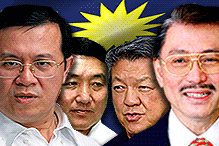 Vice-president and Transport Minister Ong Tee Keat will lock horns with former vice-president Chua Jui Meng, also a former health minister. It does not matter now that both had then shared the same platform and were in the same camp during the Ling Liong Sik-Lim Ah Lek leadership crisis.
Both were against the acquisition of Nanyang Siang Pau spearheaded by Ling and on several occasions, Chua defended Ong, then MCA youth chief, in 2001 against the many “unjust” decisions of the incumbent Ling leadership in handling the infamous “youth chair-throwing” fiasco on August 3, 2001 which led to the suspension of the youth wing.
Sharing some common characteristics like outspokenness and political courage, both are defenders of justice and righteousness. Political adversaries nevertheless agreed on common ground that both are capable of taking divergent views away from the herd-mentality.
Both had been politically marginalised by a previous incumbent leader. However, the similarities end here.
No eternal friends or foes
While Chua had contested against incumbent president Ong Ka Ting in 2005 and lost, Ong Tee Keat has never been defeated in his political climb.
There is a ring of truth in the maxim that in politics, there is no 'eternal' enemy and no eternal friend. “Be cautioned that your greatest ally can betray you while your bitter enemy can become your greatest supporter.”
Unsurprisingly, the distinct factional political alignments which prevailed in the past crisis-ridden MCA has blurred today.
For this rare phenomenon, MCA in the coming elections is void of a leadership transition or a succession plan as witnessed in the Ling’s infamous 2003 leadership retirement plan. Outwardly, the party is back on track towards a more democratic path unlike the tribal politics of its “un-evolved” political master, Umno.
In this context, two former “comrades” of Team B will be facing each other for the presidency, namely Ong Tee Keat and Chua Jui Meng while two former Team A leaders Ong Ka Chuan, the current secretary general, will be facing a contest against Dr Chua Soi Lek, the former vice-president and ex-health minister.
Straight fights?
It is uncertain at this stage whether it will be straight fights for the presidency and deputy presidency as nomination day is still weeks away.
Jui Meng with 15 years of government experience, nine as a cabinet minister and 30 years of serving the party, is known for being outspoken on issues during the party crisis.
Seven years ago, former president Dr Ling Liong Sik set up a 6-man investigative committee comprising party elders to look into the “youth chair-throwing incident” involving both factions, Team A and B, the latter led by former deputy president Lim Ah Lek.
“I think this is one of the rare occasions in the democratic practice in this country … definitely within the Barisan Nasional that the Committee of Elders can overturn the decisions of a general body (youth assembly) of a party, in this case the youth (MCA). It insults and offends the very basic principle … (of democracy),” Jui Meng, a lawyer, said in defence of Tee Keat at a central committee meeting on December 20, 2001, chaired by former president Ling Liong Sik.
Jui Meng had objected to the undemocratic manner in which Ling’s central committee - dominated by Team A leaders against the gang of 8 in Team B - had tried to push through a report submitted by the 6-man special investigative party elders’ committee, chaired by Chor Chee Heung.
Team B leaders led by Lim Ah Lek included Chan Kong Choy, Wong Mook Leong, Dr Tan Yee Kew and Fu Ah Kiow had also objected that Ling had by-passed the disciplinary committee and releasing the investigative report to the press even before submitting it to the central committee.
Upholding values
On hindsight, the stand taken by MCA leaders during this episode reflected their characters and values they held. A party central delegate from Wilayah said, “The revamping of the party in the coming internal elections should not be a mere changing of “faces” but on issues and principles they stand for.”
But how many of the central delegates reflect this thought of wisdom?
Indeed, wisdom in politics is like scarcity of water in a desert. The mantra repeated by candidates that they will place their political destiny to the wisdom of the delegates is suspected to be more of a myth rather than reality.
If political science is aptly defined more on behaviourism of human nature in politics then wisdom by logic can only be drawn from past experiences.
Experience can be a hard teacher because one often suffers first before receiving the bitter lesson. Unlike other sciences, there is no laboratory in experimenting politics to extract the intangible product like wisdom.
Only from the candidates’ stand and views on party issues can inferences of their character and value judgement be drawn on their capability and integrity.
“Party delegates would have to be knowledgeable about the candidates’ background, track record and personalities in order to vote wisely. Who are the leaders courageous enough and ready to lead,” another Perak delegate posed.
Recalling a past experience, a party insider said, “Despite objections against Team A's leadership for alleged undemocratic handling of the investigation, several Team A leaders in the central committee voted in support of the report’s recommendations including censuring Ong Tee Keat, rejecting the removal of two youth leaders by the youth EGM and suspending the youth wing over a stipulated period.”
Those who voted in support of the report and suspension of the youth wing (and activities) in 2001 by a central committee resolution included Ong Ka Ting, Ong Ka Chuan, Dr Chua Soi Lek, Dr Ng Yen Yen and Lim Siang Chai.
They also supported the party’s acquisition of the Nanyang Siang Pau.
Rebirth needed
Often certain leaders support a party president out of narrow focus and parochial interests or to be in the good book of his political master rather than on principles and value system.
“It is these candidates that delegates should form their basis judgement based on their leadership track record,” said a party veteran.
For instance, using a transcript from a meeting deliberating on the youth ruckus in 2001, shows the following debate:
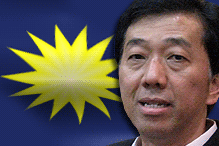 “Dato president (referring to Ling), I think the lawyers know better ... the purpose of the suspension is to settle any dispute arising from within the party or between any organisation. To my mind when I tried to read through (report submitted by Chor), is actually for the good of the party … it’s nothing disciplinary, it is reconciliatory the problem,” Ka Ting defending the suspension order (of the youth wing).
“I disagree with Ka Ting. This is a disciplinary action (suspension of the youth wing), the most severe nature. You’re attacking all the youth in this country … under the MCA banner. This is a very far reaching thing you’ve done,” Jui Meng argued.
Chor in response to Jui Meng said, “Let me explain, actually what I decided to do after conferring with a few central committee members, now because of late, we’ve been, I mean, the party has been brought to much ridicule…especially the youth. I’m not saying, Tee Keat, you’re wrong. No. But true enough, everyday it appears in the papers. I’m thinking how to solve this … so how are we going to bring calm back.”
Supporting the motion to suspend the youth, Soi Lek said, “….if we can restore peace and stability to MCA, MCA youth, I must be very sure, everybody here who loves the party must support this resolution. Let the police do their report ... the police may take five years.”
Defending himself, Tee Keat addressed the central committee, “If I may say a few things, since I am the interested party and I wish that what I’m saying be put on record.”
“….since you (central committee) want to suspend the youth wing, my feelings are not hurt ... this is none other than a different form of emancipation of powers and also the provision of the rights of delegates, the youth delegates.”
“What I am trying to say is that you may call in any 3-man or 6-man committee or what have you, just like the peace-keeping force of the UN (United Nations) to oversee the whole process….,” said. Tee Keat.
Perhaps looking back into history, some party insiders ardently viewed that both presidential candidates should avoid the coming challenge. Some viewed that both should be fighting at different levels: for the presidency and deputy presidency respectively instead of one becoming the casualty.
Another delegate viewed in metaphorical rational: “The MCA is like a star (incidentally its symbolic logo is a yellow star) burning itself out of hydrogen as it orbits along a path threatened by meteor storm Pakatan Rakyat. Unless it goes through a rebirth, it will eventually be doomed, gravitating towards the dying planet Umno.”


Report this comment
Are you sure you want to delete this comment?
This action cannot be undone.