




DNA bill 'worst piece of legislation'
Debate continues to rage over the DNA Identification Bill 2008 which is before the Dewan Rakyat, still without benefit of input from stakeholders.
Debate continues to rage over the DNA Identification Bill 2008 which is before the Dewan Rakyat, still without benefit of input from stakeholders.
At a public forum organised by the Bar Council yesterday, critics outnumbered supporters in the panel convened to discuss the draft law which has already been described as a disaster for legal and human rights.
It had its second reading during the August session of Parliament over the objections of the Bar Council among others.
 Prominent constitutional lawyer Tommy Thomas, speaking on the theme ‘The DNA Bill: Do We Need It?’, reiterated key points of dissent.
“Big Brother is (as in George Orwell’s ‘1984') about to tighten his noose around you - and we are under threat of becoming a police state,” he said.
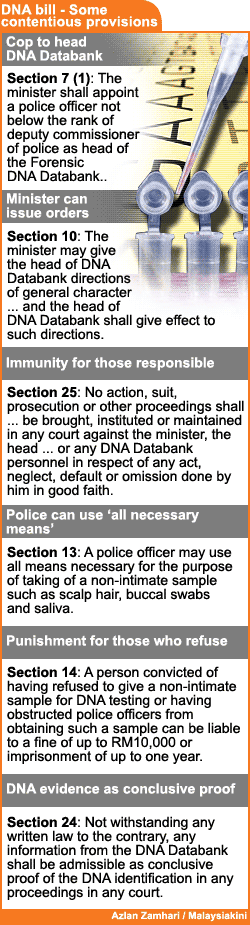 Thomas said the main concerns are the proposed:
- appointment of a police officer to head the DNA databank (Clause 7);
- right of the police right to rectify evidence which is not seen as tampering (Clause 9);
- power of the minister to give directions to the set-up; and
- jailing of those who refuse to give non-intimate specimens when demanded by police.
“To top this the evidence submitted will be conclusive and cannot be challenged, according to Clause 24,” he said.
“It is the worse piece of legislation proposed in Malaysia. We should chuck it to the dustbin and consult stakeholders before we make any DNA law.”
Criminal law specialist V Sithambaram was equally critical of the bill, which he feared will be passed without sufficient safeguards.
“My objection is that the police should not have anything to do with the databank. The police are ill-suited to deal with this,” he said.
“An ideal solution would be perhaps funding one of the universities to hold the lab, so that (the results) will be purely scientific. They should have no direct connection with the police.”
He explained that, when all the roles are with the police, the investigating officer could collude with the forensics officer and objectivity would suffer. The forensics officer could unconsciously assume a prosecutor’s bias in interpreting the data.
While the DNA match itself may be reliable, Sithambaram pointed out that context is important.
 Sithambaram
((left)
cited the Norita Shamsuddin murder case where several specimens were found at the crime scene. A determination had to be made on duration and volume, for instance, requiring interpretation.
Sithambaram
((left)
cited the Norita Shamsuddin murder case where several specimens were found at the crime scene. A determination had to be made on duration and volume, for instance, requiring interpretation.
“Clause 24 removes from the judge (the power) to judge the validity of the DNA profiling since it (is rendered) conclusive. Therefore (the defence has) no right to cross-examine or provide other experts to dispute the DNA profile from the databank,” he explained.
‘Gaps in bill’
The sole politician on the panel, Sungai Sungai PSM parliamentarian Dr Jeyakumar Devaraj, told those present to get their elected representatives to hold back passage of the bill in view of the glaring problems detected.
The Act allows for a non-intimate sample to be taken from anyone suspected of an offence or is a detainee, and so would include all those held under the Internal Security Act, he said.
 “It will be the first bill to be discussed after the budget session, and will pass soon. The opposition MPs are
opposed to it
, but the government majority will carry the bill through.
“It will be the first bill to be discussed after the budget session, and will pass soon. The opposition MPs are
opposed to it
, but the government majority will carry the bill through.
“The DNA databank should be under a medical department, not the police. Malaysians are not convinced of the impartiality of the police and the attorney-general’s office, so giving this power to the police is dangerous.”
The third reading of the bill, which will enable it to become law, is expected during the current session of Parliament, after the ongoing debate on the Budget 2009.
 Dr Koh Chong Lek, head of the of the DNA Centre at the Nanyang Technological University Singapore outlined various benefits of DNA in criminal investigation.
While he highlighted the rigorous process and precision of the science, he also maintained that DNA should be used to corroborate evidence and not become an end in itself during investigations.
“There are concerns with the DNA bill since it does not spell out the clear purpose, scope and function of the DNA databank,” he added.
“It is uncertain if the bank will be responsible to the board or just to the minister. The proposed Act is silent on this.”
Defence of current work
Representatives of two departments now involved in DNA examination - the police forensics laboratory and Chemistry Department - defended the need for such profiling.
 “Recidivism rates are reduced by DNA profiling. In the UK, the databank has 4.2 million specimens and 1,700 crime scenes have been matched,” said forensics director Primulapathi Jaya Krishnan of the Chemistry Department.
“80 percent of crimes are being solved with the assistance of DNA profiling over there, and we should be able to solve more crimes here in Malaysia.”
Agreeing with Koh that the data should be corroborated with evidence, he also defended his department’s work.
“The system we have is randomly checked on by international monitor groups, and we have been accredited,” he said, adding that human error - while possible - is being minimised.
 Police forensics head Dr Yew Chong Hooi said DNA profiling is invaluable in criminal prosecution, arguing “you cannot ask the police to fight crime without the right tools”.
He acknowledged that it is more difficult to secure, process and maintain DNA in an equatorial country like Malaysia, where humidity and heat are likely to deteriorate the evidence.
Yet, despite these challenges, he said the police have processed evidence through a stringent process which takes up to 10 hours for every sample.
“DNA matching reliability has improved from the early years. From nine-point match-ups, we have gone up to 16-point match-ups” he said, adding that it is impossible for a properly secured and processed profile to be erroneous.


Are you sure you want to delete this comment?
This action cannot be undone.