




'Allow free movement of goods across South China Sea'
Local shippers, port authorities, consumers and manufacturers in Sabah and Sarawak are keeping their fingers crossed to see the free movement of goods between Peninsular Malaysia and Malaysian Borneo.
Local shippers, port authorities, consumers and manufacturers in Sabah and Sarawak are keeping their fingers crossed to see the free movement of goods between Peninsular Malaysia and Malaysian Borneo.
This would become a reality if the federal government abolishes the Cabotage Policy - which allows a cartel to control the transport of goods across South China Sea - following a just completed study by the Transport Ministry.
 Deputy Minister Lajim Ukin has said that “the ministry would be discussing it (the Cabotage Policy) soon with the relevant departments and agencies and the report will be submitted to the federal cabinet.
“Since it is a policy, only the federal cabinet can decide,” he said responding to calls in recent days by the Federation of Sabah Manufacturers (FSM) and local chambers of commerce to abolish the policy.
The Cabotage Policy, basically to protect the local shipping industry, allows Malaysian shipping companies to form a cartel.
This has allowed them to control the movement of goods between Peninsular Malaysia and Malaysian Borneo, allowing them to dictate shipping charges, which leaves consumers at their mercy.
Sabah and Sarawak point out that there is no cartel in the aviation sector and this has allowed Kota Kinabalu International Airport to emerge as the second busiest in Malaysia after the Kuala Lumpur International Airport.
 Transport Minister Ong Tee Keat has blamed other freight charges and inland transport for the price differences between Peninsular Malaysia and Malaysian Borneo and has so far only hinted at a progressive liberalisation of the Cabotage Policy.
His remarks have not gone down well with the general consensus of public opinion in Sabah and Sarawak.
Transport Ministry is MCA territory
“The Transport Ministry is MCA territory. When issues involving the ministry are brought up at the federal cabinet level, the recommendation of MCA ministers carry more weight than all the other federal cabinet ministers combined,” said an industry analyst.
“We have ministers like VK Liew, Dr Maximus Ongkili, Shafie Apdal and Bernard Dompok from Sabah who have proven that they cannot be relied on to represent Sabah’s interests (in shipping). They are more interested in apple-polishing, cutting ribbons, gas projects and church publications,” he said.
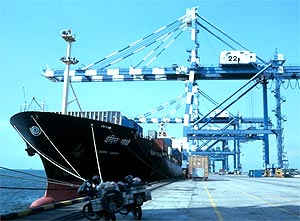 “It is well known that freight charges from Hong Kong to Port Klang are far cheaper than from Port Klang to Kota Kinabalu. Imagine, for more than 20 years, Sabah and Sarawak have been left behind in Malaysia’s drive for industrialisation, modernisation and development just because of freight charges,” the analyst added.
Shipping companies involved in the Port Klang-Kota Kinabalu traffic say that while the freight charges from Hong Kong to Port Klang is RM1,500 minimum, the Port Klang to Hong Kong freight charges is RM200 minimum.
The Cycle and Motor Parts Traders Association (CMPTA) of Kota Kinabalu add that the freight charges from Port Klang to Kota Kinabalu are even higher than the freight charges from Japan to Port Klang.
One source in a shipping company which plies the Port Klang-Kota Kinabalu route, who simply gave his name as Khairidy, claimed that “the present port structure even in Kota Kinabalu, productivity and efficiency are less than satisfactory and therefore not attractive for shipping lines to call”.
“There is not even a gentry crane in the Kota Kinabalu Port. Furthermore, the equipment is old and worn-out. There are only 18 moves per hour at the Kota Kinabalu Port compared with 30 moves per hour at Port Klang.
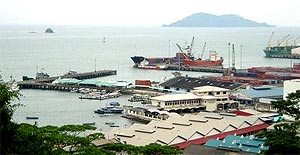 “The Kota Kinabalu Port is also closed on weekends unlike Port Klang which works everyday,” he added.
Khairidy swears that ports in Malaysian Borneo would not be able to attract the larger international shipping lines, and even if they did, “there’s no guarantee that they would not dump their rates so low that local shipping companies would be driven out of business”.
The pro-Cabotage Policy lobby says that “high freight rates mean higher cost of living in Sabah is a myth” and use Maggie Mee to get their point across.
The price difference between Port Klang and Kota Kinabalu for Maggie Mee should be RM0.04 sen per packet based on the fact that a 20-feet container can load 33,120 packets of Maggie Mee and given present freight charges i.e. RM 1,050 plus EBS (Emergency Bunker Surcharges) of RM709.
Hence, ocean freight is said to contribute to only 46 percent of the price difference between Port Klang and Kota Kinabalu and “there are other factors that result in the higher cost of living in Sabah”.
The best thing is to open up
However, FSM president Wong Khen Thau begs to differ.
“In Sabah, the prices of goods are 20 to 30 percent higher than in Peninsular Malaysia because of the Cabotage Policy. This is not fair to consumers. The best thing to do is open up so foreigners can also participate.
“It is good for us to export. Competition will bring down prices. It is for the whole industry to survive,” he said.
 FSM and the various chambers of commerce have since sent a joint memorandum to the federal government pleading for control of the EBS, among others.
Last September, they sent a memorandum to the federal government on the Cabotage Policy, suggesting “an open policy to prevent monopolisation and manipulation of prices by shipping cartels and which in turn would benefit Sabah in terms of competitiveness in the export market and the consumers as a whole.”
The FSM however is willing to back the Cabotage Policy provided it is confined to within Peninsular Malaysia or within Sabah and Sarawak”.
“But not between Peninsular Malaysia, Sabah and Sarawak which are separated by a vast sea distance. There is no other way ... it must be opened up,” said Wong.
CMPTA president Yong Chen Lip sees prices falling further with the abolishment of the Cabotage Policy.
Already, he pointed out, “the wholesale prices of some of the parts in Sabah are much cheaper than in Peninsular Malaysia” and attributes this to the stiff competition in Sabah among the Peninsular Malaysia-based cycle and motor parts distributors.
The Sabah People’s Progressive Party (Sapp) sees Port Klang operating as a national load centre at the expense of Sabah and Sarawak and wants the Cabotage Policy abolished.
“The Sepanggar Bay Container Port Terminal should also be made a national load centre,” said Sapp treasurer-general Wong Yit Ming.
“This can be done by giving Sabah a special exemption from the Cabotage Policy (if not abolished),” he added.


Are you sure you want to delete this comment?
This action cannot be undone.