




Empowering the voices of the unheard

 If the
Freedom Film Fest 2005
is anything to go by, social and community activism has found a new platform, and a new voice through small budgets, a bit of creativity, and of course, a video camera.
If the
Freedom Film Fest 2005
is anything to go by, social and community activism has found a new platform, and a new voice through small budgets, a bit of creativity, and of course, a video camera.
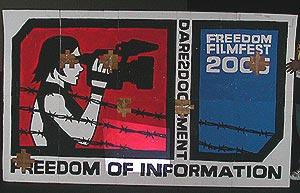
Organised for the second time by Pusat Komunikasi Masyarakat (Komas), the festival features a selection of international and local short films and documentaries, based on the theme "Freedom of Information".
The festival culminated in an awards night on July 10, which was plagued by technical glitches but saved by strong performances from dancers and singer-songwriters.

 If the
Freedom Film Fest 2005
is anything to go by, social and community activism has found a new platform, and a new voice through small budgets, a bit of creativity, and of course, a video camera.
If the
Freedom Film Fest 2005
is anything to go by, social and community activism has found a new platform, and a new voice through small budgets, a bit of creativity, and of course, a video camera.
Organised for the second time by Pusat Komunikasi Masyarakat (Komas), the festival features a selection of international and local short films and documentaries, based on the theme "Freedom of Information".
The festival culminated in an awards night on July 10, which was plagued by technical glitches but saved by strong performances from dancers and singer-songwriters.
"18?"
The highlight of the afternoon on the opening day was the documentary "18?" by Danny Lim, which was awarded second prize for the amateur category.
The film, which aptly lasted 18 minutes, portrayed Lim from a first person perspective, gallivanting across Kuala Lumpur searching for clues to the mysterious "18?" stencil graffiti which had cropped up all over the city.
 From walls to pillars to phone booths, the documentary contrasted how the "18?" graffiti, along with other politically charged images created in similar fashion, were as ubiquitous as advertising and political messages.
In a series of interviews, Lim talked to the people on the street, only to find a myriad of explanations to the phenomena. One subject suggested it had to do with National Service, while several thought it was the mark of a street gang.
The documentary later featured several prominent and colourful activists such as Eric Paulsen of Suaram, Sonia Randhawa of the Center of Independent Journalism and even former ISA detainee Hishammudin Rais, all offering their individual theories and insights, while obviously hiding the identity of mysterious graffiti tagger(s).
While there was no general consensus by the interviewees as to what "18?" meant, the documentary leads viewers into understanding the symbolism of graffiti as a form of expression, desperately competing for an audience in a over saturated public space.
Acclaimed communications theorist Marshall McLuhan said that one should look at the medium for the message. The same can be said of the graffiti and how this documentary was conceived.
Thus, at least to this reporter, "18?" was never meant to be a mystery, but a carefully crafted metaphor for the perceived lack of free speech in this country, and being creative to get around it.
But highly public graffiti is nothing new. What makes "18?" so compelling is that it features graffiti with explicit political and social messages. It would seem as though the graffiti had cropped up as a direct response to repressive laws in Malaysia which allows detention without trial and little freedom of expression.
To conclude, "18?" is a praiseworthy effort and a whiff of fresh air, as it explores a relatively obvious, yet overlooked phenomena in Kuala Lumpur. Also lookout for Hishammudin as he provides insights on 'art' in Malaysian public toilets.
Bottomline: Gritty, humorous, guerilla style and thought provoking. Ntv7's Edisi Siasat could learn a thing or two from Lim.
Score: 3.5 out of 5 teh tariks
Clean Shit
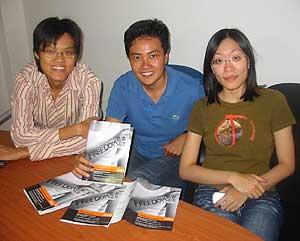 My pick of the festival, and incidently winner of the amateur category, would be Ong Ju Lin's (
photo, centre
) documentary entitled "Clean Shit".
My pick of the festival, and incidently winner of the amateur category, would be Ong Ju Lin's (
photo, centre
) documentary entitled "Clean Shit".
As the lights in the Actors Studio dimmed over a packed evening house, the audience was treated to images of lush greenery typical of a rural area. As the montage played on to the sounds of blissful guitar music, we are brought to the village of Broga.
The documentary centered upon Alice Lee, a clerk in a furniture factory, and her role in her community's tenacious struggle against an omnipotent force out to build the largest waste incinerator of its kind in Asia, literally in their backyard.
This film drew a roar of the applause as start of the ending credits, again at the end of the credits, and yet again as the film producer, Alice and her comrades took the stage for a post-screening Q&A session. Albeit a 'sitting' ovation, the crowd was appreciative nevertheless.
Perhaps the audience was overwhelmed by how the producers portrayed the best side of humanity in the face of such a tremendous adversary, through explaining the resilience, righteousness and a sense of community in Broga, challenging greed, corruption and environmental destruction.
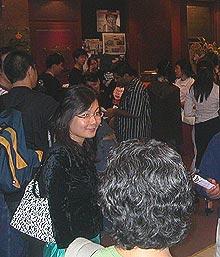 During the Q&A session, from the sea of hands waiting to voice concerns and questions for Alice and her comrades, it was obvious Ong and her crew had driven the Broga community's struggle deep into the heart of the audience.
The central appeal of this documentary was not on the gravity of issue at hand, but on Alice and the many people who made up the relentless community of Broga, in their struggle for justice.
Often, documentaries consult experts for their professional opinions into a matter. Aside from an official from the Prime Ministers Department who declined to give detailed comments, no public figure was interviewed for this documentary, not even opposition politicians (who had provided support for the Broga community).
This documentary is solely about how the layman can rise up and persevere against oppression, thus ensuring its universal appeal.
This reporter hopes, that the simplicity and effectiveness of this documentary will becomes the benchmark for documentaries in this genre, and a inspiration for all community activist.
Bottomline: Brutally honest and empowering, yet poetically executed. A sweet and moving soundtrack to boot.
Verdict: 4 out of 5 teh tariks
In the future
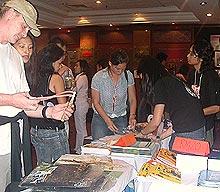 Considering that the festival is still in its infancy, the organisers of the event has performed a commendable effort, by providing an avenue for independent film makers to showcase their talent and stories to the public.
While I can't really find anything to gripe about the festival per se , I would like to suggest to the organisers to find some place else to hold the festival next year. Had I not been assigned to cover the event, I would not have even considered showing up, as the event may be free, but the infamous parking lot within the complex was not.
In fact, the parking rates were downright outrageous, which possibly negatively affected attendance.
It is also strange that a film festival promoting egalitarian values and championing the plight of the disenfranchised and downtrodden would be held in a shopping center that caters to the social elite.
 In closing, the two aforementioned documentaries blurs the line between investigative journalism, activism and film making which resulted in very compelling pieces of work, all with a minimal budget and a flair for expressing their findings.
The two films effectiveness in bringing out their respective issues proves that other just about anyone can emulate what they have done, circumventing restrictions imposed on traditional media, and reaching to the masses.
For example, Ong, when contacted, explained that "Clean Shit" would be distributed in VCD and DVD format in the future, and that she has received many offers to have her movie screened at various venues. Lim however, had opted for "18?" to distributed via his website .
Activism it seems, is no longer confined to street protests and campaigns, but has spread into personal living rooms and theatres. And hopefully, we'll be treated with more at the festival next year.
ANDREW ONG is struggling to be a creative writer, and thanks to an accident, will be limping for another three weeks. Comments and criticism can be directed at andrew@malaysiakini.com .


Are you sure you want to delete this comment?
This action cannot be undone.