




Food galore in Spain Pt 1

WE landed in Spain with a hungry mission to eat our way through an encyclopedia of tapas, gazpachos and paellas. After all, this is a country that has awakened from the isolation and destitution of the Franco years to rebirth as one of the most vibrant, liberal and creative culinary and cultural vanguards of Europe.
 In fact, a revolution has been boiling over in the Michelin-starred kitchens of Spain in the last decade. Started by a radical and visionary Catalan superchef named Ferran Adri who is hailed as the best cook on the planet, the experimental nueva cocina (new cuisine) fuses ground-breaking research in physics and chemistry with traditional ingredients to create surreal, whimsical edible constructs.
Lauding ourselves as food purists (but only after a quick budget check dispelled any lofty notions of wining and dining at Adri's restaurant), we thumbed our nose at nueva cocina and went about sniffing for traditional cooking at our first stop, Barcelona.
In search of traditional Catalan cooking
Barcelona is the capital of Catalonia, a region with its own language, character and turbulent history - many Catalans do not think of themselves as Spanish - and is a world apart from the flamenco-dancing and bullfighting south of Spain.
My guidebook warned that visitors primed for tapas and sangria in Catalonia will be disappointed. But a stroll down La Rambla, a lively pedestrian boulevard that is Barcelona's most famous street, took us past a dozen of tapas bars packed with English tourists sipping jugs of mid-morning sangria (which incidentally is branded by the Spanish as a tourist drink).
Determined to have our first taste of authentic traditional Catalan food, we strode purposefully past these tourist haunts, the twittering bird market and riotous flower stalls, to the bottom of La Rambla where Barcelona meets the sea.
Once an eyesore, Port Vell is an old harbour that has been given a face-lift and we found ourselves strolling down neat palm-lined promenades lined with scores of gleaming yachts bobbing in spangles of sunlight. The harbour front is laced with stylish Italian and seafood eateries but rustic grandmotherly Catalan cooking remains elusive.
Tapas fest
After a two and a half hour search, we wound up in a grey and gritty area called La Barceloneta, which was long a factory-workers' and fishermen's quarter. Rounding a corner, we stumbled onto a crowded pavement that has become the al fresco extension of a seafood tapas bar called Bar Jai-ca. Unable to support my buckling legs anymore, I collapsed onto the first available chair and filed Catalan tradition for another day.
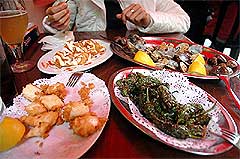
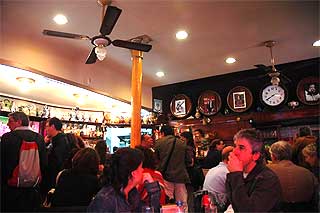 There was no menu so we made our order by vigorously pointing at our neighbours' food and accepting recommendations from the owner who spoke in Spanish not found in my phrasebook. My drink arrived first - I called for the evocative sounding clara which is proclaimed as Spain's beloved summer refresher - it turned out to be something very familiar to Malaysians called Shandy or beer topped with 7-Up.
What came next were unfussy but scrumptious platters of piquant fried green peppers (pimientos) sprinkled with sea salt, juicy clams sauted in olive oil, deep-fried thick and tender calamari, and fluffy potatoes topped with allioli (a zesty garlic mayonnaise that Catalans use to enliven a myriad of dishes).
While Catalonia doesn't have a long tapas tradition, places like Bar Jai-ca certainly make up for it by excelling in simple, ingredient-driven tapas. Later, I discovered that Bar Jai-ca is one of the best seafood tapas bar in Barcelona.
The dreamworks of Gaud
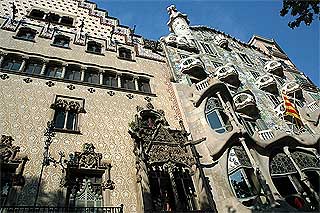 The next day, we resumed our hunt for Catalan food after visiting Casa Batll. Inside this astonishing apartment house designed by Barcelona's wackiest Modernista architect, Antoni Gaud, one gets the pleasant, floaty sensation of being underwater. Walls and windows undulate in ripples, ceilings swirl into vortexes and breast-like protrusions and every surface playfully curves and curls with sinuous grace.
Down the road, the La Pedrera (Quarry) is another Gaud dreamwork. Its chimerical facade is dominated by elaborate wrought-iron balconies writhing with vegetal forms and its roof is crowned with giant chimney pots resembling medieval knights.
After wandering through miles of leafy wide streets and spacious plazas of the middle class L'Eixample (Extension), Barcelona's 19th century solution to over-crowding in the medieval quarter, we were suddenly stopped in our tracks by the jaw-dropping sight of Gaud's crowning masterpiece, the unfinished La Sagrada Famlia (Temple of the Holy Family).
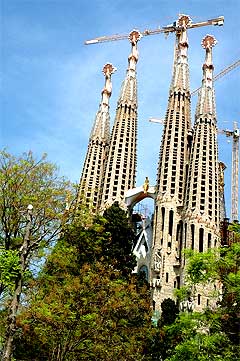 With towers spiralling to more than 100 metres, the La Sagrada appears more like a sculpture than a church. Always borrowing inspiration from nature, Gaud designed the towers to resemble the bizarre peaks of Monserrat outside Barcelona and the leaning pillars of the interior nave to emulate the trees in a forest, and even decorated the top of the towers with bowls of multi-coloured fruits. Despite being uncompleted after 125 years, the La Sagrada is already a legend.
Artichoke massacre
In the shadow of the La Sagrada Famlia, we found an unadorned bar (in Spain, casual restaurants are called bars) of the same name. We struggled with the Spanish menu and the Spanish-speaking waitress and waited to be surprised by our order.
Two large artichokes were subsequently plonked on our table. No cutlery, no garnishing, no instructions on how to eat it. If you are as unfamiliar with an artichoke as we were, it is an inedible-looking giant bud enclosed in thick, protective, green scaly petals.
We followed our instincts and peeled off the outer petals before chewing on them. After a few tries, it became apparent that the petals were too fibrous and bitter to swallow but the delicious soft flesh at the bottom of each petal was divine!
After tearing through to the centre of the artichoke, we discovered its most treasured prize - the heart or choke is the most succulent part of the plant that is revered by gourmet chefs around the world. Less sublime but also very tasty were the flavourful seafood broth and baked cod that came after the artichoke massacre.
Medieval home turned classical restaurant
That evening, we entered the brooding Barri Gotic, Barcelona's medieval tangle of narrow, winding streets, quaint plazas, grand mansions and noble monuments. Tucked away in one of the little alleys, we found a line of people waiting for the doors of the Pitarra Restaurant to open at 8pm which is typically the time restaurants in Spain open for dinner.
Once the home of the 19th century Catalan playwright Frederic 'Pitarra' Soler who is considered the father of Catalan theatre, it is presently incarnated as a homely restaurant renowned for serving up classical meaty Catalan dishes. Just what we have been looking for!
 We promptly joined the line and were given a tiny table in the middle of an aisle - presumably punishment for being the only ones in the room brazen enough not to have a reservation. The restaurant resembles someone's cozy dining room with walls and shelves adorned with memorabilia of the life and work of Pitarra and his writer friends.
This time, we did not trouble with the menu and blindly took recommendations from the waiter. The baby goat and bream fish that arrived were both tender and juicy but the highlight of the meal had to be the crema catalana, a typical dessert in Catalonia and the Spanish version (and even origin as some believe) of the more famous French dessert, crme brulee.
It is an exquisitely simple dessert that plays on the thrilling effect of contrasting temperatures and textures; of cool and soft custard that dissolves in your mouth and crusty, crispy fire-torched caramel glaze that crunches between your teeth.
Photo credit: Ken Yeong
Part 2 on Friday
SHIRENE CHEN is a restless pilgrim taking a rest from the corporate world to read, write and live. Comments can reach rentakini by emailing francis@malaysiakini.com


Are you sure you want to delete this comment?
This action cannot be undone.