


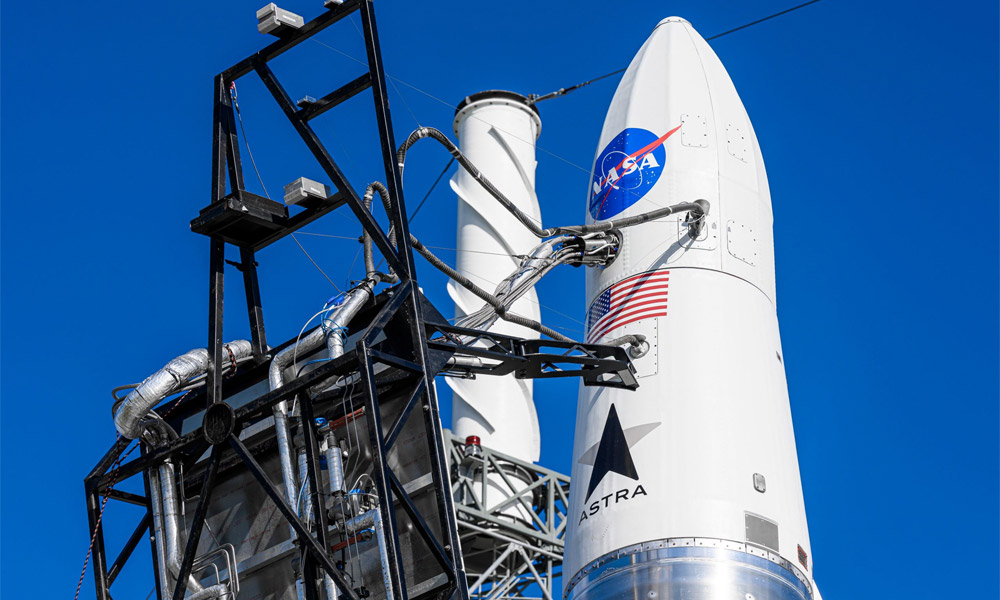

Space launch startup Astra scrubs latest attempt to reach orbit
California-based rocket startup Astra Space Inc aborted the planned liftoff of its first operational satellite launch, a National Aeronautics and Space Administration (Nasa) mission, on Monday, citing a technical glitch that emerged at the last second.
The countdown was halted at T-minus zero, just moments before Astra's two-stage, kerosene-fuelled Launch Vehicle 0008, also known as Rocket 3.3, was due to blast off from Launch Complex 46 at the Cape Canaveral Space Force Station in Florida...
California-based rocket startup Astra Space Inc aborted the planned liftoff of its first operational satellite launch, a National Aeronautics and Space Administration (Nasa) mission, on Monday, citing a technical glitch that emerged at the last second.
The countdown was halted at T-minus zero, just moments before Astra's two-stage, kerosene-fuelled Launch Vehicle 0008, also known as Rocket 3.3, was due to blast off from Launch Complex 46 at the Cape Canaveral Space Force Station in Florida.
Astra's director of product management Carolina Grossman said during a livestream of the event that the launch team had decided a short time later to scrub the flight for the day and try again at some unspecified future time.
The next available launch window for the Nasa mission was not immediately clear. Both Astra and Nasa said the launch was put on hold due to a minor telemetry issue that required further review.
Shares of Astra, which went public on the Nasdaq in July, were down 14 percent in late trade on Monday, after the mission was aborted for the day.
The postponed ELaNa 41 mission is designed to carry four miniature research satellites, or CubeSats, into orbit for Nasa - three of them developed by public universities and one by Nasa's Johnson Space Flight Center in Houston.
ELaNa stands for the Educational Launch of Nanosatellites programme, which has sent more than 100 CubeSats into space since its 2010 inception under Nasa's Launch Services Program that contracted Astra for this mission.
Headquartered in Alameda, California, Astra is one of a burgeoning array of new firms building small-payload launch systems to cash in on the exponential growth in compact satellites needing a ride to orbit.
Front-runners in this class of commercial space ventures include Firefly Aerospace, owned by entrepreneur Max Polyakov, US-New Zealand startup Rocket Lab and British billionaire Richard Branson's Virgin Orbit.
The boom is fuelled in part by venture cash and technology advances that have reduced the size, and boosted the capabilities, of satellites used for everything from communications to national security and climate studies.
- Reuters




Report this comment
Are you sure you want to delete this comment?
This action cannot be undone.