




Studying the Bible, maths and science in Malay
Doubtless, the attacks on churches were carried out by a fringe group and roundly condemned by the mainstream. But following the firebombings, the Malay polity is further inclining to the hardline.
On Jan 15, Sinar Harian, a more neutral publication compared to the rest of the Malay papers, had the front page headline: 'Jais senarai 25 kalimah larangan' .
Doubtless, the attacks on churches were carried out by a fringe group and roundly condemned by the mainstream. But following the firebombings, the Malay polity is further inclining to the hardline.
On Jan 15, Sinar Harian, a more neutral publication compared to the rest of the Malay papers, had the front page headline: 'Jais senarai 25 kalimah larangan' .
The words forbidden to non-Muslims by the Selangor religious department (Jais) include: Allah, firman Allah, nabi, mubaligh, syariat, wahyu, mufti, Kaabah, hadis, rasul, iman, ibadah, fatwa, haji, kiblat, Ilahi, Injil, ulama, khalifah, wali, syeikh, iman and dakwah . Previously banned words are solat and Baitullah .
Majlis Agama Islam Negeri (Mais) endorses the Jais stand. Mohammed Khusrin Munawi who heads the latter agency gave a reminder that missionaries caught proselytising to Muslims, and in the process using any of the 25 words whether orally or in written form, can be fined RM3,000 or jailed up to two years, or both.
 Eleven other states are set to follow suit in enforcing the enactment pertaining to Non-Islamic Religion (Control of Propagation among Muslims).
Utusan Malaysia
gleefully reports that the only states without this enactment as yet are Sabah, Sarawak and the Federal Territory.
Eleven other states are set to follow suit in enforcing the enactment pertaining to Non-Islamic Religion (Control of Propagation among Muslims).
Utusan Malaysia
gleefully reports that the only states without this enactment as yet are Sabah, Sarawak and the Federal Territory.
The convention of 'Allah' belongs to Islam. Heightened "sensitivities" currently prevailing is premised on this plain understanding, particularly among ordinary Malays in the peninsula.
Malaysians who are pro- Herald and jumping up and down remind me of the proverbial frog being boiled alive. The poor amphibian had been immersed in a pot incrementally heated and not realising its fate, unlike if it were otherwise scooped from the lily pond and suddenly dunked into hot water. We should get real.
Facts on the ground
The reality is that Malays are angry over this issue and it's not an altogether manufactured syndrome, Umno's visible hand in the instigation and agitation notwithstanding.
Their disquiet on the basis of theology is a legitimate sentiment although imagining enemies and threats to Islam are not.
In the opposing camp, the minorities drawing a line in the sand are not necessarily the direct stakeholders, i.e. Christians who worship in Bahasa Melayu.
 They, meaning everyone else aside from Sabahan, Sarawakian and Orang Asal Christians, have been finally cornered into a confrontation with the control-and-command higher authorities.
As to the bone of contention, the guarded consensus is that Christians can use the word 'Allah'. The operative word is 'can', but with reservations.
Again, while aware of the predicament faced by native Christians, I'm still somewhat perplexed as to why the Catholic Church should want to pursue this unswerving strategy which is kicking an own goal.
Sharing 'Allah' just makes it more likely for Christians to be converted than vice versa. How many Malays do you know of who have become Christians? I've only heard of two, Lina Joy and Joshua Jamaludin, the latter detained and tortured under ISA.
Among the Christians who have converted to Islam, the best known is Dr Mohd Ridhuan Tee Abdullah. Another prominent Chinese convert is MCA's Omar Ong Yoke Lin.
Perkim and the religious departments would have the register of 'bin' and 'binti' Abdullahs. It doesn't take a genius to figure out which in direction the tide is fast flowing.
Cultivated Malay 'sensitivity' gene
In the current situation, a parallel ought to be drawn to the Cowhead episode. The bloodied, severed head of the cow taking centre stage overshadows the salient fact that certain Muslim residents of Shah Alam are adamantly exclusivist.
These Muslims refuse to tolerate the presence of other houses of worship in their vicinity. At the heart of the matter is their insistence that other gods have no place in an Islamic state.
Malaysians should not forget that Hindraf started out as the Hindu Rights Action Force. Indian NGOs had banded under the coalition umbrella because of the mopping up of 'illegal' Hindu temples.
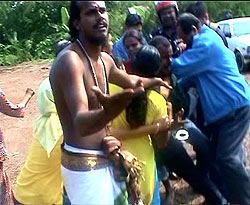 Prior to the political tsunami of March 8, 2008, local council enforcement officers had smashed idols and treated religious statues with contempt when they demolished Hindu and Taoist temples. The Shah Alam-types consider 'syirik' any uniting of Allah with other divine entities.
It is in this context that the Herald case should be viewed. At the core of worry is not the major damage done to the Metro Tabernacle Church or the minor physical damage consequently to the other buildings. We should be more worried by the exclusivity adopted by the Malay middle ground mindset.
Christians, it seems, cannot grasp that from the point of view of the Muslim man in the street, Jesus (despite the reverence generally accorded him in Islamic literature) and the Holy Spirit are 'syirik' if conjoined with God the Father.
As a non-Christian, I can see where the Malays are coming from when they cry foul at what they perceive to be the "hijacking" of their religion.
Yet there is room for accommodation as the Indonesians have shown. Interestingly enough, in Aramaic which is the language Jesus spoke, God is 'Alaahaa'. There is actually closer resemblance between the Aramaic 'Eesho' and 'Maarryaam' to the Malay names of Isa and Maryam (I'm presuming inherited from Arabic narrative) than to Jesus and Mary in English.
Which begs the next question: An inclusive interpretation of tradition allows Malays to accommodate Christians but are they willing to do so? The answer seems to be 'No'. Why?
Fuelling the suspicion
There are several reasons but I will touch on one - bad faith. It's puzzling how ulterior motives and ill intent are imputed to Christians when circumstances hardly substantiate the distrust. The vocal Malays somehow think that Christians are out to 'convert' and 'confuse'.
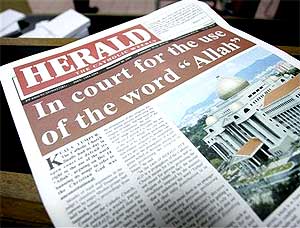
Can you blame Malays if they don't buy the language argument proffered? It's been argued that Christians requiring use of the 'Allah' word cannot access the Bible or worship services unless in Bahasa Melayu.
The Kuching Declaration 1989 by the Christian Federation of Malaysia affirms that churches want to continue using Bahasa Malaysia.
A freelance journalist who has contributed articles to Herald, K Anand writes that Catholics lacking exposure to English need to have their community news and spiritual guidance explained in Bahasa Melayu.
 Using the same logic, the pro-
Herald
crowd by right ought to have been against the use of English in the teaching of Math and Science (PPSMI). Just as the indigenous people require the
Al-Kitab
in Bahasa Indonesia because their incompetence in English rules out the English Bible, they would also require Math and Science to be taught in Bahasa Melayu, don't you think?
Using the same logic, the pro-
Herald
crowd by right ought to have been against the use of English in the teaching of Math and Science (PPSMI). Just as the indigenous people require the
Al-Kitab
in Bahasa Indonesia because their incompetence in English rules out the English Bible, they would also require Math and Science to be taught in Bahasa Melayu, don't you think?
Nonetheless, those backing Herald today had, at the height of the PPSMI debate, failed to protest that Sabahans, Sarawakians and Orang Asal schoolchildren cannot understand the two subjects in English. Applying the same force of argument, PPSMI would have hindered their learning and deprived these kids of "their human rights".
By year 2035, Malaysia is projected to have a population of 41 million, 72 per cent of them Bumiputera and by extension, Malay-speaking. Mother tongue education is a human right too.
I know that among the 86 percent who did not "support the government's decision to teach Maths & Science in Bahasa Malaysia", the poll question in Che Det's blog, were some vociferous Christians.
Out of the 100,204 votes in his online survey, 86,360 supported Dr Mahathir Mohamad in pressuring that Math and Science be taught in English. The non-English speaking Sabahans, Sarawakians, Orang Asal (and additionally rural Malays) were conveniently forgotten by these people back then.
There is some amount of sophistry to the pro-Christians making their case presently. However, inconsistent action speaks louder than ardent words in persuading Malays.
Writing earlier in conjunction with October's National Language Month, Utusan senior editor Ku Seman Ku Hussain complained, "One thing most unfair is when those championing English consider Malay language nationalists as 'chauvinists'."
Well, he can turn around and justifiably ask, "Having your cake and eating it?"


Are you sure you want to delete this comment?
This action cannot be undone.