




Say 'no' to money politics
Money and politics made headline news during the recent Chinese New Year holidays. A political secretary to a senior minister resigned and no reasons were given.
Money and politics made headline news during the recent Chinese New Year holidays. A political secretary to a senior minister resigned and no reasons were given.
Another headline drew attention to a story about the Malaysian Anti-Corruption Commission (MACC) taking away substantial amounts of Malaysian ringgit from an apartment allegedly used by the political secretary.in Teluk Ayer Tawar, Penang.
What was the purpose of the money?
Money is an essential resource to sustain democracy through competitive politics.
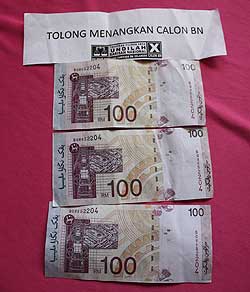 A leading politician from California in the 1960s described money as “the mother’s milk of politics,” meaning it is the political resource that matters most. Anti-corruption activists today say that money politics is the mother of all corruption.
Political parties need money to run campaigns, for elections and day to day administration of party activities. But how much money is needed for these activities and where does the money come from? Does legal or illegal money flow into party coffers?
Without adequate regulations covering disclosure and transparency in political financing, it is difficult to obtain information on the amount of money spent to sustain democracy in Malaysia.
It is even more difficult to determine the sources of money for political purposes without effective disclosure mechanisms. Membership fees and donations from the public are important sources of funds for most political parties. But these sources are insufficient to meet the costs of elections and party affairs.
Declining memberships
The scarcity of resources and inequality of resources are two main reasons why political parties need to look beyond membership fees and donations to fund their political activities. Parties of the haves will naturally have more money than the parties of the have-nots.
Compounding this problem is declining membership in political parties, a global phenomena. This is yet another reason why political parties need to look beyond membership support for political financing.
The unequal distribution of wealth in society makes the democratic principle of a level playing field almost impossible to attain in competitive party politics.
Unequal access to money translates into an unequal playing field for political competitions like elections.
So other sources like businesses, kickbacks from projects, foreign money, personal wealth and underground money flow into the political system. Money from these sources can influence the outcome of elections. Special interest money come with ulterior motives.
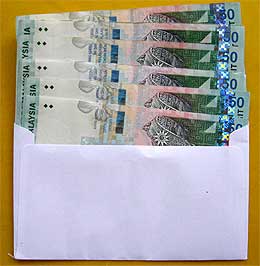 Those who make large contributions to political parties are likely to influence public policies, the awards of contracts and development choices such as privatisation of public assets, massive land clearances, exploitation of forests and other natural resources. Privatisation programmes in some countries have been called ‘political privatisation’ . They have replaced the ‘10 per cent commission’ for party and personal funding.
Corporations are major political donors in countries where the laws do not prohibit such donations. The late Tan Sri Ahmad Noordin, who won the Magsaysay Award had expressed concerns in the 1980s on the nexus between politics and business.
By then political parties in Malaysia had begun to own businesses particularly the coalition parties of Barisan National.
The risks of money politics are huge for democracy, good governance and the economy in countries where regulatory mechanisms for the control of money politics are absent or implementation of laws is weak when they are already in place.
Consequences of political corruption
Political corruption, electoral fraud and rigging of elections are all linked to money politics. Ample evidence of the consequences of political corruption exist globally. Poverty, lawlessness , migration and instability plague nations where political corruption is widespread.
In countries where there is widespread poverty and economic deprivation, business tycoons and wealthy landlords have founded political parties, become kingmakers and use the political system to enrich themselves, their families and cronies. For example a study of money politics in Africa shows that politicians in Nigeria are called ‘money bags’ and the political system is known as ‘contractocracy’. In Taiwan money obtained by political parties and politicians through ‘dark and secretive means’ is referred to as ‘Black gold’.
Countries in Asia, Latin America and Europe have instituted reforms related to money politics because of its brazen role in the corruption it engenders. Japan, South Korea and Taiwan have introduced laws and regulations to rid their nations of the scourge of money politics.
 Public opinion has played an important role in the reforms in how parties finance political parties and election campaigns. The public in these countries have shown they will not tolerate past practices of the use of money in politics such as the accumulation of wealth by politicians.
The reforms in political financing in these countries have brought a level playing field to politics. In South Korea, Taiwan and Japan opposition parties have won elections and formed governments without challenge to their legitimacy.
Importantly, the reforms in political financing in these Asian countries have created truly autonomous election agencies like the Election Commission and a freer press that gives equal access to media coverage for all political parties.
A Canadian scholar, Khayyam Z Paltiel in 1976 said, “enforcement demands a strong authority endowed with sufficient legal powers to supervise, verify, investigate and if necessary institute legal proceedings.” Although initially people did not believe him, countries like Canada, US, UK and Germany where the rule of law preceded popular governments have effective monitoring mechanisms for political financing.
State funding
Reforms in political financing must include banning of business ownership by political parties including media and corporate funding for elections. State funding is a viable option as has been done in Japan and South Korea. An impartial and competent elections commission and a media environment that provides equal access to all political parties are essential for greater transparency, disclosure and accountability in political financing.
To achieve these reforms political parties and political elites must be committed to the highest standards of political behaviour. Are Malaysian politicians and their parties ready to reform?
Continuing public pressure and opinion will be key to achieving reforms in political financing in Malaysia and rid the nation of political corruption.
JOSIE M FERNANDEZ is currently an Asian Public Intellectual Fellow, director of Philanthropy Asia, researcher and engages with Transparency International Malaysia in anti-corruption measures. An educationist, Josie moved on to citizen's advocacy as founder president of ERA Consumers and regional director (Asia Pacific) for Consumers International.
She holds a masters degree in development management from the Asian Institute of Management, Philippines. Working on sustainability, philanthropy and anti-corruption actions are some of her current passions besides writing.


Report this comment
Are you sure you want to delete this comment?
This action cannot be undone.