




Mahathir's colonial mind
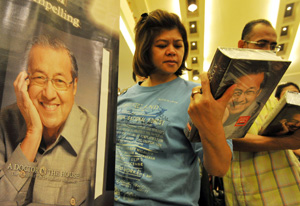
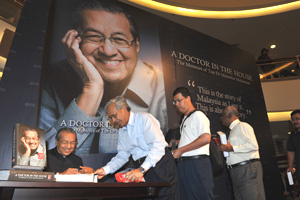
It would take a mediocrity of an astonishingly rare order to know that the release of Dr Mahathir Mohamad’s long-awaited memoirs ahead of the next general election is in time to cast further aspersions on Anwar Ibrahim, whose ability to unite the opposition alliance remains crucial. The bitter veteran also hopes to salvage his rotten image with a book of more than 800 pages.
It would take a mediocrity of an astonishingly rare order to know that the release of Dr Mahathir Mohamad’s long-awaited memoirs ahead of the next general election is in time to cast further aspersions on Anwar Ibrahim, whose ability to unite the opposition alliance remains crucial. The bitter veteran also hopes to salvage his rotten image with a book of more than 800 pages.
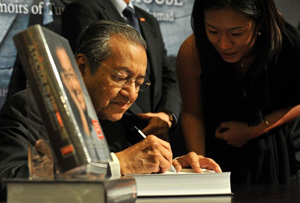 More on that later as I am finishing the book. But at least Mahathir finally owns up to the fact that he does have Indian lineage from his father’s side, although he does not know which part of South Asia his ancestors hailed from.
Fearing that having Indian roots may dilute his “Malayness” - hence the loss of his legitimate claims to bumiputra status and all the so-called privileges that go with it - he is adamant that “my mother tongue and home language is Malay, my culture and tradition is Malay and I am a Muslim”. And he ends the chapter dedicated to explaining his ethnic background by declaring that “I am a Malay”.
Which of course is fine. Each and every individual should be entitled to choose an identity that best expresses his or her intents in life as a human being, on the premise that no-one is put to harm as a result of others’ conscious or unconscious decision as such.
However, does one’s ethnic origin add extra values to one’s being? I don’t think so. Ethnicity is neutral and often beyond human control.
Some years ago in a dialogue session with refugees, I witnessed a European officer telling the destitute and overwrought group that “you did not choose to be born in Burma, just like my being a European was by chance”. Despite his smug tone, what he said was absolutely true. However, whether or not he would want to be born in a Third World country if given a choice is everyone’s guess.
A unique product of his time
Born between the wars and in a colonial setting, Mahathir is a unique product of his time. While he did not make it clear, it would seem that his mixed parentage did bother him to some extent. The urges for identification were too powerful to be overcome, and it was only natural that he eventually became resolved to being recognised as a Malay.
At a time when the Malays were much ignored or even despised, it did take courage for one like Mahathir to state out loud he was not ashamed to be one. It reminds me of the Irish and Jewish migrant workers in Britain in the late 19th and early 20th centuries, who would lose no opportunity to pronounce their ethnic identity while acutely aware of the hostility and racism coming from the host society.
 While ethnicity itself is valueless, a resolute yet peaceful expression of it in a climate of abhorrence and bigotry is a testament to uncommon intrepidity.
There is nothing wrong in Mahathir’s certitude in his Malayness. Rather, it is his fixation on “race” (for “ethnicity” would be too complex an idea for a colonial product like him) that poses threats to the sustainability of Malaysia as a multiethnic society.
He argues in his memoirs that education was made a top priority when he was in government, yet the race-based political structure - which Mahathir refused to dismantle but perpetuated - ensured that a great deal of resources that could have trickled down to the neediest in society were wasted or even swindled by the so-called political leaders in Umno, MCA and MIC.
Mahathir was right to observe that the lack of a good education had been a bane for rural Malays, but failed to see significant segments of the non-Malay communities were equally in need of it.
 In his early years as education minister, his immediate concern was to reach out to poor Malays. For some bewildering reasons, he was persistently unable to identify indigenous, Indian, and Chinese children living in abject poverty. Their numbers might have been comparatively small, but it was nevertheless unjustifiable to overlook their needs.
In the latter part of his tenure as prime minister, much government effort was devoted to expanding private tertiary education in an attempt to placate the increasingly antagonistic non-Malay voters. While many were grudgingly pacified, the reliance on private colleges and universities to produce better educated populace only served to heighten social divisions as the income gap widened, especially within the Indian community.
The Hindraf revolt in 2007 was by far the most radical response to the decades of neglect of the downtrodden under Barisan Nasional.
Misguided Malay nationalism
In addition to his obsession with race, Mahathir’s misguided Malay nationalism also allows only one vision for the community, which is to make the Malays as “industrious” and “competitive” as other races.
 Mahathir chastises the colonialists because they “liked the idea of a simple and changeless Malay world”, which was responsible for Malay backwardness. He believes only a mastery of modern technology and control of the capitalist system can ensure the survival of the Malay people, as if farming and fishing do not involve hard work and labour.
Nobody would be so foolhardy as to dismiss the importance of technology and trade. But as far as Mahathir sees it, this is the only way to achieve affluence and success. Little wonder our agriculture and fishery industries have been lagging behind those in Thailand, Indonesia and Vietnam.
Most importantly, when the Malays finally found the bravery for change in the wake of the judicial crisis and police violence in 1998/1999, it was Mahathir that was shocked and terrified. Since then, he has been denouncing the people that he claims to love for their “betrayal”, “ungratefulness” and “rebellion”.
I never dispute that all colonial powers prefer timid, submissive, simple and changeless subjects because to rule over them would be a no-brainer. It just so happens that, after years of “racial engineering”, more and more people now find Mahathir’s mindset is no different from that of the colonialists. The only thing is that the old man will perhaps never want to admit that.
JOSH HONG studied politics at London Metropolitan University and the School of Oriental and African Studies, University of London. A keen watcher of domestic and international politics, he longs for a day when Malaysians will learn and master the art of self-mockery, and enjoy life to the full in spite of politicians.


Are you sure you want to delete this comment?
This action cannot be undone.