




The US Mideast policy in need of overhaul
A Malay e-group fellow of mine, a fairly young chap, recently dismissed (again) the notion of human rights because of what the so-called hegemonic America had done to Iraq.
Coincidentally, one of my students at the New Era College posed a question to me just last week: "How much can we trust the United States in safeguarding the world, especially the Middle East, when it was the Central Intelligence Agency that had bred the likes of Osama bin Laden and some of the Shiite rebels in Iraq?"
Both of them had a point. And I was particularly surprised by my student's eagerness, even though I was well pleased with his concern. In this time and age, young people are known for their insatiable appetite for reality shows and dream-making idol series: the American Idol, Academi Fantasia, Big Brother, you name it. That a student in a politically dull and intellectually vacuous Malaysia would demonstrate an interest in world affairs does go a long way in keeping me hopeful.
A Malay e-group fellow of mine, a fairly young chap, recently dismissed (again) the notion of human rights because of what the so-called hegemonic America had done to Iraq.
Coincidentally, one of my students at the New Era College posed a question to me just last week: "How much can we trust the United States in safeguarding the world, especially the Middle East, when it was the Central Intelligence Agency that had bred the likes of Osama bin Laden and some of the Shiite rebels in Iraq?"
Both of them had a point. And I was particularly surprised by my student's eagerness, even though I was well pleased with his concern. In this time and age, young people are known for their insatiable appetite for reality shows and dream-making idol series: the American Idol, Academi Fantasia, Big Brother, you name it. That a student in a politically dull and intellectually vacuous Malaysia would demonstrate an interest in world affairs does go a long way in keeping me hopeful.
But the e-group member clearly missed the whole picture. He might have reflected the sentiments of much of the Malay community, yet it must be pointed out that the ideals of human rights can be found in most of the world's religions and cultures, past and present, and no less so in Islam. The fact that certain self-styled democratic countries have been trying to dominate the world with mendacity does not negate the noble values embodied in, let's say, the Universal Declarations of Human Rights, endorsed by most of the nations today.
In other words, never throw the baby out with the bath water, or most of us would find ourselves compelled to reject the Muslim faith in its totality now that so much damage has been done by the terrorists in the name of Islam. But no, I firmly believe the positive Islamic values do play an important role in shaping the world for the generations to come.
Deepest crisis
As for the Middle East, the situation is rather complex for me to provide an answer that will satisfy my student's curiosity. Myself a finite creature, I do not seek to be an expert or authority in this area, although I do like to contribute my two cents on the issue.
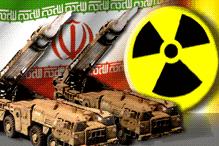
 It is beyond doubt that the Middle East is caught in its deepest crisis in recent decades. An overconfident and confrontational Iran under President Mahmoud Ahmadinejad is testing the limits of US power and patience, while Iraq continues to be beset with a host of domestic challenges, ranging from economic ailments to sectarian violence.
Like it or not, the Iraq of today is a bitter fruit of the White House's failed attempt to impose democracy in the country. Four years after the fall of Baghdad, the mechanisms of the "re-born" nation are yet to function effectively and normally, while the path of reconstruction is strewn with difficulties and dangers.
 If the western countries, under the auspice of the US, blamed much of the world's conundrum on Pan-Arabism in the 1950s and 1960s, the hardest task of today is how the Americans can contain the rise and spread of Islamic fundamentalism. In Iraq, the situation has been made all the more complicated because the country is now a confluence of Shiite revivalism, Sunni extremism, Kurdish nationalism, and the deadly appeal to violence in advancing all these ideals.
The US had hoped to introduce democracy to the post-Saddam Iraq, either naively or foolishly convinced that it could curb religious fanaticism and extreme nationalism. But what is at risk today is secularism precisely the very legacy of Saddam that the Bush administration wants to preserve and strengthen. And the crisis is heightened by the presence of foreign soldiers in Iraq.
Grand Mideast strategy
As Robert Pape, a terrorism expert, has said, there is no absolute correlation between suicide attack and Islamic fundamentalism as many would have perceived, for terrorist act is often a response to foreign occupation. No more, no less.
The problems, of course, are not limited to Iran and Iraq, but the US' grand strategy for the Middle East over the last few years has produced reverberations in other parts of the region also.
The outcome of the Palestinian elections early last year sent shockwaves across the western world. It was a damning verdict on the pro-US Fatah as well as an endorsement of the anti-West stance adopted by Hamas. Shilbely Telhami, a Middle East watcher at the Maryland University, even predicted that Hamas' victory could embolden the electorates in other Arab countries to opt for Islamic parties if given a chance. For them, both Pan-Arabism and secularism have failed, and they are longing for something radical.
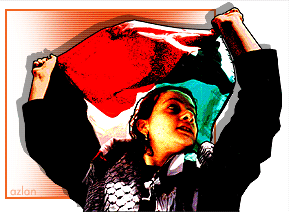 Quite clearly, many a potential voter in the Muslim world today sees the endeavour by the Bush administration to push for political reform as a veiled attempt to force the Arab leaders to forge closer strategic alliances with the Americans, only with a democracy fig leave. Unfortunately, the refusal of the US and Britain to acknowledge the Hamas government and to deal with it accordingly has only reinforced such negative impression.
The olive branch extended by Nancy Pelosi in Syria last week may help to narrow the gaps between the US and the Arab world, and her reconciliatory rhetoric has gone down well with the media there. President Bush is piqued, but he is faced with the dilemma that Pelosi is the Speaker of the House of Representatives with a popular mandate, whose authority cannot be easily disregarded. If the president truly desires democracy for the Middle East, he should first learn to live with it on his home turf.


