




Death to capital punishment
The execution of the Bali Bombers - Imam Samudra, Amrozi Nurhasyim and Mukhlas Nurhasyim alias Ali Ghufron, has certainly stirred-up the debate for and against the death penalty.
Most predictably on the ‘pro’ side were those who believe that punishment should fit the crime. This stance has been taken by a great many people, especially relatives and friends of the victims, in statements I’ve seen ranging from the quite reasonable, "I am very, very happy but a bit disappointed that it took so long", to the rabid "Dig them up and shoot them again."
The execution of the Bali Bombers - Imam Samudra, Amrozi Nurhasyim and Mukhlas Nurhasyim alias Ali Ghufron, has certainly stirred-up the debate for and against the death penalty.
Most predictably on the ‘pro’ side were those who believe that punishment should fit the crime. This stance has been taken by a great many people, especially relatives and friends of the victims, in statements I’ve seen ranging from the quite reasonable, "I am very, very happy but a bit disappointed that it took so long", to the rabid "Dig them up and shoot them again."
Perhaps most persuasively in favour of the death penalty were the bombers themselves who, as Tom Allard and Lisa Murray co-wrote in the Sydney Morning Herald , "admitted their guilt and showed no remorse.
"They said they welcomed death but launched appeal after appeal to forestall their executions and help craft an image as holy warriors who were the victims of an unjust, unIslamic judicial system."
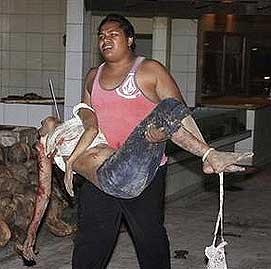 But this ‘holy warrior’ or ‘martyr’ aspiration on the part of the condemned trio was the very reason many opposed their execution. Nashir Abbas, the former head of the training for Jemaah Islamiah who turned anti-JI following his arrest in 2003, was reported by the
Sydney Morning Herald
as reasoning that the bombers should be spared because "if they are not executed they won’t be seen as heroes or saints.
But this ‘holy warrior’ or ‘martyr’ aspiration on the part of the condemned trio was the very reason many opposed their execution. Nashir Abbas, the former head of the training for Jemaah Islamiah who turned anti-JI following his arrest in 2003, was reported by the
Sydney Morning Herald
as reasoning that the bombers should be spared because "if they are not executed they won’t be seen as heroes or saints.
"They will get old and people can change day by day".
I agree entirely with his logic, as reportedly does Richard Flax, a longtime Australian Bali resident who helped evacuate many of the bombing victims back in 2002, who was quoted as saying recently that "I think the execution will simply inspire more dissatisfied youths to acts of violence".
Vengeful violence could certainly be on the cards if enough youths listen to the likes of Abu Bakaar Bashir. Founder and ‘spiritual’ leader of Jemaah Islamiah, Bashir damned the execution of his three followers as "an injustice committed by the government of Indonesia", at the same time claiming that the bombing was really a conspiracy between Australia and the US, who exploded a "micro-nuclear device" to "make Amrozi and the others look like terrorists" and to "stigmatise Islam".
Ismail Yusanto, a spokesman for the Hizbuth Tahrir organisation agrees.
An eye for an eye
But some opponents of the executions were motivated by higher and altogether more admirable considerations than the possible consequences of such insanity. Claire Hatton, whose husband was killed in the bombing, reportedly said, "I saw a quote by Mahatma Gandhi and it said ‘The trouble with an eye for an eye is that it makes us all blind’. That’s what I think."
And Brian Deegan, whose son Joshua was one of the victims, made an eloquent statement on ABC Radio that went, in part: "What I am concerned about is this: I am absolutely against capital punishment in any form for any reason.
‘I am tired of reading about young women being stoned to death in Iran and Iraq and other countries for lesser offences. The thought that it is occurring somehow in connection with myself and my family is abhorrent to me.
"The deaths of these individuals will never bring back my beautiful son. The closure it will bring is not going to heal the wound, it’s going to ulcerate it."
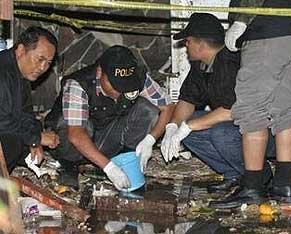 If only the Australian government could have summoned-up such strength of character. But Prime Minister Kevin Rudd played politics, seeking to appease both sides of argument by first saying, as quoted in a
Sydney Morning Herald
article by Deborah Snow, that the bombers "deserve the justice that we deliver to them" and later that "we’re universally opposed to the death penalty (but) we only make interventions in support of Australian citizens."
If only the Australian government could have summoned-up such strength of character. But Prime Minister Kevin Rudd played politics, seeking to appease both sides of argument by first saying, as quoted in a
Sydney Morning Herald
article by Deborah Snow, that the bombers "deserve the justice that we deliver to them" and later that "we’re universally opposed to the death penalty (but) we only make interventions in support of Australian citizens."
The Australian citizens he had most urgently in mind, of course, were three of the so-called Bali Nine, Scott Rush, Andrew Chan and Myuran Sukumaran, currently on death row in Bali for conspiring to traffic heroin.
Which brings us back to the age-old debate about the death penalty. Supporters claim it’s a fitting punishment for the most heinous crimes, and a deterrent to other would-be offenders. But which crimes should qualify?
Only the likes of murder and kidnapping, as in some relatively civiliSed jurisdictions, or a long litany of offences ranging from rape and drug trafficking to adultery, sodomy and blasphemy in less progressive parts of the world?
And where’s the evidence that death is a deterrent? There were over 300 capital offences in 18th century England, with no notable diminution of the crime rate. And in the cases of terrorists like the Bali Bombers, the prospect of death, far from deterring them, holds out the compelling if spurious promise of some kind of paradise.
Many opponents of capital punishment argue that it’s harsh, cruel, brutalising to the rest of society and flat-out morally wrong. But for me personally, it’s not so much a matter of moral wrong as a conviction that governments and their agencies can’t be relied on to get it right.
Is it ever right?
US states that still retain the death penalty, like Texas, for example, still execute prisoners who are arguably too mentally defective or outright deranged to be deemed legally responsible for their crimes.
Others may have been wrongly convicted, as has been shown by fresh investigations into a great many cases since the advent of DNA-testing and other forensic procedures.
But if the situation’s suspicious in the "Land of the Free", it’s absolutely outrageous in many other countries.
In Indonesia, for example, where the justice system is so lax and corrupt that Samudra, Amrozi and Mukhlas enjoyed celebrity-style access to the media, even on death row. And where Tommy Suharto, convicted during the 1990s for ordering the murder of a judge, was let off with a 15-year jail sentence of which he served just a small fraction.
In short, my objection to the "right" of any state to execute people in the name of ‘justice’ is that justice is at best uncertain, and at worst – as in dozens of countries around the world, including Malaysia - simply not to be trusted.
Rich and politically-connected criminals get off lightly or scot-free, and the rest of the people, for all their governments care, can go hang.


Report this comment
Are you sure you want to delete this comment?
This action cannot be undone.