




Poll irregularities? Here’s the evidence
‘Move not unless you see an advantage; use not your troops unless there is something to be gained; fight not unless the position is critical.’
This appears to be the opposition’s strategy for the Batu Talam by-election. Whichever way you look at it, the Batu Talam state seat - which has been in the hands of the ruling coalition - is an Umno stronghold.
It would be near impossible for PAS to wrest the seat from its political rival. Indeed, the electoral majority is way too big to overcome in just nine days of campaigning, more so when the might of the BN machinery can be used to its full capacity.
The Batu Talam battle is also not a critical conquest for the opposition. Win or lose, it will not change the power equation in Pahang where the seat is located.
There is even a chance that PAS may suffer a humiliating loss, with an even higher margin of defeat than in 2004 when it squared off with its rival, Umno.
This partly because Batu Talam has been largely unaffected by the recent spate of price hikes due to the current record high palm oil and rubber prices which has cushioned this rural community.
Given this, the opposition has opted to do the unexpected - boycott the election. It’s a decision which even Sun Tzu - author of The Art of War - would have approved.
Fight another day
Clearly, the aim of the boycott is to conserve energy to fight another day.
By staying out of this minor skirmish, the key opposition parties seek to keep their troops focussed on the real battle, the general elections, which could be held as soon as later this year.
In order to claim the moral high ground, the opposition dressed the boycott as a protest against unfair electoral rules. Their timing couldn’t be more perfect. Only days earlier, the Election Commission (EC) chief said election laws were obsolete and called for an independent review.
The boycott has now put both the government and the EC on the back foot.
The response from the government is predictable. Its leaders took turns to slam the opposition’s boycott arguing the opposition has nothing to complain about as it has won elections in the past.
It’s a case of perverse logic - much like telling the bulls that they should be happy since they, too, have run down a few matadors in the past.
'Importing' voters
On his part, the EC chief has demanded evidence of electoral irregularities.
One needs not try very hard to come up with this. It’s all there for everyone to see. Take, for example, the commission’s redrawing of the electoral boundaries to ensure victory for the ruling coalition even before the first ballot is cast.
Just before the last general elections, we showed the rather crude and blatant way the EC handed victory to their paymasters for three parliamentary seats in Kedah which had been snapped up by PAS in the 1999 general elections.
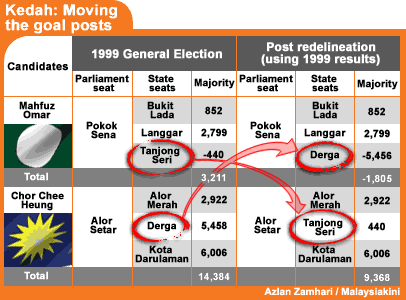
At the last re-delineation exercise, the EC ‘moved’ voters in and out of the three seats - Pokok Sena, Jerai and Baling - in such a way that the seats eventually went to BN in 2004.
For Pokok Sena, the EC’s new boundary now included more than 5,000 pro-BN voters from a neighbouring constituency long regarded as the ruling coalition’s stronghold.
By the time the exercise was completed, PAS - which had earlier won the seat with a 3,211 majority - had already lost Pokok Sena on paper by a margin of 1,805 votes.
No wonder ex-deputy premier Anwar Ibrahim - whose fingerprints are all over the opposition’s boycott decision - did not have to do much to convince PAS to stay out of Batu Talam.
Similarly, the EC ‘imported’ BN voters into Jerai and Baling from other seats. PAS saw the writing on the wall after which some of its incumbents abandoned their ‘unwinnable’ seats and contested elsewhere in the last elections.
EC shenanigans
The man responsible for this gerrymandering is Abdul Rashid Abdul Rahman, a career civil servant and the country’s most experienced election officer. He joined the EC in 1979 and was the EC secretary - the organisation’s second most powerful man - for 16 years.
 Abdul Rashid was, however, abruptly transferred to the Education Ministry in 1995. He retired two years later.
But even before he could unpack his golf clubs, Abdul Rashid was brought out of retirement. He was immediately tabbed as the EC chief and has now led the commission for the past seven years.
If there is one person who knows every trick in the electoral book, it would be Abdul Rashid. After all, he has five general elections tucked under his belt.
The redrawing of the electoral boundaries alone is a clear indictment of EC’s inability to play fair and square. We’re not even talking about a host of other EC’s shenanigans - a list long enough to be compiled into a book.
So what say you, Abdul Rashid? Or perhaps you would prefer to follow the example set by your boss - keep an elegant silence.


Lapor komen ini
Anda pasti mahu padam komen ini?
Komen anda tidak akan boleh dikembalikan semula.