




'BN doesn't share the same dream anymore'
Newly-minted Umno Youth chief Khairy Jamaluddin has bemoaned the lack of shared principles among the 13 component parties in Barisan Nasional.
Newly-minted Umno Youth chief Khairy Jamaluddin has bemoaned the lack of shared principles among the 13 component parties in Barisan Nasional.
Conceding that he was no longer sure what the ruling coalition stands for, Khairy said that the opposition Pakatan Rakyat appeared more cohesive despite the ideological divide among PKR, PAS and DAP.
 "Whereas for us, I'm not quite sure what is it that we want, so I think we have to go back to square one and decide what is, or what are, the core principles that BN shares, (and) the BN Youth shares.
"Is it justice? Is it equality or economy empowerment?" he told Malaysiakini two weeks before he won the much-coveted Umno Youth chief post.
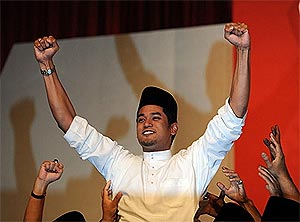
On Wednesday, 33-year-old Khairy seized the much coveted Umno Youth chief's post - a nurturing ground for future leaders.
In the interview, Khairy also gave some indications of what he would do as leader of the Youth wing and his proposals for reform in Umno.
Malaysiakini: If you win the Umno Youth post, how are you going to overcome racial polarisation?
Khairy: What we lack today is not just the regularity of contact amongst component parties, but also the shared principles are becoming loose.
I'm not sure what is it that we stand for together. Whereas it's clear that as much as the ideology clash, PAS, DAP and PKR, they can fashion their move around very well, (and) they hold quite strongly together.
Whereas for us, I'm not quite sure what is it that we want, so I think we have to come back to square one and decide what is or what are the core principles that BN shares, the BN Youth shares. Is it justice? Is it equality or economy empowerment?
And we have to spell these things out because at the moment we are going in our own directions, MCA is going this way, Umno is going that way, and when we come together during elections, there is no spirit, because we don't share the same dream anymore.
How can BN reform itself? Should it do away with race-based parties and form a single party instead?
 One thing is structural reforms and the other thing is policy reforms. They are equally important, some people think that just by having structural reforms you can win back the people's confidence, which I don't think is true.
Even if you do away with the quota system (in Umno) or you enlarged the franchise of delegate to vote for the leadership, that's not going to change much if your policy reforms don't take place.
The two policy reforms that I would like to push for, as far as BN is concern - one is for direct membership of BN. Many people might have said maybe it's time to do away with race-based parties, but then the large segment of population who still, for some reason, relate to race-based parties - you know, they still want to be a part of Umno, a part of MCA or MIC.
So rather than going for a revolutionary course of fusing everything and having it rejected by your hardcore, your base, have this one entity which sits in there. It's experimental, maybe initially - a direct membership, anyone can join, it's BN.
How it's done, the structure, the constitution... that is for us to work out the details. And if the entity ends up growing bigger and bigger, then you'll know that that's the future. Rather than having to go through this turmoil of having to fuse everything together that is going to be painful, you create something in the middle. And if that grows, you'll know that that is the ticket to the future.
Secondly, this whole business of core principles - we have to sit down and agree what it is that we are going after. I've said this before, it is very difficult for us to take action against our own members. For example, Ahmad Ismail, even though we did, but it's was really difficult for us to act against him.
Similarly, components parties have difficult time acting against their members, so we must have joint force - if you transgress these principles that cut across the parties, then there must be a mechanism to punish at the top of BN, so no one party has to carry the can for punishing its own member. That will look bad on the party leadership of component parties.
So this structural reforms are important. Of course, the policy reforms that we spoke about earlier, Pak Lah's reforms - that must come back to centre stage.
You said that Umno is not facing a crisis. Can you elaborate on that?
‘Crisis' in the sense that this is not '87, where you have the whole chunk of Umno ripped out from the mothership and deregister. That was real crisis - crisis of leadership, political crisis... It's not '98 either, where you have another chunk of the party ripped out, you have Malay support for Umno dropping to below 50 percent, first time ever.
 In 2008, Umno has problems, I'm not denying that it has problems but it's not in the state of political crisis, in the sense that Malay support for Umno was still above 55 percent or thereabouts.
So to start off with an assumption that it's in crisis - you have to overhaul the entire thing and have siege mentality - is to put yourself in a corner where you might end up doing the wrong thing trying to reform the party. That's what I was guarding against - these guys are saying that we are not Malay enough, not Islamic enough, we're not tough enough on ISA.
When you think you are in crisis and when you've siege mentality, there's when you do silly things. But when you acknowledge that you have problem, and especially a lot of problem is not because of the Malay community but because of the non-Malay community - Chinese electorate, Indian electorate... Then you'll know that the problem is not with Umno per se, but it is with the entire coalition.
And of course, Umno contributed to some of the problems but we have to fix the entire thing and not just say that Umno is in crisis. To me, I find it a little bit opportunistic and disingenuous for people to say Umno is in crisis. We've seen crisis before, '87, '98; I don't think we're in a similar situation.
I think Umno today still have very strong base, we need to make certain reforms and changes the way we do things, but I think we have the solid base to build from. It's not like we have to register a new party, it's not like we've lost half of our membership, no. The base is still there, so that's as far as the crisis is concern.
The victory, yeah of course, I mean sometimes when you ended up with 93 percent parliamentary majority, you cannot manage that success.
For a long time, Umno didn't have the ability to form a government of its own. In 2004, we could have formed a simple majority government on our own, and that may have gone into our heads, and we may have become a little too assertive at the expense of that shared principles that BN had talked about.
But do you think the other leaders share your view that the party is not in real crisis?
I think some of them talked up the crisis for opportunistic reasons. When you talked up a crisis, then you can push the needle into the soils and whoever takes a fall... You know, real crisis it's real bad, there's a groundswell, he must go and then only there and then the party recover. So, to me, part of it was certainly opportunistic.
So certain quarters in Umno were trying to get rid of Pak Lah?
Yeah of course, everyone can see that.
Do you think the new leaders can follow through with Abdullah's policy? Be it in the party or the government.
 I don't know, I wouldn't know. How would I know?
But if such policies are good for the people, by right it should be followed through.
Subjective, it's subjective. I mean, you saw how my fellow candidates for the Youth leadership think. It's not obvious to everybody what is obvious to me, just as it is not obvious to me what is obvious to them.
Do you think is fair to just allow 2,500 (delegates) to vote (in Umno polls)?
I think in long term we have to change the electoral systems. I'm not saying that that is going to end all our problems, but I think that you must give more space to the grassroots to voice their feelings. Whatever it is that they end up wanting, whether it is more hardline or whatever, you must respect the way it is and you have to try to educate them.
If you don't agree with what they think, be a leader and lead, and not be led. That's always been what I've believed in, and if people are not willing to be led to the Promised Land then maybe you're the wrong person at the wrong time.
What is your opinion on Ku Li's proposal to let the divisions vote?
That's a good proposal, but we have to trash out the mechanisms, have it one day, perhaps. The mode of campaigning is important. That's good, it's a good suggestion, something that we can think of.
How do you compare Najib with Abdullah?
I think that Najib is a very urbane and contemporary leader and I think he understands the challenges that the country is faced with. And I think that he has the ability and experience to take over.
And I hope the reforms with continue under his stewardship. I mean, I can only hope for, I won't be able to speculate.


Are you sure you want to delete this comment?
This action cannot be undone.