




Silver lining in Lim-Anwar spat
There was a time during the early existence of the Barisan Alternatif (BA) when any public disagreement between the leaders of DAP, PAS or Keadilan would be interpreted as a sign of the ‘wobbly’ nature of the nascent opposition coalition.
The fact that DAP did finally pull out of BA after the September 11 attacks in the United States and just before the 2001 Sarawak state elections because of irreconcilable differences with PAS over the Islamic state issue only confirmed the precarious state of the opposition coalition.
 Hence, it is not surprising that similar fears of a Pakatan Rakyat implosion have been sparked by the very public disagreement between Penang Chief Minister Lim Guan Eng and PKR leader Anwar Ibrahim over the issue of the state’s Malay deputy chief minister.
But such fears are grossly overblown. The Pakatan coalition is on much firmer ground than the BA. In fact, the public spat between these two Pakatan leaders may actually be a good thing for the opposition coalition. It shows that Pakatan is attempting to find a ‘formula’ of inter-coalition cooperation that is different from the formula currently practiced by BN.
There was a time during the early existence of the Barisan Alternatif (BA) when any public disagreement between the leaders of DAP, PAS or Keadilan would be interpreted as a sign of the ‘wobbly’ nature of the nascent opposition coalition.
The fact that DAP did finally pull out of BA after the September 11 attacks in the United States and just before the 2001 Sarawak state elections because of irreconcilable differences with PAS over the Islamic state issue only confirmed the precarious state of the opposition coalition.
 Hence, it is not surprising that similar fears of a Pakatan Rakyat implosion have been sparked by the very public disagreement between Penang Chief Minister Lim Guan Eng and PKR leader Anwar Ibrahim over the issue of the state’s Malay deputy chief minister.
But such fears are grossly overblown. The Pakatan coalition is on much firmer ground than the BA. In fact, the public spat between these two Pakatan leaders may actually be a good thing for the opposition coalition. It shows that Pakatan is attempting to find a ‘formula’ of inter-coalition cooperation that is different from the formula currently practiced by BN.
There are probably some within Pakatan and within the ranks of their supporters who would have preferred the spat between Lim and Anwar to have taken place in private instead of being played out in the media.
But by making the decision to go ‘public’ with his dissatisfaction of being kept out of the loop by Anwar in regard to the situation with former DCM1 Mohammad Fairus Khairuddin, and with his possible replacement, Guan Eng has shown that unlike his predecessor in Penang, he is not afraid to ‘flex his muscles’ vis-à-vis the de facto leader of Pakatan.
And Anwar, by apologising for having kept Guan Eng in the dark, has shown that he is using a different leadership approach compared to his Umno counterpart.
Guan Eng clearly did not usurp Anwar’s authority when he stated that the DCM1 position was, and still is, very much Anwar’s decision, and Anwar will demonstrate this authority by nominating the person who stands in the Penanti seat to be the next DCM1 in Penang. Hence, both sides can chalk up a ‘win’ in their respective scoring columns.
By-elections help solidify Pakatan
Pakatan has been somewhat fortunate in that their victories in all the Peninsular Malaysia by-elections held after the 2008 general elections have solidified inter-party cooperation and understanding within the opposition coalition.
The fact that Anwar did not lose any Malay support in Permatang Pauh or that PAS did not lose any Malay support in Kuala Terengganu because of their cooperation with DAP would definitely have allayed fears among the leadership and rank-and-file members within both these parties in terms of working with the predominantly Chinese party.
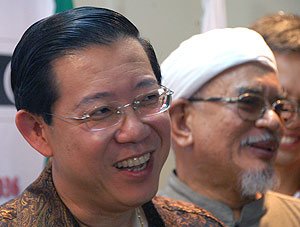 And the fact that Bukit Selambau and Bukit Gantang were won largely on the back of overwhelming non-Malay support showed that the ‘scare’ factor associated with voting for PKR, and more specifically PAS, has more or less evaporated among the non-Malays.
With the morale of Pakatan supporters, members and leaders galvanised by these by-election victories, the question of whether DAP would put its full support behind PKR in the upcoming Penanti by-election was a rhetorical one.
Now, after Guan Eng and Anwar have resolved their differences publicly, we can expect the DAP apparatus to be in full swing come by-election time. While PAS’ request from its local members to field a candidate from their party is likely to be rejected, there should not be much doubt that the Islamic party, especially at the national level, will mobilise resources to help out in the Penanti by-election.
This does not mean that any public disagreement between Pakatan leaders or their policy statements do not have any political repercussions. But the evidence shows that these repercussions tend to strengthen, not weaken, inter-party cooperation between the Pakatan parties.
Two examples illustrate this point.
Firstly, the decision of Penang PKR chief Zaharain Hashim, who is also the MP for Bayan Baru, to publicly criticise the decisions of Guan Eng, will come back to haunt him in that it will surely keep him from being nominated as the Penanti candidate and hence scupper his ambitions to take up the position of DCM1 in Penang.
Zaharain clearly felt that he had to ‘speak up’ on behalf of Anwar and perhaps by doing so, increase his chances of being picked as the candidate for Penanti. But he failed to realise that his decision to voice his unhappiness in such a public manner may also force the Penang CM to ‘veto’ him as a candidate for Penanti.
If Anwar decides to nominate Dr Mansor Othman, a longtime ally of his, to contest in Penanti and to be named as DCM1, the result would be a DCM1 that would most likely be more capable than the previous DCM1, and also one who is not tainted by a history of ‘calling out’ the Penang CM publicly.
As such, the state government and hence Pakatan in Penang will definitely benefit from Mansor’s nomination as the Penanti candidate rather than Zaharain.
PAS Malay unity faction in trouble
Secondly, the decision by PAS president Abdul Hadi Awang to continually float the idea of a unity government with BN (read: Umno) has caused him to lose a lot of support so much so that there is now talk of ousting him as party leader. The fact that he has since retracted his call to have a unity government does not seem to have stemmed these calls for him to be replaced.
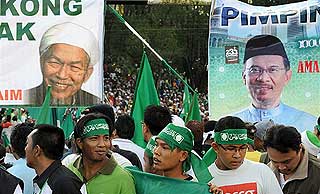 In addition, the leaders within PAS who are associated with being suspiciously eager to work with Umno in a unity government, namely Mustafa Ali and Nasharuddin Mat Isa, are also in danger of being sidelined, or even removed, in the upcoming PAS muktamar in June.
Again, these are indications that a large majority of PAS members would prefer to stay and work within the Pakatan fold rather than to throw their support in a unity government with BN and Umno. PAS leaders, especially those in Terengganu, will surely refrain from associating themselves from any mention of a unity government, even if the political situation in that state regarding the BN menteri besar continues to deteriorate.
If those who had expressed interest in working more closely with Umno do indeed lose their positions in the upcoming PAS muktamar, the inter-party cooperation within Pakatan will only strengthen.
In other words, rumours of the impending death of Pakatan have been greatly exaggerated. Whatever public disagreements their leaders may have are part and parcel of the growing pains of an opposition coalition that is slightly more than a year old.
Indeed, some of these public disagreements may ultimately benefit Pakatan more than it hurts it in that it will show that Pakatan is trying to carve out a governing philosophy that is different from BN and that leaders who seem to want to weaken Pakatan will suffer certain political consequences, including being punished by the members of their own party.
ONG KIAN MING is a PhD candidate in Political Science at Duke University. He can be reached at im.ok.man@gmail.com.


Are you sure you want to delete this comment?
This action cannot be undone.