




Top civil servant rises to Perak secretary's defence
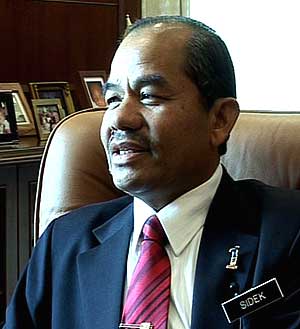
Chief secretary to the government Sidek Hassan defended the actions of the Perak secretary Abdul Rahman Hashim, during last year's tussle between BN and Pakatan over the silver state.
Chief secretary to the government Sidek Hassan defended the actions of the Perak secretary Abdul Rahman Hashim in this year's tussle between BN and Pakatan over the Silver State.
During Perak's crisis of governance, Abdul Rahman had been severely criticised for his apparently pro-BN stance, despite many seeing Pakatan Rakyat as still being the government of the day unless legally dissolved.
According to Sidek, the state secretary "was following the rules as a civil servant. I would have done perhaps the same thing. As a civil servant you have to do what you think is right under the circumstances and reading the rules".
He said this during an interview with Malaysiakini at his office in Putrajaya on Tuesday.
During the interview, Malaysiakini asked Malaysia's top civil servant about the perceived lopsided treatment the civil service is seen to be giving to Pakatan states, in contrast to its apparent single-minded loyalty to the BN led federal government.
The following is the first part of Malaysiakini's interview with chief secretary of the government Sidek Hassan:
Malaysiakini: He (Perak state secretary Abdul Rahman Hashim) was appointed by the federal government, does the state government need to endorse his appointment?
 Sidek:
He comes from the PTD, ‘Perkhidmatan Tadbir dan Diplomatik', but it has to be agreed to by the state government, so the service may be federal, but his government is the state government.
Sidek:
He comes from the PTD, ‘Perkhidmatan Tadbir dan Diplomatik', but it has to be agreed to by the state government, so the service may be federal, but his government is the state government.
So he has to abide by the state's decision?
Exactly, but I suppose his was a special case seeing that you know, at that time, there was a judgement call. And according to that call, because we don't know which one to choose... he was following the rules as a civil servant.
I would have done perhaps the same thing. At that time, and you are talking numbers (state seats) and all that, and what do you do? As a civil servant you have to do what you think is right under the circumstances and reading the rules...
I am always on the side of the civil servant that follows the rules. Because had he not been following the rules then he has not been doing his job.
What about federal instructions to certain federal organs in Pakatan-controlled states not to cooperate with local authorities on certain issues?
It depends, as I said earlier, and this is where you have to look at the way our country's constitution is. We have in our constitution what is known as the federal list, then there is the state list, then there is a concurrent list, meaning both, but usually when it is concurrent, it reverts to the federal government.
Therefore, if it comes under federal list, you are talking about loyalty to the government of the day right? Then loyalty is to the government, the federal government. When it is the state list, then loyalty is to the state government.
Despite the fact that you say the civil service is not there to make things difficult?
No, it's not, all I am saying is that as a civil servant you have to be loyal to the government of the day.
Even if it means you cannot serve the people you are supposed to serve?
It's not that... you have to be loyal, because the government serves the people... because you see in the final analysis, the government have to be answerable to the people. And if the government thinks that the best way to serve them is to do it in a certain way, as civil servants we follow what the government tells us to do.
Is the civil service prepared for two-party rule? And what is the mindset that needs to be changed in this new political environment?
In the civil service, we are all professionals.
But not according to some Pakatan leaders?
Well then, they have to learn to govern. The federal government is not complaining that civil servants are not cooperating... Max Weber taught us neutrality of the public service. Neutrality means you must be loyal to the government of the day. We have to be loyal to the government of the day.
A civil servant working in the state of Selangor or the state of Perak, they have to be loyal to the federal government or to the state?
To the government of the day.
Which is the state or federal?
It depends on who are you serving. If you are serving the Selangor, then the state secretary...
The Pakatan states have complained that it seems there is a directive for civil servants not to cooperate with the state government.
Oh, I am not entirely familiar with that.
So they don't take direction from the federal government?
It all depends, for example there are some federal government officials working in the state for federal government agencies, then they have to follow instructions from the federal government. Where they are working for the state, they follow instructions form the state, that's all.
Would it be feasible in the next 15 to 20 years, to chart a transition, where state civil servants are state civil servants and federal is federal?
We have already have that now, for example in the state of Johor, they come from the Johor Civil Service.
Johor is an Unfederated State.
That's right, but you are talking about future, it's already there.
But after 52 years after independence, shouldn't the Federated States also transit into the same formula?
But you are talking about a federation, you might as well be a unitary or whatever it is. As I said, there is nothing wrong with it... for example, the state secretary of Penang was posted there, not recently but a couple of months ago. I don't see you complaining about him.
The system is there to allow a situation, where a state government is under ‘the opposition', really has no control over their own civil servants.
What can we do about that if they don't control? In the state list, among others, there will be the local authorities. Local authorities are obviously under the state, that is very sure, and yet I still have people complaining to me as chief secretary about local authority. And that is obviously, under the state government.
So the state can appoint anyone they want as YDP (Yang di-Pertua (head of the local government)?
It is... theoretically yes.
 The state government has full authority over the YDP and local authorities?
They have, it's their people. If they don't trust the people they have, what can we do? If you are telling me that the state cannot control them... something is not right. You cannot be harping on to me or to the government, you can't control your people, something is wrong with you.
So they should just change and appoint whomever they want to these positions?
If they want to do it.
So the state government has no excuse to say that they have no cooperation from local authorities?
It is as if they are saying that in their own homes, they can't do it... It's their people... that is the way our system works.
So the local authority staff are considered as separate?
Exactly, except for, as I said, the YDP.
The YDP doesn't have to come from the PTD (Perkhidmatan Tabdir dan Diplomatik)?
Yes.
The issue about police is not as much the numbers but they have been... seen to be siding with the government.
What's wrong with siding with the government?
 In terms of controlling public rallies... that is where the public perception is ‘hey look! What are the police doing? They should be serving the public, not the government'.
But the government is serving the public.
But the issue is professionalism... the public perception is there, the fact that the police have not been professional.
The public service has been professional and continue to be professional, and want to improve. And we want that to be appreciated, not you ‘hentam' us all the time. That's it.


Are you sure you want to delete this comment?
This action cannot be undone.