




Malaysia too dependent on oil and gas, says World Bank
The World Bank said that Malaysia is too dependent on revenues from oil and gas and should instead broaden its revenue base.
The World Bank said that Malaysia is too dependent on revenues from oil and gas and should instead broaden its revenue base.
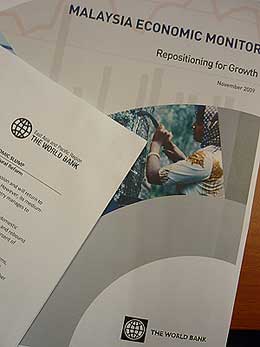 "With proven oil reserves at 4 billion barrels as of early 2009 and production rate in 2008 at 727 thousand barrels a day, expanding the revenue base helps prepare for the day when the reserves deplete," said the body in its
report
released yesterday.
"With proven oil reserves at 4 billion barrels as of early 2009 and production rate in 2008 at 727 thousand barrels a day, expanding the revenue base helps prepare for the day when the reserves deplete," said the body in its
report
released yesterday.
The report entitled "Malaysia Economic Monitor: Repositioning for Growth" pointed out that oil-and-gas revenue presently account for about 40 percent of the country's total revenue.
It added that proposals under the 2010 Budget, unveiled by Prime Minister Najib Abdul Razak last month, compelled Petronas to pay an additional RM4 billion in tax annually over the next five years.
"This is following the proposal to carry forward the tax assessment basis for upstream petroleum companies from preceding-year to current-year assessment.
"Under the budget, the additional tax burden that this implies will be spread out over a period of five years," stated the report.
The body also noted that excessive incentives and exemptions offered to the various industries and companies have eroded the country's tax base.
"The World Bank concludes that Malaysia's tax and incentive structure is overly generous and complex, and may leave room for tax abuse.
"Measures that are initially designed to be temporary run the risk of becoming easily entrenched," stated the report.
Government needs to reassess domestic borrowing
Due to the improving economic outlook, the body pointed out that the government would be competing with the private sector for funds from financial institutions.
Most of the country's fiscal imbalance is currently financed domestically. As private investment demand drops, the government was able to expand domestic borrowing without potentially crowding-out private investment.
"However, as the economy recovers, large borrowing requirements may dampen the prospects for private investment financing," stated the report.
The body said that it welcomes the government's move to gradually reduce its involvement in economic activities where it competes with the private sector.
The World Bank also said that the social safety net system in Malaysia is "weakly targeted and fragmented across government agencies and levels of government".
It was suggested that the government re-assess the extent to which these safety net programmes are achieving their intended targets and objectives.
The World Bank forecast that Malaysia's gross domestic product (GDP) would decline 2.3 percent this year, before growing 4.1 percent in 2010.
"Both the decline and rebound are attributed to conditions in the country's manufacturing sector, which accounts for some 30 percent of the GDP," said the World Bank in a statement yesterday.


Report this comment
Are you sure you want to delete this comment?
This action cannot be undone.