




Indian Muslims - in defence of Mahathir
Indian or Muslim, you cannot be both to be Malaysian!
Just when one hopes for clarity of vision or some astute observation from our senior statesmen, out comes this really strange statement. But to be fair, what was the context and what was the situation that Dr Mahathir Mohamad was referring to?
Former premier Mahathir never minces his words. He tells it as it is. He also does not need the government to “protect” him. He calls a spade a spade. He gives as good as he gets.
In this case, he was speaking at a function organised by the Kadayalannur Muslim Society, telling a group of people who still define themselves by their place of origin to be less tied to their ‘homeland’ and instead...
Indian or Muslim, you cannot be both to be Malaysian!
Just when one hopes for clarity of vision or some astute observation from our senior statesmen, out comes this really strange statement. But to be fair, what was the context and what was the situation that Dr Mahathir Mohamad was referring to?
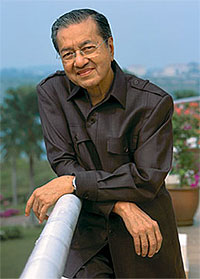 Former premier Mahathir never minces his words. He tells it as it is. He also does not need the government to “protect” him. He calls a spade a spade. He gives as good as he gets.
In this case, he was speaking at a function organised by the Kadayalannur Muslim Society, telling a group of people who still define themselves by their place of origin to be less tied to their ‘homeland’ and instead focus on being more Malaysian.
He said that for 1Malaysia to succeed, those of migrant origins must be less attached to their homelands. By this, he was referring to a metaphysical attachment to the “mother country”, the reference point that migrant societies often use to anchor their new-found identities in their country of adoption.
To be Malaysian, to Mahathir, means giving up this emotional link to one’s country of origin. He also said that the Indian Muslims must decide whether to be Indian or Muslim. In the context of his speech, this means deciding whether one was Indian as an ethnic category or Malay, as Muslims are defined constitutionally.
Almost immediately, Mahathir was condemned as racist and Islamically “unenlightened”. To my mind, our ex-premier was merely stating a fact when speaking about Indian Muslims. He could very well be referring to himself or speaking from self-experience.
To be or not to be
Malaysia is a very diverse country with a very complex history. Indian Muslim refers to a very wide group. It could refer to a person of Indian ancestry who is also a Muslim; or it can refer to a long-time domiciled group whose way of life is the result of many years of integration and, who at some point in time, have been accepted to be part of the wider Malay Muslim community.
Readers must also be reminded that Mahathir was speaking in Penang, where there is a large Indian Muslim community that have for more than 200 years contributed to the development of the state, particularly in Georgetown.
Like the Peranakan Chinese in Malacca, some Indian Muslims no longer speak Tamil or their inherited ‘mother-tongue’. Constitutionally, they can be considered ‘Malays’.
What is particularly interesting here is that historically the definition of Malay as “a person who habitually speaks Malay, practices a Malay way of life and is a Muslim” was created in Penang in the 1920s.
In fact, the Penang Malay Association (now called Pemenang) defined its members in this fashion to avoid the more exclusionary definition then prevailing in Singapore.
In those days, the British colonial government accepted representations from various ‘ethnic’ groups and it was worthwhile for the more urbanised ‘Malays’ of Arab and Indian ancestry to identify themselves as ‘Malays’.
When we became an independent country with the introduction of electoral politics and race-based parties, it became imperative that the ‘Malay’ category be boosted by co-opting groups that may not previously be considered Malay. In fact, in the pre-World War II Pan-Malayan Malay Convention, the Penang Malay Association was excluded precisely on the grounds that its members were not ‘Malays’.
So, to Mahathir’s mind, Indian Muslims have an essential choice: be Indian or be Muslim. He is not asking them to leave Islam, he is telling them that if they are less India-oriented and emphasise their Muslim identity more, they can enjoy the privileges associated with being a ‘Malay’. He might as well say: “Look at me... I am a Muslim and have become a Malay and the sky is the limit”. What an inspirational speech.
The problem is that Mahathir was speaking to Malaysians in 2008 and not 1948. In an intensely ‘racialised’ environment with a bureaucracy that is very ‘race-conscience’, it is simply not good enough to be more Muslim than Indian.
Many Indian Muslims have been asked to produce their parent’s birth certificates before they can qualify for privileges reserved for the ‘bumiputeras’. When it is learnt that they have Indian parents, they fail to obtain the desired scholarships.
The conundrum of 1Malaysia
Mahathir is not racist. He cannot be because he does not believe in race. As a medical doctor and a man of science, he knows that scientific research into the human gnome has made race theories, even the ones employed in his famous book ‘The Malay Dilemma’, obsolete.
His most recent statement about Indian Muslims confirms this but he should go one step further and help Umno make the transformation from a ‘Malay’ to a ‘Malaysian’ party.
After all, if one can be less ‘Indian’ and more ‘Muslim’, surely a ‘Malay’ than be less ‘Malay’ and more ‘Malaysian’? Of course, Mahathir will say that being Malay is being Malaysian.
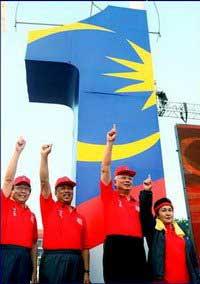 Here is the conundrum: the 1Malaysia formula is an integrative one – where everyone should come together based on our common national experience. If that was true, then we all have to give a little. This means everyone – the Malays included.
Confused? It now seems that the 1Malaysia rhetoric has managed to create ambivalence. This is the only way the government can win back the middle ground and yet retain the race-based political set-up.
But you cannot fool all the people all of the time. The reality is that so long as the political structure is based on outdated interpretations of ‘race’, and is therefore very narrowly race-based, nobody will be “allowed” to be more Malaysian.
Action speaks louder than words, even when one does not mince one’s words. For the BN to truly reflect their own 1Malaysia rhetoric, they have to become more integrated. The political parties in the BN must bite the bullet just as Pakatan Rakyat has done in its first convention . The BN really does not have a choice. It must lead by example – integrate or bite the dust.
As for the Indian Muslims, in a non-sectarian society, they would not have to make the choice that Mahathir has put to them. They can be both Indian Muslim and Malaysian.
One can only hope that the scales have fallen from the eyes of all Malaysians. None of us need to set aside our ethnic heritage for scholarships or other privileges, and Indian Muslims would not have to be asked to be less ‘Indian’ and more ‘Muslim/Malay’.
NEIL KHOR has recently completed his PhD at the University of Cambridge. He is co-author of ‘Non-Sectarian Politics in Malaysia: The Case of Parti Gerakan Rakyat Malaysia’ (2008).


Report this comment
Are you sure you want to delete this comment?
This action cannot be undone.