




MACC not at fault, says commission chief
Malaysian Anti-Corruption Commission (MACC) boss Abu Kassim Mohamed said that while the commission has completed its investigations on a number of high-profile cases, they are being held up by the Attorney-General's Chambers pending decision on aspects relating to evidence.
Malaysian Anti-Corruption Commission (MACC) boss Abu Kassim Mohamed said that while the commission has completed its investigations on a number of high-profile cases, they are being held up by the Attorney-General's Chambers pending decision on aspects relating to evidence.
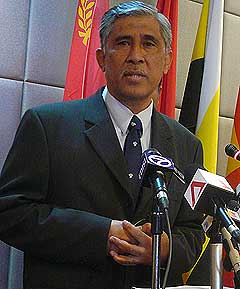 These cases include those involving Selangor opposition leader and former menteri besar Mohd Khir Toyo, current Menteri Besar Abdul Khalid Ibrahim and former tourism minister Azalina Othman Said.
"I hope the decisions are made as fast as possible," he said.
However, he said the attorney-general must explain to the commission’s advisory panel if he does not take action within six months after MACC has wrapped up its investigation.
"Under the new commission and under the new setup, anything that has been kept by the AG for more than six months must be explained to the operation review committee. They have the right to ask. The mechanism is there," he added.
Abu Kassim had a one-hour informal discussion with MACC advisory panel member Anis Yusoff, Malaysiakini columnist KJ John and editor-in-chief Steven Gan a week ago.
Among the topics raised at the discussion, which took place at the Malaysian Anti-Corruption Academy in Jalan Duta, Kuala Lumpur, included the actions MACC must take to regain public trust, its never-ending probe on Khir Toyo and why the commission is reaching out to the alternative media.
The following is an excerpt of the discussion. Part one appeared yesterday, while the final part will be published tomorrow.
Gan : You have decided to meet with alternative media. Why?
Abu Kassim : Because whoever who wants to fight corruption is a friend. I don’t care who they are. If they are corruption fighters, let’s work together.
But don’t kill the anti-corruption agency. It’s like the situation with the media, why would you want to kill the messenger? You don’t kill an agency which fights corruption.
We should be making MACC a strong body. If we are strong, everyone will be afraid. I prefer that the public and the media help us.
That’s what happened in Indonesia - when the (anti-corruption) boss was said to have been framed by the police, and when the government wanted to amend the law to make KPK (Indonesian Anti-Corruption Commission) weaker, the public and the media stood behind it.
I’d be very happy if I have support like that. I’m not a politician, I’m a corruption fighter.
Gan : But you will only get that support if you’re seen to be effective.
Abu Kassim : Yes, allow me to explain. I was with all the senior officers of MACC for four days to discuss the most important things that we are supposed to do.
One, we must be seen to be independent. The public must feel that we are independent. So our action, the way we react, the timing and all that must be carefully calculated.
The situation today is very difficult compared to 10 years ago. If Harun Hashim (former ACA chief) is the chief commissioner today, I am not sure he can...
John : It’s a different world today.
Abu Kassim : Yes, at that time, there was no Internet [laughs].
Secondly, we must be transparent so that the public know the difficulties, and what we are doing and what are the things we have done. We have to say, when we have completed the investigation, that they have been sent to the legal department. We should not be shy.
I have tried to come out with the policy where for all public interest cases, it’s high time for us to declare the findings. If we talk about transparency, we must be able to say that, 'Okay, this is the findings. This is what we have. If anybody has more information, they are welcomed'. We are ever willing to re-look and reinvestigate.
So transparency is important. But it is limited to what is within the law and what is allowable.
The third element is professionalism. Human rights, ethics and integrity are the basis of professionalism. You may have the right to interrogate a person at night but if he is in the hospital, we can wait.
Judgement must be based on human rights, ethics and integrity. Just like the taxi driver who is driving a pregnant woman and is caught speeding, the police officer can stop him. But a professional police officer, when seeing that a pregnant woman is about to deliver...
John : He should serve as the outrider.
Abu Kassim : That’s right. That’s professionalism. That element is very important. By doing this, I believe the public will come back to support us.
Gan : So you’re saying that as soon as an investigation is done, you will announce it.
Abu Kassim : No, only in public interest cases. What is a public interest case? A public interest case is when the public already knows the case. When we complete an investigation, we send it to the AG’s Chambers or the AG Chambers officers in our office - they decide (whether to close or prosecute the case).
If there is no case, we present it to the operation review committee. After the operation review committee has endorsed it, then we will declare. This is because the operation review committee represents the public.
So it’s not just us and the AG. The public, through operation review committee, can also decide.
John : Can they send it back if they are not happy?
Abu Kassim : There are two cases which they have requested to re-look.
Gan : What are the two cases?
Abu Kassim : I cannot answer that.
 Gan
: Here’s one major public interest case - Khir Toyo and his multi-million ringgit bungalow. What’s the status of that case?
Abu Kassim : We have completed the investigation.
Gan : And?
Abu Kassim : We have sent it to the head of prosecution. If you said ‘completed’, the AG’s Chambers may say, ‘No, it’s not completed yet, that’s why we are sending it back to you’.
So, in principle, the investigation has come to an end. But I cannot say it’s completed.
Gan : So you send it to the AG, and he said, ‘I need more information on this, I need more....’
Abu Kassim : Then we go and collect more information, and so on and on.
Gan : So the report is still...
Abu Kassim : It’s on and off... We have sent it to the AG...
John : Is there a deadline to how long this ‘ding-dong’ effect can take? If I’m the AG, and I want to be naughty with you...
Abu Kassim : Under the new commission and under the new setup, anything that has been kept by the AG for more than six months must be explained to the operation review committee. They have the right to ask. The mechanism is there. Unfortunately, the public do not understand.
It is totally different now, I tell you. Working in MACC is now like hell...
Gan : But for MACC to regain public support, it is these few key cases which will change perception.
Abu Kassim : I hope the decisions are made as fast as possible.
Gan : Going back to Khir Toyo, how long has this ding-dong battle been going on between you and the AG?
Abu Kassim : I have to get the details from (his deputy) Shukri (Abdull).
Gan : It’s either you tell the public that there’s no case or...
Abu Kassim : We have completed the investigation. But where is it now, I cannot tell off-hand.
Gan : What was the recommendation - charge or no charge?
Abu Kassim : That will be the AG’s decision.
Gan : But what was MACC’s recommendation?
Abu Kassim : I cannot tell you but in our investigation, we have left no stone unturned. We are satisfied with the investigation.
John : So you have done a thorough job...
Abu Kassim : My work is to find the truth.
Gan : What about the investigation on the donations of cows by Selangor menteri besar (Abdul Khalid Ibrahim)?
Abu Kassim : That was completed already.
Gan : So it’s with the AG?
John : That’s more than six months.
Abu Kassim : Then it will be explained. I have not checked on the duration (of the case).
John : That was before the last Raya.
Abu Kassim : If it is more than six months, then the investigation department will inform the operation review committee that...
John : What about the (former tourism minister) Azalina’s case? As a former public servant, I’m concerned.
Abu Kassim : That’s completed.
John : So you may have about 30 cases sitting with the AG.
Gan : That’s the problem.
John : There was a TV series called ‘Yes, minister’. They can say ‘yes, minister’, then throw the files somewhere. Now with the six-month limit, who will talk to the media after this six-month period?
Abu Kassim : It depends. They (advisory panel members) are independent. If they want to see the media, they have the right.
John : So who are the members of this committee?
Abu Kassim : Tan Sri Hadenan (Abdul Jalil), the former auditor-general.
Gan : Is there a spokesperson for that committee?
Abu Kassim : They themselves.
Gan : So anybody can speak.
Abu Kassim : Anybody. We cannot impose anything on them. We have no power over them.
John : But for all the five panels, they should have a spokesperson each.
Abu Kassim : No, they are independent.
Gan : Then you’re going to have a problem. Take the example of (advisory panel member) Robert Phang, who said that the case against MCA chief Ong Teat Keat was close, and MACC later had to issue a statement denying it.
Abu Kassim : He was not talking on behalf of the committee. He was talking on behalf of himself.
Part 1: MACC chief: Kick my ass if I'm wrong


Report this comment
Are you sure you want to delete this comment?
This action cannot be undone.